Mendi 1950-51
While Rev Gordon Young was busy establishing a new mission in Mendi, his wife Grace Young was also preparing to join him. At first, she had to wait while her husband went ahead. Gordon and Grace Young had been working in Namatanai Circuit on New Ireland with the Methodist Church since the end of the War in the Pacific. Grace Young was willing to go with her husband to a strange new place because they believed that God had called them to this work.
Grace Young wrote her own story about how she came to Mendi. She was the first white woman to go to Mendi, but she always said that the first missionary women to Mendi were the wives of the island pastor-teachers who arrived there one week before she did. Grace’s story tells of the experience of the women as they waited. She writes of the care and education of their children and planning what they might need when they finally arrived in Mendi. They thought about orders of supplies and taking cuttings for new gardens. They wondered about safety and about how they could make new homes in very simple shelters. Grace Young found that the Mendi people were very curious about this strange white woman and wanted to watch her all the time. She didn’t understand their language but tried to learn it.
This is Grace Young’s story.

In July 1950 we had to say goodbye to our friends and the little home we loved at Namatanai in New Ireland. It was also hard or even harder for our companions, Kaminiel Ladi, his wife, Miriam, and their children, Nicholas and Kusikai, another catechist, Tomas Tomar, and the young helper, David Bulu. A truck took us to Ulapatur on the West Coast to meet a trawler which was to take us to Rabaul. The trawler had engine trouble and we could not sail that day. We slept the night on a Chinese plantation. In the middle of the night, Ladi came to Gordon and said that Miriam had run away. They went to look for her and found her on the road to Namatanai. Miriam was overcome by fear and homesickness, because of all the stories they had been told by their relatives of how the early missionaries from Fiji were killed by their ancestors when they came to New Guinea district. Their friends had begged them not to go as the same thing would happen to them, and they would never see them again. By morning, Miriam had peace of mind and we set sail in the trawler, not knowing what the future holds in store for us all, but we all knew that God had called us, and we were on our way in answer to his call.
A few days after our arrival in Rabaul, Gordon, Ladi, Tomas and David flew to Lae to meet the Reverend E Clarke, Nelson, Steven and Libai from Papua District who would go with them as a survey party to the Highlands. At Lae they were looked after by the Lutheran mission. Gordon had left Namatanai with a tropical ulcer, that would not heal, so the doctor in Lae put his leg in plaster, and he arrived in the Highlands to commence the survey on crutches.
It was not known how long it would be before Miriam, the children, and I would have to wait before joining our husbands. Miriam, Nicholas, and Kusikai went to Watnabara to George Brown Training College in the Duke of York Islands . Miriam wanted to gain further knowledge of medical care by helping in the hospital and the children could go to school. I spent part of the time at Raluana and Vunairima Mission Stations, New Britain. We were able to share in New Guinea District 75th anniversary of the landing of Dr. George Brown, at the Duke of York Islands in August. This was a wonderful occasion.
While recuperating in hospital in September, I received a letter from Gordon asking me to join him at Oglebeng, the Lutheran mission station near Mount Hagen in the Western Highlands. It was wonderful news and I managed to obtain a berth on the Malaita, sailing for Madang via Manus Island early in October. At Manus we spent several days and made a trip to see the Japanese who were serving long-term sentences in prison. This prison was quite different from the prisoners of war compound in Rabaul where Gordon had been chaplain to the men who were awaiting sentence.
Arriving at Madang I scanned the people on the wharf, but there was no familiar figure. Where could Gordon be? He had promised to meet me there. Presently a small Canadian gentleman, who I had noticed on the wharf, came to me and asked if I was Grace Young, introducing himself as Doug Daeschel from the Lutheran mission’s supply depot in Madang. Doug explained that Gordon had sent word to say that he had gone with an administration patrol to Mendi in the Southern Highlands and that he hoped to be back at Oglebeng to meet me. The Reverend E.Clarke had already left for Australia, and Libai had returned to Papua before the patrol left for Mendi.
Monday, October 30, 1950. A Madang Airlines Dragon flew me to Ogelbeng Lutheran Mission station. To my horror through the windows of the plane, the mountains seem to loom towards me, or we were heading straight into them. I looked towards the pilot and saw him reading a book. Well! I heaved a sigh of relief and thought he’s not worried, so why should I be? Years later the pilot told me it must’ve been the last time he read a book while flying as it was too dangerous. The plane landed, and a head appeared in the doorway, not Gordon’s, but another Canadian’s, the Rev Felix Doering. The Rev Herman Strauss, his wife Ermina and also children. Also, Mrs. Hedwig Doering and children were there to greet me, Thomas Tomar and Nelson were there too. It was great to see Thomas’s happy smiling face again. Gordon was only permitted to take three men with him; Ladi, Stephen and David.
Mr. and Mrs. Strauss, who were missionaries from Germany, made me most welcome in their home. Nobody seem to know when the patrol was due back as they had been expecting them before then. We had finished our evening meal, and were sitting quietly talking when the boys called that “They’re coming.” Although the patrol was late arriving at Mount Hagen, Gordon decided the extra miles to Ogelbeng were ‘something nothing’ after walking for seven days to Mendi and five days on the way back to Mount Hagen. Oh! With what joy, I ran to meet him and the others. There wasn’t much sleep that night. We had so many things to tell each other.
On the following Friday, we moved to live with Mr. Charles Pfarr, the young American medical missionary. We were to share his house and cook for him while we waited for permission to go into Mendi, thinking it would be several months. Gordon walked into Mount Hagan to the district office next Wednesday, November 8, only to return and tell us that he was leaving next morning with another administration patrol and this time he was to remain at Mendi with two patrol officers until a site was chosen for the Mission station. Ladi, Tomas and David went with Gordon and Steven and Nelson had to return to Papua . We waved them goodbye in the early morning as Brian Corrigan, the patrol officer in charge of the patrol, like to travel early and try to set up camp about 2 PM.
[Grace Young stayed at Ogelbeng with the Lutheran Mission and describes their kind hospitality.]
After Mendi airstrip completed, my task was to sort out a Dragon load of cargo into small Auster loads, ready to be flown on to Mendi. Doctor boys and other lads on the station always came on the run when the Auster landed to help carry the cargo from the house up to the strip, which was on the mission property. Gibbs Sepik Airways owned the Auster and my ears became so sensitive to the sound of aircraft approaching I could tell what type it was coming, and through which cloud or spot it was likely to first appear. Pineapple tops were saved and put away for sending to Mendi, and our friends gave us some fresh plants as well, plus different varieties of banana palms, seed potatoes, and anything else they felt would be useful. Bread, cake, biscuits, and even a cat to eat the rats found a place on the plane. (A police boy lifted the lid of the cat’s box at the Mendi airstrip, away ran puss, and so we had to find another cat to send to take her place.) Unfortunately, the Mendis did discover that this strange new animal was good to eat, and had to be told these were household pets. I learned how to cure pork and kept some hanging in the kitchen ready to send. Pigs were not plentiful or cheap enough to do this at Mendi. Setepano Nabwakulea and Timothy Newai came from Papua District to assist at Mendi. Timothy was a pit sawyer.
[Grace Young describes her time at Ogelbeng. This included celebrations of Christmas 1950 and Easter 1951.]
Miriam, Nicolas and Kusikai came with Daniel Amen, Sidni To Iara, their two wives who were sisters, Doris, and Dulcie. (They were daughters of a New Guinea District minister, who was killed by the Japanese) together with their families early in 1951. The men flew in to Mendi, but the wives and children stayed with me because of Mendi still being a restricted area for women. Our time of waiting drew us very close together. I discovered that Dulcie was pregnant, also as time went on, we realized she was not well and the doctor at Mount Hagen advised me that she had kidney trouble. Her condition did not improve, so the doctor put her in the hospital at Mount Hagen and Doris went into Hagen to be near her. She lost her babe, but was able to go to Mendi later, receiving constant treatment while there. Eventually, she went to the Madang Lutheran Hospital, and from there, both Dulcie and her husband returned to the Duke of York Islands, where she died after giving a wonderful testimony, one Sunday evening during the service.
Nicolas and Kusikai needed schooling so each day they came to my house where Miriam taught them in Kuanua, the Rabaul language, which they had been taught at school in New Ireland, and I taught them all English.
The Lutheran Mission staff (both Brown and White) were wonderful to all our staff who came under their care and we cannot give them thanks enough and high enough praise. They treated us like their own, they shared our joys, they gave us courage, and encouragement, and assisted in every way possible to get those in authority to agree to we women joining our husbands.
Poor Ladi had to be flown back to Ogelbeng once. We did not recognize him, because he was so swollen all over. The doctor discovered that he was allergic to Pandanus nuts which the Mendis had kindly given him to eat. Gordon too came back once, perhaps it was just to see me, I can’t remember, but I do remember how tired and thin he looked with dark red circles under his eyes. A pioneering situation is not an easy one, especially when you had to stop the Mendis fighting every day, They would come into the station to work each day clearing the site, you handed them a spade to work with, and it did not take them long to learn that a spade was almost as good a weapon as a bow and arrow.
Both the administration and missions owe great deal to the pilots who flew in the highlands of New Guinea, especially in the early days. They had a very important part to play in the opening up of the territory. They were always friendly and courteous. Nothing was too much trouble to try and help you. The Highlands was and still is extremely dangerous flying country, but progress has been made in the type of aircraft being used today. All the same, perhaps a close personal contact between pilot, and those whom he served may have gone. We all know those who gave their lives in this great enterprise, and remember, with gratitude, all the pilots who assisted us personally.
Unfortunately, in June I had to be flown out to Madang for hospital treatment and was one of the first to use the stretcher for the new Lutheran Mission Auster. Henry Hartwig, an Australian pilot with the Missionary Aviation Fellowship was piloting the Lutheran mission plane until such time as they had an aircraft of their own based in the territory. Dr. Braun and his wife, who had been prisoners of war, were at Yagaum Lutheran Hospital and were wonderful to me, likewise to the Supply House staff. Dr. and Mrs. Braun went home to America at that time for a holiday and for the study. On my return to Ogelbeng, I again lived with the Strauss family as everyone felt that my permit must soon come through. Thanks be to God for Christian friends. Their friendship is a treasured memory.
Finally, the red tape for the Pacific island wives had been cut. Miriam, Doris, Dulcie, with their families left for Mendi a week prior to my departure by Norseman. I was the first white woman to live in Mendi, but theirs was the honour of being the first missionary wives to live there.

Our time of waiting drew us very close together.
If my memory serves me correctly, it was on the morning of the 24 July 1951. When the Lutheran Mission Auster plane landed at Ogelbeng on route for his first flight to Mendi. The pilot Harry Hartwig had to take a patrol officer from Mount Hagen, who had flown to Mendi before with him, as this was the D.C.A. regulation. Providing the weather was good, and he made the first flight safely, he told me that he would return for me. Yes! Permissions for me had been granted at last because they finally had a tele-radio at Mendi patrol station. (Incidentally, this had been burned the night before, and was out of action.)
Harry landed at Mendi, only to find the two patrol officers up at the mission station. The three men watched the aircraft coming in, and noting the red colour, decided it was the mission plane. Gordon and some helpers ran as fast as they could, to the airstrip, one and a half miles away, followed by the officers. As Harry was about to take off again, he turned to Gordon and said ‘I’ll be back with your wife in just over an hour.’ This news created a stir. Gordon did not return to the mission, but stayed at the airstrip sending back word to the teachers to say I was coming. Things began to fly as the house was not finished. For one thing it had no doors or windows. Ladi and Tomas decided I couldn’t possibly sleep where Gordon had been sleeping on a canvas sleeve slipped over two pieces of round timber, and slung in the centre of the small store, office, workshop, home, and everything. Quickly, the men went to work, and made a woven shutter for one bedroom window.
It is hard to find words as to my feelings that day, after 12 months of waiting to join Gordon in this venture of service for the extension of the kingdom of God. There was great excitement of being reunited with my husband, and actually no fear of the unknown. This thought of going to Mendi was part of my life. Perhaps one could best describe the feeling as one of the joy and anticipation.
Previously three men from Mendi had been flown to Mount Hagen to see the outside world and had been driven out in a jeep to see me at Ogelbeng, to prove that these strange men from Outer Space did have women too. They, on their return, had spread the word. When the plane landed at Mendi, it was hard to open the door for the people crowding around to catch a glimpse of this most peculiar creature, a white woman. They lack of clothing did not worry me as the Hagen folk had similar type of clothing, the men with the woven apron in front and leaves tucked in the back of the back belts and woven or bark caps on their hair or wigs. The women with their mini skirt. Grass skirts, back and front tied on with homemade string and their woven caps with large bags on their backs besides neck ornaments and armbands.
We walked over to the patrol officers’ quarters and had a bite to eat before setting off on the walk to Unjamap, Methodist mission station, which could be seen from the airstrip up on the hill to the north on the other side of the river Mendi. Crowds waited outside and walked with us when we left.
The patrol officers had made a road to the Mangani Creek and erected a timber bridge across it. Work was in progress on the road over the other side, but only for a short distance, and we stopped to talk with the workers. The track led us around to the river Mendi., where also a timber bridge replaced the first vine bridge, which had been erected by the Unjamap, Poromanda and other people, when the people from the other side of the river cut the existing bridge to prevent those strange white men from leaving them and going to live in their enemy territory. Urum Tiba had yodelled (Mendi telegraph) to all the men to come and bring materials and assist with the remaking of the vine suspension bridge, when he realized what had happened and saw Gordon and the teachers waiting to cross over to their side of the river again and the remains of the old bridge floating helplessly in the river. They completed their task in five hours and so the men crossed over to the other side.
Hence the commencement of the Methodist Mission station began in November 1950 with the erection of two one-man tents for Ladi, Tomas and David and strips of unbleached calico slung over poles to form a tent and fly with bush partly filling the ends for Gordon and all the supplies etc.
Crossing over this new firm, secure (as we thought) timber bridge with no trouble, and we came to the track on the other side, which went straight up the hill above the bridge. It was a good excuse for me to stop occasionally to view the glorious mountain scenery around us, and the river below, as my breath was ‘coming in short pants’, unlike the Mendis, who let theirs go by drawing in their breath, and letting it out again with a ‘Woo Woo’ sound.
Our home to be was at last in sight and the other Pastor Teachers, wives, and families with many more Mendis were there to greet me. Gordon took me into the first mission building where he was living, and then we made a tour of inspection of the new home. Later, army-type ponchos like a large ground sheet or raincoat with a hole in the middle to slip over your head, were hung in the doorways for privacy on the bedroom and back. These were valuable equipment as in years to come the roof leaked when it rained and we would rush around and cover up beds, etc. with the ponchos. The house was a labour of love by the Pastor Teachers with the Mendis helping by bringing in the materials. The teachers had built themselves one-roomed houses with separate kitchens toward the back of the station at the foot of the hill behind our home.

The framework of the house was made of round timber, woven pit pit blinds for walls, floor and ceiling fastened with battens. Pieces of pit pit were tapped, split open, flattened, and then woven up by plaiting strips together into a large blind made to the size required, rolled up for carrying to place in position. The roof was made from large bundles of the long kunai grass tied together on the pitpit frame. Rounded ends were a feature of the house, because of the prevailing winds: a Mendi women’s house was built with rounded ends too. Our Lutheran friends have given us this idea from their own experience, so it was surprising to find that the Mendis already had the same idea. Between the outside, and the inside blinds on the walls, grass is being put in as filling for insulation against the cold weather and wind. Most of the rooms did not have blinds on the floor, walls or ceiling inside yet, but we put two camp stretchers in the bedroom to sleep on using the other facilities of the other building and kitchen at the rear. Rugged up with warm night attire and with Gordon’s thick woollen socks on my feet, sleep came easily that first night, but only to be awakened by men’s voices and noises outside. I lay there listening for a while, then woke Gordon and asked in a whisper ‘what’s that?’ only to be told ‘Go to sleep again. It’s only the men going home from courting’. The old track led right past our house.
Kitchens should be a woman’s pride and joy. Ours made me so ‘happy’ every time I went into it, I cried. Smoke billowed from the woodstove without a flue through the roof for it to escape. By the way, the stove had previously gone in on an Auster load, the pilot removing a few pieces here and there to fit it in. Cupboard and work table with lengths of pit pit tied together to form open shelves along both sides of the walls, with the stove being at one end, and the door at the other. Washing laundry was an open-air community affair, the teachers’ wives helping me, then doing their own. it was a good idea to bring the clothes off the line by midday because of wind and rain, which seem to come nearly every day. Water was carried up in buckets on a pole by the boys from a spring down at the back of the station. Later, 44-gallon drums were a help as these could be filled. Nicolas helped me in the kitchen and later on Kusikai did, too. David Bulu was sent back to New Ireland in January 1951 so Gordon had relied on local help until my arrival.
Toilets in different countries vary and ours was a bush building with a screened entrance over a pit with a tiny hole in the middle of the ground floor, not more than 4 inches square. In the early days, the Mendis, in their checking up process, came from miles around to see this strange new creature with four eyes; I wear glasses. Just as in the early days, they discovered Gordon could remove his teeth, part denture. Everyone brought their friends to see this man with a body like their own as far as they were able to ascertain, but teeth that could be taken out and in, this was really something magic.
Gordon erected a rope fence, three feet from the house around the area. Before that there were always faces at the windows and open doorways, hoping to catch a glimpse of me. As I walked past one opening, they would run to the next. They were very good and showed respect for our privacy, by not coming inside the house. Every time I went out of the house, they would be waiting by the rope to call me to come over close so that they could say ‘Ish!’ and ‘Ah!’ and have a good look at me.
Beyond the rope was a small building used as a Medical dressing room and I relieved Gordon and the teachers of this task of giving treatment to all who were courageous enough to ask for help. They would come along and point to themselves and the building, making signs that they wanted treatment. One day, Urum Tiba came and told me he had a piece of wood in his hand. Or this is what I thought he said. I searched but could not find it but already that hand showed signs of infection. I gave him some sulfa tablets, and made him swallow a bottle of water, dressed the hand, and sent him on his way with instructions to come back next day . Eventually, I did extract a piece, 2 inches long, and the hand healed beautifully. Not being a trained nurse, one had to learn by experience. While busily attending a patient one day, I felt something behind my back, and put my hand behind me to brush it away, only to find one of the young women trying to lift my dress up to see how I was made underneath. Years later, we laughed together over this episode.
Overseas Missions General Secretary, the Rev Cecil Gribble arrived on the Lutheran Auster the following week after me, to see how the staff were, and what progress was being made. To the Mendis he was only another white man, not a VIP, but he, like that white woman, had four eyes too. How many visitors slept in that guestroom after his visit I do not know, but they were legion. Mr. Gribble talked with the administration officers, our staff, and the Mendi people. What we fed him on I can’t remember, but for one meal, all the staff and families joined us. We sat on our unfinished dining room floor, and Mr. Gribble was delighted. He felt quite at home as he said that it was like being in Tonga. it was my privilege to cut his hair, an art I had to learn very quickly in my missionary career. One thing he did not like at the time was traveling in the little plane. He felt they were most unsafe for the Highlands. Perhaps he had a premonition, because after taking Mr. Gribble back to Madang, Harry Hartwig took off for a Lutheran Mission station in the Highlands, he delivered his load of cargo, but on the return flight to Madang was caught in a downdraft and killed. The Auster was a total wreck.
A week after Mr. Gribble left, there was a heavy storm throughout the valley and the river Mendi gathered speed and took with it our beautiful bridge. Also, the administration bridge over the Mangani creek too. Not only were we sad for all the time and effort that had been put into making the bridge and the convenience of it, the fact remained there was now no communication with the patrol station. One of the teachers found out from the people that there was another track at the back of our station which came in at the south of the administration station. One of them volunteered to go with a message and it was about two hours walk. Other men were persuaded to go, but so many of them were afraid to go into enemy territory, even fight leaders were scared of what might happen to them. Another vine suspension bridge was erected again and remained, although at times being reinforced, until March 1955 when another solid timber bridge replaced it.
Our nearest shopping centre was 148 miles away and it was advisable to order approximately a six-month supply at a time as aircraft were so few and far between, slightly different from what it is today. Sweet potatoes supplemented our main diet of tinned food. Sweet potato is the Mendi staple diet. Other types of food were wild spinach, and hard bean seeds (later named by the Sisters as ‘windbreakers’) purchased from the Mendis with salt or small beads. Bread, I baked myself, the weevils in the flour added extra protein; one got tired of trying to remove them all. Many a soldier would be amazed at the many tasty varieties of meat dishes one learns to make from a tin of Bully Beef.
Church services were held from the very beginning in the open air. It was the custom of the men who were not preaching to go and invite any Mendis who should be passing by to come over and join us for the service. One Sunday Gordon walked across to a group of people and my heart missed a beat when one of the men raised an axe behind his back, as though to strike him while he was talking to the others. The service went on and soon the people came over with Gordon and sat down with the congregation. Who was this strange god these men tried to preach about? They only knew evil spirits.
Now we had children of the Pacific islands staff so Sunday, August 12, 1951 Sunday School began with five children sitting on the floor of the dining room, just on the round pit pit without the blind covering. Other Mendi children came, and our numbers gradually increased to 26. From these children, a primary school was commenced at the beginning of September 1951, with Setepano Nabwakulea as a teacher of eleven children. A school building has been built at the bottom of the hill near the river. At first, children looked on the school as a type of prison like the one they had at the administration station where one of the older boys had been imprisoned. The teachers would look out for any children who came onto the station and they would take them by the hand and show them the school, but they did not always receive a good reception. The numbers increased to about 33 children on the roll.
The pastors and Gordon managed to purchase about 200 small casuarina trees and had them planted around the station as a break-wind but they were still only small. Red lily bulbs had been sent in on early aircraft loads of cargo and had even flowered before my arrival. Gladioli bulbs and rose cuttings also came in from Ogelbeng and added beauty to the surroundings later on. It was a thrill to be presented with a bunch of orchids by two shy little girls, with grubby hands and smiling faces, daughters of Urum Tiba, Bolin and Mondalam. Ground orchids grew wild on the hillside, and perhaps instinctively they knew that all women love flowers.
Communicating with the people was a problem, but we seemed to manage. The pastors’ wives found it even more difficult as they had to learn English too so we met regularly in one of their homes to study English. It was also our task to find as many words as we could by asking the Mendis ‘What is that?’ and writing down the answer. In this way, we added to the vocabulary the teachers and Gordon were compiling. It was an attempt to learn as well as make contact with the people.
My movements were restricted as I could only walk between the mission and administration stations. By the end of September, a road through the centre of the station down the hill to the bridge, and the other side of the river to the administration station, was complete. It was not a main highway but at least it was better than the old tracks. The patrol officers often came to share a meal with us, quite often on the Sunday night and after tea we would hold the service in the house. The men conducting the service in turn in English. Years later an afternoon service in the church replaced the home church service.
In October 1951, the Rev Roland and Miriam Barnes with their infant son Malcolm arrived with Miss Elsie Wilson, a teacher, and Sister Joyce Walker. It is interesting to note all the Australian missionaries transferred from the New Guinea District to the Highlands. A white baby – the Mendis were staggered! Naturally they also thought Roland was a man after their own heart with three wives, and when it was explained to them, they couldn’t understand why these other two white women didn’t have a husband.
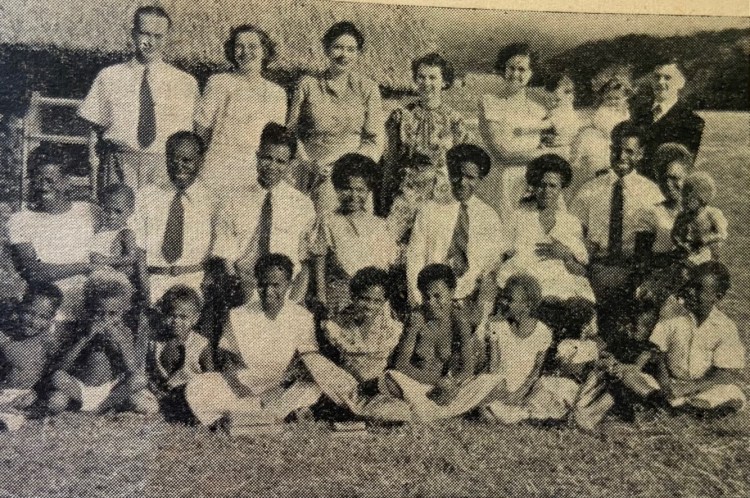
The Sisters’ house was not yet finished, so they slept in the kitchen and had meals with us and the Barnes, who are living with us. It meant each one making adjustments in the new environment. After a week or more after their arrival, we went for a hike to Poromanda, a hamlet to the north of the station. This was quite an experience for we girls. For the first time we saw women’s and men’s houses at close quarters and walked through Gardens. The wives, young children and pigs, all live in the same house. It has walls about 2 1/2 feet high made of round pitpit, grass or bark roof 6 feet to the top of the ridge and the ends are rounded. Across the narrow doorway, are placed several pieces of timber, which slip into a slot on either side. A fire keeps smouldering inside to keep them warm. The husband and all the boys sleep in the men’s house, which has an open veranda-like section in front of a fire around which they sit and talk, smoking a pipe. Behind this is the sleeping section. Around the men’s house we saw, was a high timber fence to keep away their enemies.
With the arrival of more staff, we were able to go on furlough to Australia. Our time of service in New Guinea District, the waiting period and commencement of the station all counted, and it would be wonderful to spend Christmas with our loved ones at home. It was hard to leave as the work was becoming established, and we were accepted, but ours was the task to make known to the people of Australia, the great need for their support and prayers in this tremendous venture of faith, the Methodist Overseas Missions, Papua-New Guinea Highlands field.
Grace Young
1950-51 Mendi
Source: Typed manuscript provided by Grace Young, c.1954
 Margaret Reeson