Tari, 1953
Why did a new Methodist mission start in Tari in 1953?
In some ways this is surprising. In 1953, the mission work in Mendi was still very new. The mission group had only been there for two years. They were a very small team, with two ministers, one agriculturalist, one teacher, one nurse and six island pastor-teachers and their families. For most of the two years, only one of the ministers was there at the same time, while the other one was on leave. They were only allowed to travel a short way from Unjamap. Not many local people trusted the nurse at the little hospital. Children came to school sometimes but not every day. Mendi people thought that the agriculturalist didn’t understand the right way to make a garden. One of the missionaries wrote, ‘We know so little of the language’. There was still no sign of any response to their Christian message.
So why did they attempt to start another new mission in the Tari area at that time? They were not even sure how far away Tari was from Mendi; Young thought it was about 40 miles to the west and Barnes thought it was about 60 miles, or 97 kilometres, but they didn’t know. There was no road between the two places, only mountains, and the only way to get there was when an airstrip was built. The people of Tari spoke a different language from Mendi, and had many different beliefs and customs from the Mendi people. Another new mission would have to start at the beginning.
But in spite of the difficulties, they had a vision and believed that God was calling them. At the General Conference of the Methodist Church in Australia in 1945, they agreed that:
‘there is a call to the church to advance into areas that are still unevangelized and warmly approves the action taken by the Board of Mission to occupy a new area of mainland New Guinea’.
In 1953, the Board of Mission was happy to agree when Gordon Young asked for permission to start a new work in Tari. They wrote ‘In 1950 we answered that Call [to start in Mendi] … We were true to the traditions of Methodism. We went not only to those who needed us but to those who needed us most.’ In the church newspapers, the Board of Mission encouraged Australian Methodists to support this new work with prayer and people and money. They appealed for 15,000 pounds, which was a lot of money at that time, about the same as $587,600.00 AUD in 2023.
Gordon Young was very interested in moving to new areas as soon as possible. When he wrote about Mendi and the new work in Tari in his annual report in 1953, he said:
It is unlikely that our work will remain limited to these two places, and the opening of new stations in the area must be envisaged. What we can do in the Highlands depends largely on the response of our people in Australia. The “Highland Challenge” must be presented to our home Churches as a call of God for sacrifice in terms of money and service.
Gordon Young, Annual Report, 1953
A year later, Roland Barnes was also thinking about new work in the future. He wrote:
We have a great deal of work ahead of us just around Tari but we are looking beyond. To the west of us are areas as yet untouched and some of these are not yet explored. We have plans for an aerial survey so that we can look at some of these areas and thus have a better idea of the task of evangelisation ahead of us.
Roland Barnes, 1954
There was another reason why the Methodists wanted to move quickly. They knew that they were not the only missionary organisation who were interested in these new regions. When Gordon Young first visited the Highlands with the survey team in 1950, he saw that some large districts like Chimbu, Eastern Highlands and Western Highlands, already had one main mission group who saw that area as their responsibility; a Lutheran area, an Anglican area, a Baptist area, a London Missionary Society area. The Catholic Church went everywhere, but some of the other churches decided to have an understanding with each other and not start new work in places where other churches were already working. Perhaps Gordon Young thought that the Southern Highlands, where he was the first Missionary, ought to be a Methodist area. But if it was to be a ‘Methodist area’, the Methodist workers would have to arrive first, before other groups.
In the very small group of Australians living in the Mendi Valley in 1952 were three couples and two single women living at the Methodist mission at Unjamap. On the other side of the Mendi River at their patrol post at Murumb were three or four young Australian patrol officers, the kiaps. The young single men often appreciated the hospitality of Gordon and Grace Young and they met every time Young or one of the others went to the airstrip to collect goods or mail. Through this contact, Young learned about the new airstrip being built in the Tari Basin. It would soon be ready for a plane to land. He arranged to travel to Tari as soon as a plane was available and landed there on 7 January 1953. Catechist Tomas Tomar and teacher Inosi Kwabaiona went with him. The very next day, on 8 January 1953, a senior missionary Len Twyman from the Unevangelised Fields Mission also landed in Tari. To the Huli people of Tari, both groups of new arrivals were a great mystery.
In the first week in Tari, Gordon Young, Tomas and Inosi camped near the airstrip and went searching for a place to start their new mission. With the support of the patrol officers, they negotiated with the local people and selected a place at Hoiebia, about 2 km from the airstrip on 15 January 1953. This land was close to a river and had some level ground. The local people had seen white men before; patrol officers Taylor and Black camped at Hoiebia in 1938 and Smith, Clancy and Neville camped there in 1951. Young, Tomas and Inosi started to clear some ground and camped there for the first time on 24 January.
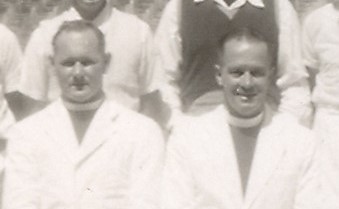
On January 26th, 1953, the Rev. Roland Barnes arrived in Tari after his furlough, ready to be the first Superintendent minister there. Gordon Young stayed in Tari for the first eight weeks and then returned to Mendi.
It was time to start a new work.
Margaret Reeson 2023
Sources:
Gordon Young, Missionary Review September 1953 p.15
Roland Barnes Missionary Review July 1954 p.13
Gordon Young, ‘Papua-New Guinea Highlands Expansion and Development 1953’ in The Open Door: the Missionary Organ of the Methodist Church of New Zealand June 1954
John and Moyra Prince, A Church is Born: a history of the Evangelical Church of Papua New Guinea, 1991, p.69
 Margaret Reeson