Tari, 1953

Roland Barnes was very keen to start his new work in Tari. He and his wife Miriam were on furlough in their home State of Queensland at the end of 1952 when they found out that he was to start a new mission in Tari. The government officers said that Mrs Miriam Barnes was not allowed to go Tari until they gave her permission, so she stayed in Queensland with her two little children to wait.
When Roland Barnes landed in Tari on 26 January 1953, Gordon Young was already there, camping at Hoiebia. As Young had predicted, the Methodists were not the only ones who had been thinking about new mission work in the great Tari Basin. Thousands of people lived there who had never heard the gospel of Jesus. The day after Gordon Young arrived in Tari, men from the non-denominational Christian missionary society, the Unevangelised Fields Mission (UFM), came to Tari as well. This mission had been working in Western Province of Papua since the 1930s and had mission teams in many places almost to the border with Irian Jaya. They started a UFM mission work at Lake Kutubu in the Southern Highlands in 1950. Like the Methodist group, they believed that God was calling them to move into the new regions of the Southern Highlands. The UFM men, Jim Erkilla and Max Garlick, met with the Methodists Young and Barnes. Both groups had many things in common. They agreed, that in a region with such a large population of people who had not heard the Christian message, there was room for both of their missions. The Methodists had a lease about 2 km away on one side of the airstrip. The UFM men arranged with the local people and the patrol officers for a lease on the other side of the airstrip at a place called Walidegemabu; this area had been a fighting ground where very few people lived. Later, the Catholic Mission and the Seventh Day Adventist (SDA) Mission came to Tari as well.
Questions raised about new work
Not everyone was happy about this new Methodist outreach. Early in February 1953, when Gordon Young and Roland Barnes were camping at Hoiebia and working with Tomas and Inosi to prepare timber and woven pitpit blind for the first simple buildings, about fifty men were meeting in Sydney. They came from all over Australia for the Annual General Meeting of the Board of Methodist Overseas Missions (MOM). These men listened to reports from all the Methodist mission areas. There was news from Tonga and Fiji, India and North Australia, Samoa, New Guinea and Papua. The new work in the Highlands was only one part of their responsibility.
Some men started to ask practical questions. ‘Why have they started another new work at Tari when the work in Mendi is still so new? Is Gordon Young moving too fast? Who will pay for this? How can we find enough workers to send? We have so many needs in other places – is this the right time to be expanding our work?’
The General Secretary Cecil Gribble argued that God often called people to new ministries, even in difficult times. He said that workers from the Solomon Islands had already offered to come to help in the Highlands, and would support their own people there. In the end, the MOM Board decided that there should be no more new places opened in the Highlands for now, until the new work was better established, and they would try to work out plans for the future. They published this in the missionary magazine.
It was resolved: That for the time being our policy of development be one of consolidation before further mission areas be opened and that the monthly meetings of the Board explore the whole subject of development in the light of changing conditions.
1953 Annual General Meeting of the Board of Methodist Overseas Missions (MOM).
Australian and New Zealand co-operation
At the same big Board meeting in Sydney, there was another important subject. One of their visitors was the General Secretary of the New Zealand Methodist Church. He asked the Australians, ‘How can we find ways to work together?’ Both the New Zealand and the Australian Methodists wanted to be independent but decided that perhaps they could share some workers and some funding. The Board decided:
That the New Zealand church is invited to cooperate with the Australian Church in the work of a particular area.
1953 Annual General Meeting of the Board of Methodist Overseas Missions (MOM).
It was only an invitation, so far, and it was not clear what ‘particular area’ would be chosen. But some of those at the meeting hoped that the New Zealand Methodists would accept the invitation and that they would choose the Highlands area. If that happened, it would help with more staff and more money for the work.
The first months of work in Tari were very busy. The little team started to prepare simple buildings and set up a pit-saw to provide timber. The new airstrip was not ready for larger planes but one day a DC3 flew from Madang to Tari with a load for the government officers and the new missions. The load, of axe heads, spades, rice, salt, sugar, flour, mattresses, blankets, nails and cowrie shell — most valuable for trade barter — was dropped. The aircraft flew up and down above the airstrip and a team of men pushed out the cargo over the dropping point. Roland Barnes was very happy when they only lost some rice and salt because a few bags burst open when they hit the ground.

Everything was new. The language of the Huli people of Tari was different from the language in Mendi and no one had ever recorded it. They started a little school in March 1953, and when Mrs Miriam Barnes was allowed to come to Tari in May 1953, with her two little children, she offered practical nursing as needed from her former professional work as a nurse. Miriam Barnes was the first white woman to live in Tari. Quite soon, Barnes started to work on a church building for Hoiebia. For the first year the patrol officers told them that they must not go any further from the airstrip in Tari than about 2 km, but many local people came to see them at Hoiebia. By the middle of 1953 they had already built a house for the Barnes family, two teacher’s houses, some buildings for a future hospital and were building a church.
The Australian Methodists in the Southern Highlands were feeling very hopeful. Their fellow-Methodists in New Zealand decided to work with the Australians in the Highlands. In 1953, in New Zealand the Methodist Conference decided ‘that the Conference accepts the invitation of the Methodist Church in Australia to cooperate in the Papua-New Guinea Highlands Mission’. This was very good news. Soon New Zealand ministers, nurses, teachers and builders would come to share their work. The MOM Board sent a message of appreciation. They said:
We convey our appreciation and with this will come our prayers that the response both in service and in giving will be such as to make possible a fruitful work of cooperation between the two churches in our newest Methodist field in the Pacific.
Australian Methodist Overseas Mission Board to New Zealand Methodist Conference, 1953
Solomon Islands Missionaries
The New Zealanders were not the only ones. In May 1952, in the Solomon Islands, the Methodists there celebrated the 50th anniversary of the beginning of Christian mission. At their Jubilee celebrations, they told the story of the coming of the first missionaries to the Solomon Islands in 1902. When they heard these stories, some Solomon Island Christians asked, ‘There is a new Methodist mission just starting in the Southern Highlands of New Guinea. Those people are the same as we were fifty years ago. Will some of our people go to them?’
Among the people listening to this story in the Solomon Islands was a local teacher, John Pirah from Bougainville and Alpheus Alekera from the British Solomons. Later, John Pirah wrote:
My heart was warmed at that time about the work in the Highlands and a little later I gave in my name as one who would go. I remembered how 50 years before Rev. J. F. Goldie had brought the Gospel of Christ to the Solomons and I thought that it is only right that we of the Solomons Church should remember people still in darkness and go to help them.
John Pirah, Bougainville TEACHER, 1953
John Pirah and Alpheus Alekera, with their wives and young families, arrived in Tari on 25 April 1953. It was a very long and difficult journey for them, by sea from the Solomon Islands to Rabaul, then Manus Island and finally Madang and at last by air to Tari; it took them six weeks of travel. After they arrived, John Pirah wrote:
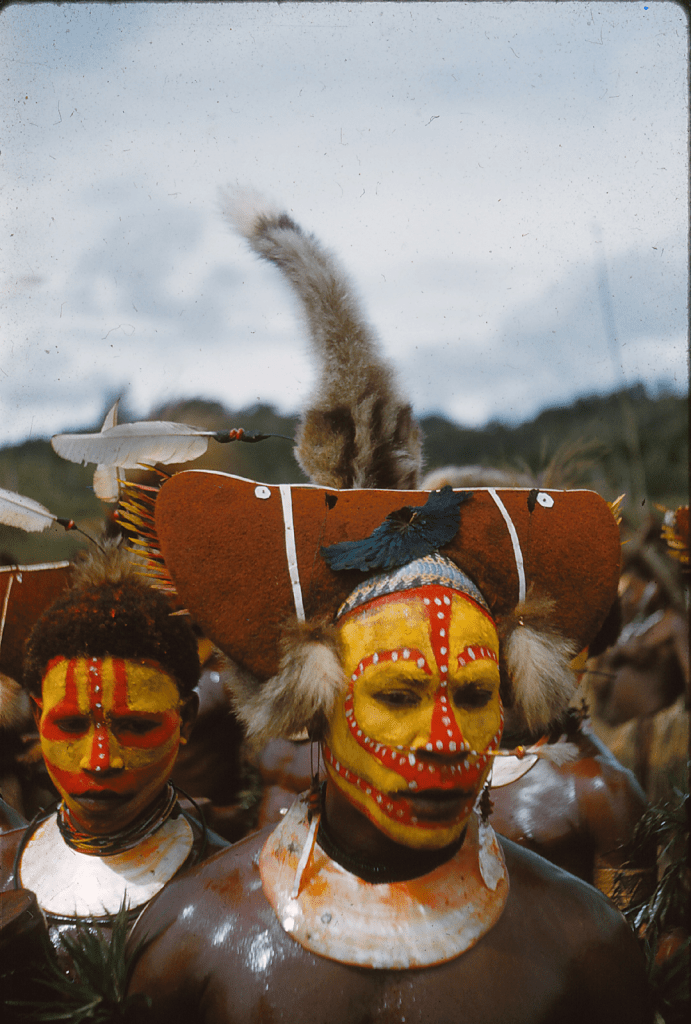
As we landed at Tari there were hundreds of people at the airstrip. They were surprised at us and we were certainly surprised at them. We thought that the men looked big and strong. We looked for a long time at the big wigs with flowers on the front of them which the men wear. We were surprised but we were not afraid for we felt that God was with us, as He had been all the way. Some of the men were carrying bows and arrows and many of them, to our surprise, were still carrying their stone axes. Since then, many more have steel axes.
John Pirah, Bougainville TEACHER, 1953


The pattern was being set. For many years, the team working in the Southern Highlands would come from many different homes and backgrounds, working together for the gospel. By 1954, there were Australians, New Guineans, Papuans, Solomon Islanders and New Zealanders. Workers from other nations would follow. Roland Barnes wrote in 1953:
We are very glad to have native teachers. What an asset they are, for they are a living example to the people that the Gospel is for them. Without them the people would very likely say that Christianity is all very well for white people but is not for them. The teachers play a vital part in our work. Tomas from New Ireland is in charge of the pit-sawing. lnosi from Papua District is teaching the classes of woman and girls. Alphaeus from the Solomons does a good deal of the teaching of the men and boys and John also from the Solomons has been working lately on buildings.
Roland Barnes, 1953

The Solomon Islands Methodists sent a number of good people to serve in the Highlands over the next years, supported by their own church. Another young couple was farewelled from Vella Lavella in October 1954. Burley and Muriel Mesepitu, from strong church families, were married one day and the next day were farewelled to serve in Mendi, leaving family and everything they knew. A missionary Sister, Davinia Clark, wrote a moving description of wedding and farewell. In writing about the speeches during the farewell, she wrote:
“The young couple count it a privilege to go and their parents are happy that God has called them. Timothy, Muriel’s father, spoke first. He offered to go to the Highlands when the first two teachers offered but he rejoices that God has revealed His will and has chosen his daughter to go. He and his wife have continually prayed that God would use and direct the life of their eldest child. Being a girl, she could not go alone, but God has found a way. His message to them was: “Go, my children, look always to Jesus and shine as lights in the darkness.” … Burlie Mesepitu said, ‘When I heard that two more teachers were needed for New Guinea my heart said ‘Go’. I prayed and prayed that if it was the will of God, I might be able to go. God heard my prayer and opened the door. God be with you who stay and us who go.”
Davinia Clark, 1954
A first film: ‘Men of the Mountains’.
A wealthy businessman from Melbourne decided to visit both Mendi and Tari with his wife in July 1953. W.A.Deutsher was a keen film maker and took his equipment to make movie films and tape recordings. Nobody else had made movies of the Highland people at that time and he thought it would be very interesting. Deutsher and his wife visited Gordon and Grace Young in Mendi and then went to Tari. They were in Tari for the opening of the first church building in Tari on 12 July 1953. Deutsher told the story of the church opening.
“After only six months service at Tari, the Rev. R. L. Barnes has succeeded in building a large native Church with co-operation from native teachers and local natives. Six weeks ago, Mrs. Barnes and two small boys arrived to join her husband in this remote outpost. Local natives have proved friendly and helpful, and the opportunity to officially open the Church on the Sunday of our presence was conferred upon Mrs. Deutsher. Messrs. Garlick and Erkilla from Tari Unevangelised Fields Mission and Mr. Murdoch from the Government Station were also present. “The Church’s One Foundation” was sung in English; Thomas Tomar, a native from New Ireland, prayed in his language; Mr. Murdoch addressed the natives through an interpreter, and Mrs. Deutsher performed the opening ceremony. About 500 natives entered the Church along with the white people and Christian natives, whilst 700 or 800 native people watched the ceremony from outside. A service was conducted by the Rev. R. L. Barnes with the aid of an interpreter, and included the christening of Job Mia — the five-days-old son of Alpheaus and Eileen Alikera, native teachers from the Solomon Islands. The native Mission staff formed a choir and sang in several native languages.”
W.A.Deutsher, film-maker, 1953
…‘Mr. Barnes invited the native population to produce a “sing-song” the following day to stress the importance of the opening of the Church and also as a welcome to Mrs. Barnes and to us. The natives were most co-operative, and many movie films and tape recordings have been made.’
This is likely to have been the first time a Huli ‘mali’ was filmed. This colour film was produced and distributed for use in Methodist churches across Australia with the title ‘Men of the Mountains’.

Early in 1954, Sister Joyce Walker was transferred from her medical work in Mendi. She arrived in Tari in February, after her furlough, to take care of the professional medical work at Hoiebia. She soon noticed that a number of local people were sick with leprosy and wanted to help them.
Roland Barnes was very encouraged by the interest that the Huli people were already showing in his message about Jesus. They were curious, open and asking questions. After only one year of contact, Barnes wrote:
“One evening in response to an invitation to come and talk about our work a number of young men came in. The simple message of discipleship, of following Jesus and of entering into His service was given to them. It was, of necessity, the simple call which our Master gave when He said, “Come ye after me and I will make you to become fishers of men.” That evening fourteen lads pledged themselves to follow Christ and to begin training for His work. They are still with us. Certainly, they have much to learn but they have set their hands to the plough.
Roland Barnes, 1954
We have talked a good deal of God and His Book and His message. Several of the old men come in. “You talk of God. His message is good. We think He is the one we call ‘Ni’ (pronounce ‘nee’). Will you call God by our name too?” We are glad of the interest of the old men and we realise that they are deeply religious at heart. We are inquiring further into their beliefs concerning their ‘Ni.’
An old woman brought her son. She was bent and wrinkled. “He is yours, will you teach him,” she says. She is making a dedication greater than she realises in seeking to bring her child. But surely the Spirit of God moves and touches in ways we are often slow to recognise. “
There was much that the missionaries did not understand. They did not understand the Huli language, their beliefs, their customs and what the young or old men may have thought about this message. They knew that there would be many challenges ahead and they would need to be patient. As Cecil Gribble wrote in 1954:
We must take long views in our work for the development and progress of these people. If in the years ahead they become citizens of a wider world, our reward will be that we saw and believed.
Cecil Gribble, 1954
But they had started their Christian work and now it would go on.
Margaret Reeson 2023
Sources:
Board Report, The Missionary Review March 1953
The Missionary Review June 1953
Roland Barnes, The Missionary Review—July 1954—Page 13
Annual Report 1953 The Missionary Review—September, 1953—Page 15
W. A. Deutsher ‘Methodism’s newest outpost at Tari’ The Missionary Review—October, 1953—Page 9
The Open Door: the Missionary Organ of the Methodist Church of New Zealand, Special Highlands Missionary Appeal Number Vol. XXXIV No. 1, June 1954
Gordon Young, ‘Papua-New Guinea Highlands Expansion and Development, 1953’, The Open Door: the Missionary Organ of the Methodist Church of New Zealand, June 1954 p.7
Davinia Clark, The Missionary Review—February, 1 9 5 5 — P a g e 5
Cecil Gribble ‘New Guinea – the forgotten people’, The Open Door: the Missionary Organ of the Methodist Church of New Zealand, June 1954 p.4
George G.Carter, A Family Affair: A Brief Survey of New Zealand Methodism’s Involvement in Mission Overseas 1822-1972, 1973, proceedings of Wesley Historical society of New Zealand, pp224-225
 Margaret Reeson