Mendi, 1953
The people at the new Mission in Mendi were very excited when the first church building was opened. Gordon Young wanted to build a church as soon as he arrived in Mendi, but they had to wait until they had houses to shelter their workers. The new building was opened on 27 September 1953 and even had a bell to call the people.
The story about the opening of the new building at Unjamap was told in a newspaper in South Australia, in a town where the people knew Gordon and Grace Young.
At the time when the church was opened, they had a visitor. At that time, not many people visited the Highlands because it was still ‘restricted territory’. This visitor was Dr E.B.H.Brotchie, who was a medical practitioner in Sydney. He was very interested in the new mission and was a new member of the Methodist Overseas Missions Board. He visited Mendi in 1953 and was there when the first church building in Mendi was dedicated. Gordon Young invited Dr Brotchie to open the new building. Dr Brotchie wrote his own story of his visit.
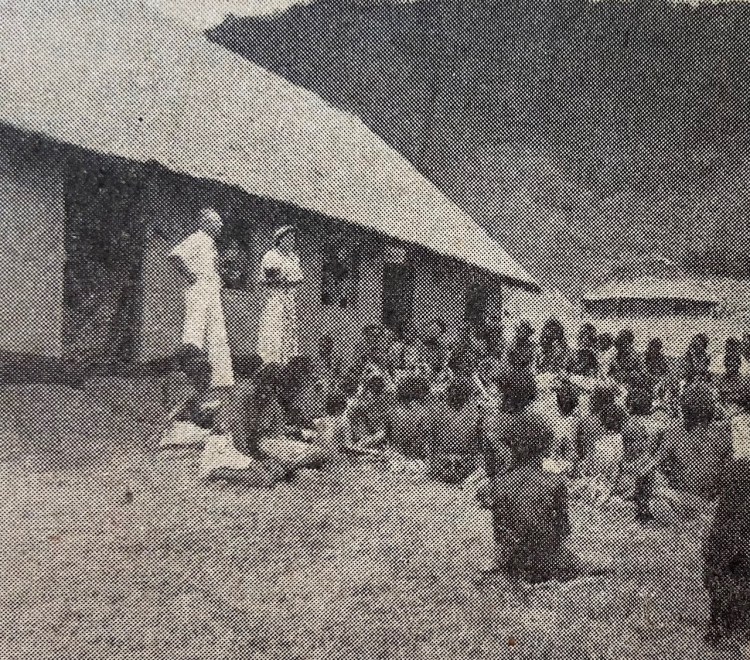
Grace Young wrote the story of the church opening:
“Mendi church is now open. It was a cold grey morning, not at all inviting weather for the Mendi people to venture forth. Still, our church was officially opened on Sunday, 27 September 1953. By 11 o’clock 200 native people had assembled outside the church, waiting, and wondering what it was all about.
After the singing of a hymn and prayer by Kaminiel Ladi, Dr E. Brotchie of New South Wales, who was visiting us, kindly opened the church. His well-chosen words were translated into the Mendi language by Miss Elsie Wilson. At the conclusion of the opening ceremony, we all entered the church for service, which was conducted by Setepano Nabwakulea from Papua.
Not only was it the opening of our church, but also our Thanksgiving day, the one-day of the year, when the native people give their offering for the work of God. There was special singing by the native staff, their wives and families before the offering was made.
The school children living on the mission station were very proud of their offerings, as they had earned them themselves. At Sunday school, the previous Sunday, they were told the story of the talents and given one penny. Instead of doubling it, they decided to increase it six times which most of them manage to do. Sunday school was held at the end of the service. Some of the Mendi children had brought a sweet potato each which they gave as their offering.
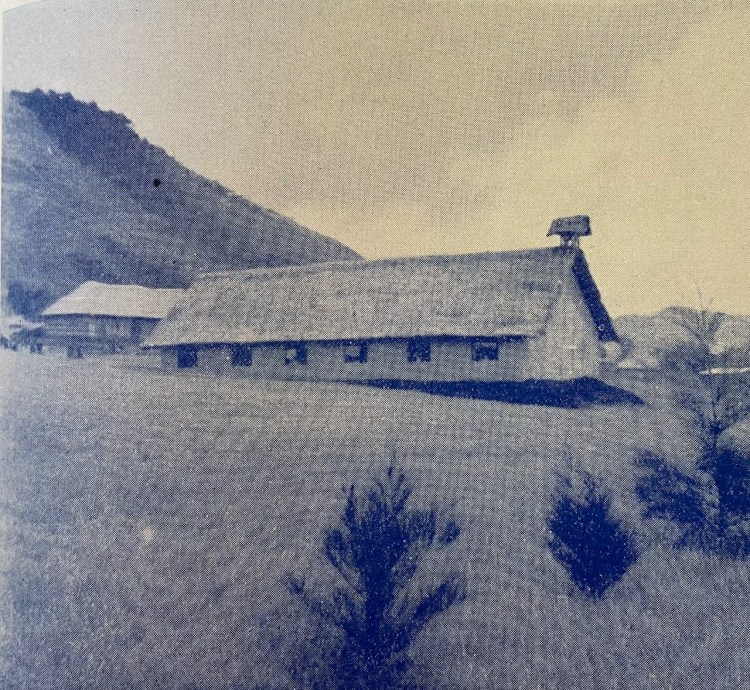
We are proud of our church, although it is not yet really completed, it was quite a picture that day with its floral display. Vases of flowers were on the ledge of all 10 window openings, and the communion table.
Rather an amusing incident took place during the service. All was quiet when suddenly there was a loud yell. One Mendi man received an unexpected backwash when a vase of flowers blew over on his back. Just imagine having your first wash for years, you would yell too. … With the singer we say, Bless this house. Oh, Lord, we pray may it truly be a house of God wherein all may come to know and worship him who is above all others. ”
Dr Brotchie wrote his impressions of Mendi:
“A visit of three weeks to Mendi Methodist Mission in the Southern Highlands District of Papua is not enough to obtain a full idea of the extent and amount of work done in this developing area. The Mission is led by the energetic Rev. Gordon Young, assisted by a small band of helpers. Progress is obvious in the greater amiability of the local tribes formerly at constant warfare, in the five preaching places besides Hunja (the Mission Station) with attendances of up to six hundred people, in the eagerness of the Native preachers to extend the work further afield, and in the building of a new Church complete with bell and belfry.
The absence of the poisoned bow and arrow and the bone-pointed spear and the presence of working tools such as knives, tomahawks and spades, means that progress is being made. Although the language is one of the most difficult in New Guinea, a conversation can be maintained and understood, and the ready smile, the welcoming hand and ‘Hunja Kundi A-v-ah!’ [The leader at Unja] means that Rev. Gordon Young is at home with them and they with him.
The new Church was opened in the presence of two hundred people. It was planned two years ago and work commenced three months ago. It is a credit to all those employed, including the four Native Teachers whose obvious enthusiasm, as they each took part in services on the opening day, indicates the spirit in which the building was carried out.

The Mission has a hundred acres, leasehold, on both sides of the Mendi River. It grows bananas, pineapples, sugar cane, passion fruit, soya bean, sweet potato, taro, and other vegetables. Natives are learning the principles of soil conservation under Mr. David Johnston, H.D.A. Their lives are being enriched both physically and spiritually. Adult and child education, under Miss Elsie Wilson, with wall charts, primers and reading books is gradually revealing the possibilities within the native mind. With children speaking six different languages, the work is not easy but a happy association between teacher and student is being maintained.
The medical services at the Mission are in the hands of Sister Joyce Walker and Sister Beth Priest. They are not afraid to tackle any problem that comes their way. Confinement difficulties, feeding troubles, pneumonia, infections, yaws, leprosy, burns, all provide opportunities to express the healing love of the Master.
The Superintendent, Rev. Gordon Young, is vitally interested in all the activities being carried on at Mendi. He has visions of extending the work still further through the Southern Highlands and hopes to have five centres within twelve months including that already opened at Tari, where the Rev. Roland Barnes is in charge. Working from early morning till late at night, he keeps a watchful eye on every aspect of the work. When the mastery of a new language is complete and other initial difficulties are overcome, the fruit will be seen which will justify the foundations being so truly laid at the present time.”
Margaret Reeson, 2023
Sources:
1953 From Pinnaroo and Border Times (South Australia) 17 December 1953
Dr E.B.H. Brotchie, The Missionary Review, November, 1 9 5 3 — P a g e 1 5
 Margaret Reeson