Mendi, 1952
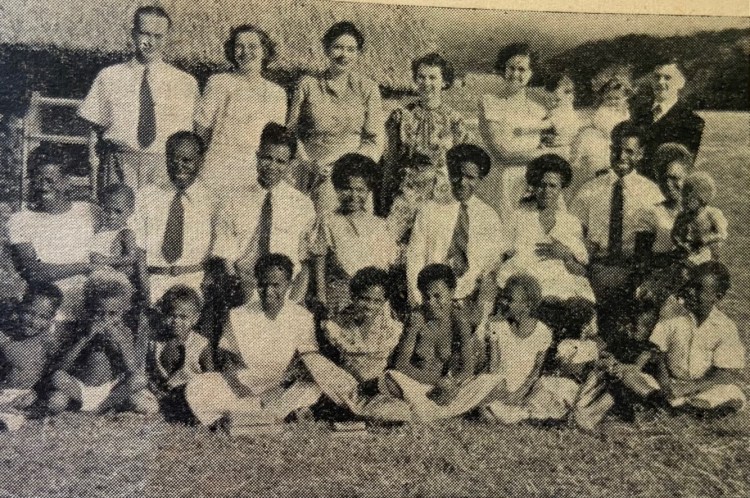
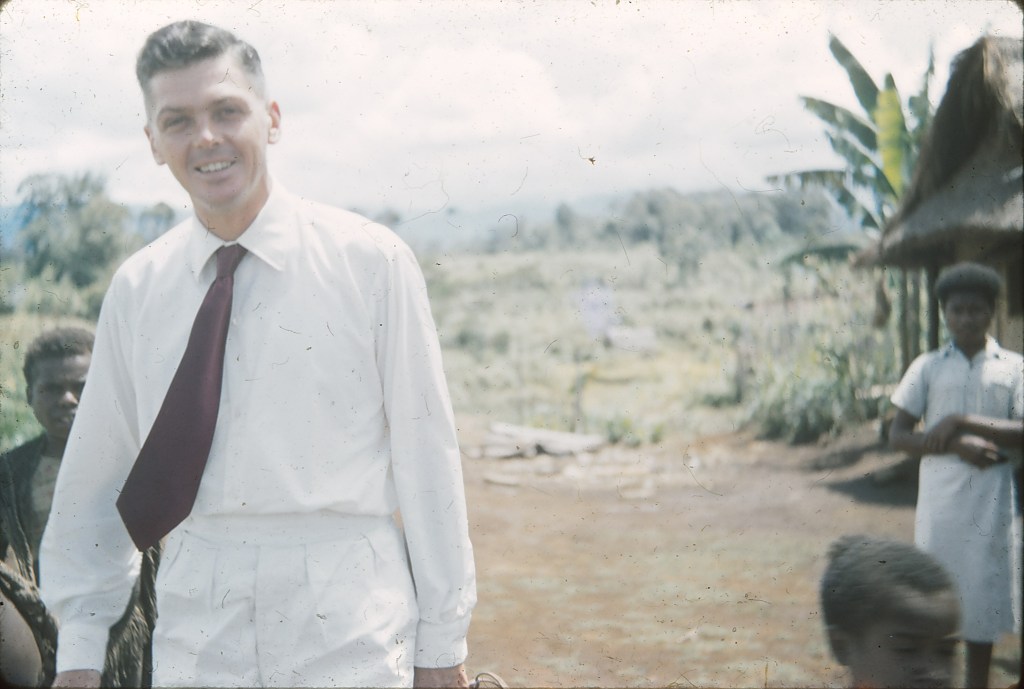
David Johnston and his wife Beryl arrived in Mendi late in 1951. The other missionaries in Mendi were people who had already been working in New Guinea for a number of years. David and Beryl Johnston came straight from New South Wales as a young married couple. David was an agriculturalist who worked to improve the gardens and diet of the people. He also loved to preach and teach the good news of Jesus. They stayed in Mendi until 1960, learned the language and loved the Mendi people.
This is what David Johnston wrote in his first year in Mendi:
“As I sit this Sunday morning, scanning the range with its sparse covering of timber and the undulating hills of kunai grass, with the morning shadows, giving the gullies an even deeper appearance, I wonder who at home is upholding us in prayer. On the track to Tend is the Reverend Gordon Young striding along with a number of local natives and some boys from the Administration station. Just ahead of him is Setepano Nabwakulea, one of our teachers. They are going to take services at two places in the northern end of the valley from the mission station. My assignment for today is the service here.
How can one tell the Mendi people of Jesus and our God and that we have come to bring them the message of Jesus and his saving grace? What words can I use (of the few I know) so they may receive the right impression? This morning’s message will be about the Sower, for they are essentially an agricultural people. They know how to grow sweet potato, but very little else, except perhaps the growing of beans and corn. They do not understand about sowing as we know it, and as our Lord apparently meant. It will be necessary to show them how to grow vegetables and other edibles, so they may improve their diet, and by so doing, introduced them personally, and individually to Jesus and his word, the seed, which he wants implanted in their hearts continually.
We are realising and being impressed with the necessity of making real contacts with their everyday life, and its problems, and so strike a chord that will be a means of aiding the Holy Spirit in the work of transforming their lives. They are impressed with Timot, a Papuan helper who lives among them, and he’s engaged in the important work of pit-sawing. Timot makes an impact on everyone he meets, for he has a real knowledge and love for the Lord Jesus who is portrayed in his bright personality.
I personally am indebted to Timot, for he has sawn enough timber for a floor to be started in our house. We have the joists in and some planks have been laid. This is a big improvement for not only will it be more comfortable for living in but it will obviate the necessity of continually patching and replacing pit-pit (a type of bamboo of small diameter) floors, as is the case in the other two houses. The pitsaw is situated on the hill to the west of the station and overlooking it by a little over 1700 feet. Each piece of sawn timber is carried down rough and slippery tracks to the station, where the people anxiously await the payment they will deserve for such an arduous task. The saw gang consists of Timot and six Mendi lads, who have become most proficient in using the saw. This would be realised if you could see the timber that is carried in each week.
I would like to tell you of two experiences I had recently which show that although one is an agriculturalist, there are many opportunities for doing other important work on the mission field. The first took place exactly one week before the second. There were two families at the hospital, consisting of children with pneumonia and their parents. About midnight, one small lass of about 10 years apparently went into a coma and the parents panicked, and took her home in the rain and cold. Next morning, I heard about it and, accompanied by the senior teacher, went to the house of the people which was easily found because of the wailing that was issuing from that direction. On arriving, we found the poor child tied to a pole with bush rope, and a number of women were around her, calling ‘my daughter’ in a pitiful monotone. She was dead. The parents in their ignorance, blame the Sister [Sister Joyce Walker] for the child’s death. We implored the other parents to bring their child back to the hospital as it was very sick, but the natural reply was “Sister killed that girl and we are not taking ours back to be killed too“. Do you blame them? In the lack of understanding, they do not realise the danger of carrying a seriously ill child in the rain and biting winds. Most of the children are naked, the rest, wearing a few leaves in a belt of bark or native string around their waist. We came home without the child, feeling very disappointed.
The second instance was similar. An influential person who lives not far away from here had a lovely boy, the son of one of his former wives. This boy also contracted pneumonia and was in the hospital for a short time. The parents took him home, as they wanted to kill a pig to appease the evil spirits, which was supposed to be causing the illness, of course, but the little fellow became worse, and when Sister and I went up to see him, there were 17 women around the mother and child, wailing softly, and waiting for his last breath. To my mind, the end was not far away, and even Sister thought it was no use taking the child back to the hospital. With difficulty, I told the parents how bad they were, and pointing to a woman who had been saved by the sister sometime before, said “We will go back to the hospital“. Much to my surprise, they put the boy in their string bag and off we set. We prayed fervently all the way down, asking the Lord to work out his perfect will. Just as we arrived at the hospital, the child had a relapse, and we thought it was dead. Soon, Sister Walker gave it some injections and food, and it opened its eyes. But this time, a big crowd had gathered, and women fully bewailing the child’s death. For days, Sister worked hard on that child, and when I looked in this afternoon to be met by a smile from the little fellow and voluminous greetings from the mother, he was reason for praising the Lord for working a modern miracle at Mendi.”
Margaret Reeson, 2024
Source: The Methodist, 20 December 1952
 Margaret Reeson