November 1954
The General Secretary of Methodist Overseas Missions (MOM) in the 1950s was Rev Cecil Gribble. He was very interested and encouraging of the new mission work in the Southern Highlands and began to visit Mendi regularly from 1951. In 1954 he came from Sydney to visit the new work in Tari for the first time.
This is his report.
“The great Tari Basin, 5,500 feet above sea level, lying near the centre of New Guinea, 130 miles from the Dutch border, is a vast valley girdled with mountains and populated with strong, cheerful, typical highland people. Tari is separated from Mendi by 60 miles of rugged mountainous country rising to land altitudes of eight thousand feet, often too cold for human habitation. Flying over these mountains and then through a gap in the rim of the basin we came into the expansive Tari area and down on to the 4,000-foot air-strip. This must be as fine a strip as there is in Western New Guinea and it will soon take D.C. 3s.
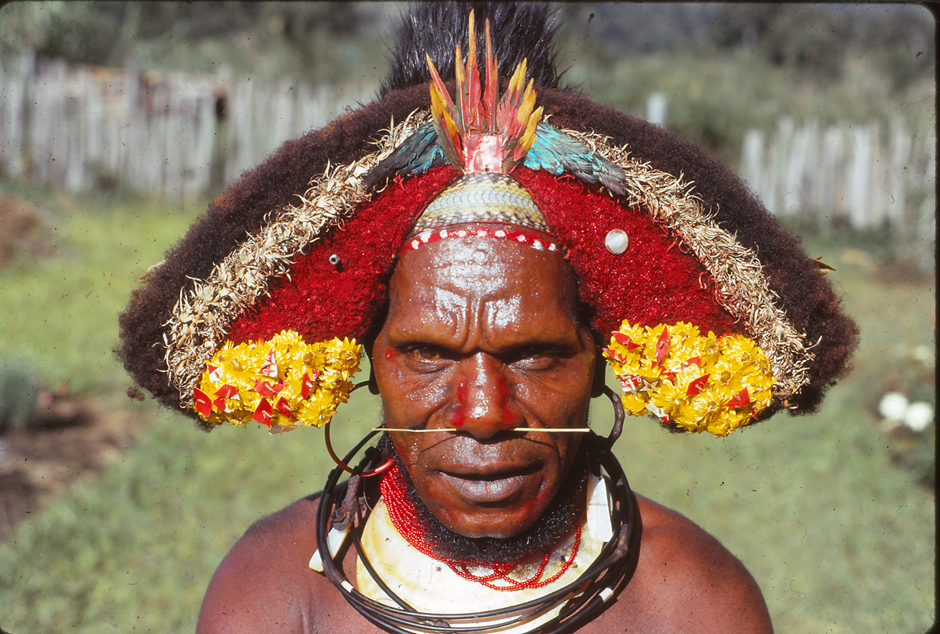
Around us as we stepped from the little ‘plane swarmed a happy crowd of these fearsome-looking Tari people; the women clad only in a bunch of leaves and a string girdle, the men with their great wigs of hair decorated, sometimes artistically, with everlasting flowers or bird of paradise feathers. Sometimes, too, the decorations have a ludicrous modern touch — a Craven A packet or a Sunshine Milk label being used. The walk from the air-strip to the Mission Station is a good mile along an undulating clay road, across two rivers and precarious bridges held up by forest vines and some faith.
It was early in 1953 that the Rev. G. H. Young and two native teachers flew into Tari in the first ‘plane to land passengers in the area. The site was chosen, Hoyebia, where the only Europeans to touch the area previously had camped while on patrol — Taylor and Black in 1938 and Smith, Clancy and Neville in 1951. On January 26th, 1953, the Rev. R.L. Barnes flew in to be the first Superintendent.

It is not easy to convey the picture of achievement in eighteen months. Houses, hospital, church, gardens and a broad sweep of green grassy lawn some three hundred by one hundred yards was the view we met at the end of that clay road from the air-strip at Ramu Ramu. Rugged mountains and massive banks of clouds were in every distant view. But the first impressions of beauty and achievement deepened as one felt the close and friendly contacts which the missionaries had made in so short a time with these primitive and violent people. The planning and building of the fine station site, the struggle with the difficult language, the planting of gardens, the enquiries into native customs and usages in the area, the securing of land, the simple beginning of gospel teaching — these and much more have been the pioneering task of our missionaries, white and brown, who have lived and worked cheerfully in this untamed area under rough and demanding conditions.
At the hospital. Sister Joyce Walker has become the trusted friend and helper of men, women and children. Women come from afar with their children. There is a card for each child and guidance is given by the Sister and eagerly accepted by the mothers. They come with all the usual troubles of children and many more that are unusual. But for the expert medical treatment many would die. No wonder there is such confidence between mothers, children and the Mission Sister.

Stretched out on a bed in Sister Walker’s consulting room in this grass-thatched hospital was a woman — her head covered to hide the blackened eyes, the bruised and beaten face and the scalp cut wide open by a husband, whose right to do this kind of thing has been unquestioned. Sister Walker fills the gaping wounds with penicillin, stitches them up and gives a kindly touch that has never been known before. Then she sends for the Government officer to question the husband and take action.
A young lad was sitting in a chair outside knitting a scarf from scraps of wool that had been sent to Tari. Four months ago he was carried to Miss Walker, a pathetic, emaciated case of skin and bone, unable to move hands, legs or joints. He can sit up now, feed himself and move his fingers. He can smile now and has hope. The father who brings the boy’s food stood by, trying to convey to me excitedly in his own language what the sister had done.
A family brings an unconscious young warrior. The sister suspects an arrow embedded deep in the neck and close to the spine. A general anaesthetic is given. The sister makes the incision deeper and deeper, searching for what she is sure is there but cannot find. She prayed and probed further. Eventually the arrow head was found, two inches long, and in a few weeks life for him was normal again.
There are many lepers at Tari and the Government is anxious that we commence a special work among them. The Mission Board has decided to set a nursing sister aside to do this work and it is hoped that one of the German deaconesses who are arriving early next year will undertake this task.
“And Jesus went forth, and saw a great multitude and was moved with compassion towards them and He healed their sick.” And He still heals, working miracles today through the consecrated hands of those who serve Him with dedicated medical training and knowledge.
On Sunday, several hundred gathered in the large Church in response to the message yodelled through the valleys that this was the day ‘for gathering together’. A more grotesque congregation surely never met for worship — men with flamboyant head-dress, bones through the nose, bodies coloured with dyes and clays, axes and the huge bows and arrows in hand; and the women with webbing bags of babies or vegetables slung on their heads.
Youngsters in front were keen, bright, quiet and interested. How do we use their primitive religious ideas upon which to build Christian truth? Several old men have come to Mr. Barnes and said: “You talk of God. His message is good. We think He is the one we call Ni. Will you call God by our name, too?” They have a supreme creator spirit — Ni, but he has a wife and two daughters! It is not easy to weave the Christian gospel into those ideas. And yet we must have understanding in our handling of their cultural possessions. It was good to see the wisdom and care with which our missionaries were approaching this problem and one was glad that all our workers are trained in the patient approach to the most cherished beliefs of the people, gradually showing by word and deed the better way which is in Christ Jesus our Lord. Thomas, the New Britain pastor, preached in pidgin and then this was translated into Tari. The text was, “Render unto Caesar the things that are Caesar’s and unto God the things that are God’s.” “Something belonga man — something belonga God.” I wish I had a transcript of the whole sermon. But whatever was made of it, there was close interest from the congregation.
It is this interest which, amid much that is slow and discouraging, gives hope in the work. An old, bent and shrivelled woman brings her son and says, “He is yours. Will you teach him?” A group of fourteen young men, after a simple talk by Mr. Barnes on what it means to follow Jesus, came and said, “Teach us how to follow and we will try. Train us and we will serve our people with you.”
And so, in the midst of a social work that is quite spectacular a few perhaps are coming to understand in a simple way the deeper meaning of our presence among them. These will grow in grace and in the knowledge of Christ and live among the people, a saving, cleansing influence until gradually the things that are dark and evil will be overcome by the good.
Patience and long views are needed, but the people of Tari are the children of God and if His Church is faithful, they will know Him and serve Him in the end. For those who are called to live and work among these highland valley people there is “Some handful of His corn to take/ And scatter far afield/Till it in turn shall yield/ Its hundredfold Of grains of gold/To feed the waiting children of our God”
Cecil Gribble, November 1954, Tari
Source: The Missionary Review—November, 1954—Page 12
 Margaret Reeson