John Rees’ Bible School began yesterday and John is thrilled as a kid about it. It is very exciting.
Margaret Higman, letter to parents May 1962
The men asked me, ‘Can we go and talk to our people about the things we have learned?’
John Rees, Missionary Review, August 1962
When John and Gwenda Rees and their young family first arrived in Mendi late in 1960, he was confronted with what seemed an impossible task. The government officers told him that they thought that there were about 40,000 people living in the Mendi and Lai Valleys. Now that most of the pioneer missionary team had left, he was the only Methodist minister in that area. Some of the men from the coast were experienced, like Setepano Nabwakulea, Libai Tiengwa, Tomas Tomar and Epineri Kopman, but all of them were working in a language that they did not know well. How could this small team do the work of sharing the good news of God and Jesus?
Rees wrote:
As the months went by, it became more and more clear that the method of Jesus must also be our method here – to train a group of men from among the people – to concentrate on a few and go deep rather than spread wide and thinly.
For over a year, Rees worked to learn the Mendi language better and spent time preparing the small number of people who had asked for baptism. He travelled around the region and visited all the pastor stations. Slowly, a few local men from the pastor stations were becoming interested in the Christian message. The pastors encouraged them and talked with them about what it meant to be a Christian.
Early in 1962, they decided to start a Bible School for local men who were new Christians. The people who attended the Quarterly Meeting were happy about this idea, but first they had to build somewhere for the men to study, sleep and cook. At that time, the only buildings at Tende were the minister’s house, a pastor’s house, one-room houses for the Australian teacher and the New Zealand builder, and the first classrooms for the Circuit Training Institute. The pastors on five stations were invited to send two men each to come to Tende to help build a Bible School.
The people were very interested in this. Men brought timber. Women came carrying big bundles of kunai grass for roofing thatch. Men organised their people to weave large panels of pipit blind for walls. Men like Sond, Enenol and Dus worked hard on the buildings. The work went ahead very quickly and in two months the buildings were ready for opening at Easter, in April 1962.
Clearing ground for the new Bible School, Mendi (J.Rees 1962)us from Yaken preparing timber for new Bible School building (J.Rees 1962)Rees paying for kunai grass for Bible School roofing (J.Rees 1962)Tundupi from Kamberep bringing woven pitpit blind for Bible School building (J.Rees 1962)Enenol from Unjamap on roof of Bible School under construction (J.Rees 1962)Enenol and Sond working on new Bible School building (Reeson 1962)First Mendi Bible School. Sleeping quarters on left, classroom and cookhouse on right (Reeson 1962)Some of the first students at Mendi Bible School. Primary School classroom behind. (Reeson 1962)
The new Bible School building was opened on Palm Sunday, 15 April 1962. This was a very busy day, with big crowds of people coming to church. There were so many people that they had the service outside because they didn’t have room in the small school classroom they were using as a church. That day, there were two visitors; the Chairman of the Highlands District Rev Cliff Keightley and Rev S.G. Andrews, General Secretary of the Methodist Overseas Missions Board from New Zealand. There was a service of Holy Communion, the baptism of the babies of six pastors and their wives, special singing by pastors from the Solomon Islands and New Guinea Islands, the opening of the Bible School and a feast. The service was in a mixture of English, Tok Pisin and Mendi language. An observer said that it was ‘a bit confused but interesting’. (The Pastors were their babies were Isaac and Emily, Joseph and Ia Laun, Saulo and Linda, Epineri and Lena, Samson and Sera.)
Coastal pastors and their families singing together (Reeson 1962)Baptism of pastors’ babies with S.G.Andrews, Palm Sunday 1962 (Reeson 1962)
At the end of the church service, everyone walked down the hill to the new buildings for the Bible School. The men who had helped to build were very happy to be there and proud of their good work. Enenol handed the key to the new Bible School classroom to the visitor S.G Andrews and he opened the door. It was a very important moment. The men who hoped to come to the new school crowded into their new building with the pastors and the visitors.
Opening of Bible School, Mendi 1962. Enenol, Pongia, Tundupi, S.G.Andrews, John Rees, Cliff Keightley, Wasun Koka (J.Rees 1962)Enenol hands the key to S.G.Andrews. Sond, centre; J.Rees, Cliff Keightley on right (Reeson 1962)
The buildings were ready but would the men be willing to come? Rees knew that a few were very excited about it. Sond and Enenol had done a lot of the work on the buildings. Sond went to Nipa on his mission trip after the opening of the Bible School buildings. When he came back to Mendi, he was always smiling with happiness and said again and again how happy he was. Dus was very interested, too; his wife was baptised at Yaken in May 1962 with some of his children.
But what about the others? Rees asked coastal pastors from five places – Tende, Wombip, Kamberep, Semp and Yaken – to send two men each. He wondered whether they would be willing to leave their homes, gardens and families for a week at a time for something very new and unfamiliar. He knew that some men from Yaken said they wanted to be baptised, but were sent to jail for tribal fighting and then decided that they didn’t want to be baptised after all.
The day for the true beginning of the Bible School was 30 May 1962. Would anyone come? First one man came and said, ‘I am here but my clan brother doesn’t want to come.’ Then another man arrived. One by one they came until there were nine men ready to start. Their names were: Dus, Sond, Enenol, Tundupi, Pongia, Mela, Pondot, Lowa, Nonga.
John Rees distributing laplaps and other items to new students at Bible School (Reeson 1962)
Margaret told her parents on 31 May 1962:
John‘s Bible school began yesterday and John is thrilled as a kid about it. I don’t blame him. It is really exciting. The nine men have been issued with blankets, soap, razor blade, shirt and shorts and towel. Today I caught a glimpse of Dus clean shaven, in sparkling clean T-shirt and astonishingly creased and immaculate shorts with a towel flung nonchalantly over a shoulder. Another chap Pongia came up. He’d had a dry shave and little bits of beard still stuck stubbornly to his chin. I’ll be heartbroken if either Enenol or Sond shave off their beards. They are both magnificent.
They’ve had their first lesson in hygiene and the virtues of cleanliness. There was also an astonishing lesson when John Rees told them that the world is round. He wants to give them some basic social studies as well as other Bible study. We had our first literacy lesson yesterday and learned to read the Mendi word for God.
Rees began the first week in the new school. But he wondered if it was going to be too hard for these men. None of them had ever been to school and would have to learn everything by memory. He asked himself:
Would they lose their interest? The days of the first week went by and our fears were put to rest. The men were keen and anxious to learn. Stories were told with stick figure pictures. Theology and selected Bible verses taught in the same way were eagerly repeated in unison and individually until they were retained. Then branching out into Christian ethics and social studies again with stick figures. They were really intrigued when it came to practice church services with criticism to follow. Now they know that this is a help to all of us to more effectively proclaim the gospel and lead the people to God.
At the end of the first week, he was very encouraged. As the nine men tidied up their rooms and folded their blankets, ready to go home, they asked Rees ‘Can we go and talk to our people about the things we have learned?’ They also asked for spades. ‘We want to make food gardens here at Tende.’ He knew that a garden is a long-term project. If they wanted to plant gardens, the men planned to stay with the school. The men all went home for a week, to look after their families, animals and gardens. In their home places, they helped the pastors from the coastal regions with Bible classes and church services.
Rees reported that
‘The pastors sent delightful reports of the enthusiasm with which the people listen to these men who know their language, their thought patterns and their customs.’
When the men came back for another week of learning, Rees had prepared sets of picture books with important New Testament Bible stories shown in simple stick figure pictures. The men were very interested in these, and they started to learn how to understand the symbols. This was easier than learning to read but they also started literacy classes with the teacher. Rees also started to teach a group of school boys and one girl, hoping that they would also be able to help with church services and Bible classes. He knew that it was not easy for new Christians. Their traditional beliefs and cultural responsibilities were very strong. The importance of their clan relationships mattered very much and if a clan planned a fight or revenge, they were still part of that group.
Rees understood that some of his group might not stay. But for some of them, he said that
‘they have become living active working members of the church which is daily growing as the church of Jesus Christ in Mendi’.
Tundupi using a new book with stick figure pictures to tell New Testament stories (Reeson 1962)
Those who knew John Rees knew that he was a man who had many ideas and moved quickly to try new things. Sometimes, this worried his friends and disturbed people like the Board of Methodist Overseas Missions. They were afraid that he was moving too quickly to bring change. Rees thought that it was more important to move to try new things while the Highland people were interested.
After the new Bible School had finished the first two weeks of learning in June, Rees had another new idea. He wrote to his friends in Australia to ask for prayer.
Our June quarterly meeting has begun plans to hold teaching missions to twelve different areas of people where we have no mission station and where we have little or no contact with the people at the moment. There are many such groups of people throughout the circuit where there is no missionary at all, either Protestant or Catholic.
At that time, there were eight pastors from the coast, nine very new Christian men who had just started to learn at the Bible School, six older school students including Wasun and Sondowe, plus John Rees. A new Australian minister had just arrived in Mendi that month, Graham Smith. This was the team who, Rees hoped, would go on mission to twelve new places. It was a brave and hopeful plan.
Sources: John Rees, Missionary Review August 1962 John Rees, letter to supporters 23 June 1962 Margaret Higman, letters to parents 15 April, 13 May, 31 May
Sometimes I feel we are getting somewhere, sometimes not. They can do excellent work if they want to do it, but sometimes their behaviour is very bad.
Margaret Higman, letter to parents
It started with complaints. Someone was stealing from the rooms of some of the mission workers at Tende. Sometimes it was money and sometimes it was clothes or other small things. Things went missing over several weeks. This was upsetting. Everyone blamed the school boys who worked in the kitchens of the mission staff, because they knew the houses well. Nobody knew which person was a thief. This was very disappointing because these students were young people who had just been baptised as new Christians.
The minister John Rees was very cross about the stealing. He told the school students, ‘We must find out who is stealing. If we can’t find that person, all of you must leave school and go home.’
These were strong words. Unfortunately, very soon after he said this, Rees left Mendi for a conference in Lae and was away for a week. Senior pastors Setepano Nabwakulea and Solomon Dongohoring did their best to find the culprit. They called the whole school to a meeting and then talked to the students one by one. At first, they thought that they had the answer. One young man admitted that he was the thief, but then he changed his story and said that he was not. Only a few boys and the girl students lived on the Tende side of the river and the others lived on the Unjamap side of the river. The students who lived at Unjamap said that it wasn’t their fault and it must be someone from Tende.
Over the weekend, all the students talked among themselves about this. They were very unhappy. Very early on Monday morning at the end of July 1962, nearly all the school students carried their school blankets, spades, cups and plates and left them outside the house of their teacher. There was a big pile of school things. The teacher was shocked to see this, and to see her students walking away on the road to their homes in the bush.
‘What are you doing?’ she asked.
‘We can’t stay. We are all being blamed for something we didn’t do. We don’t want to live here where people are suspicious of us,’ they answered. ‘We think that the mission staff are protecting the boys who live at Tende. We will only stay if you send the four boys at Tende far away so that they can’t come back in the night to steal. Very far away – like Australia!’
Wasun Koka was one of their leaders. He was an adult man who could be doing other work and he was angry because the school was no longer a good place where he could learn in peace. Many people thought that one older boy was the problem but nobody knew for sure.
Suddenly, instead of a busy school with four teachers and quite a lot of students, there was no school. Only a small group of school girls were still there. Some of the younger children went home to their families in the bush. Some boys went to ask to transfer to the government school in Murumbu. A few of the older ones went looking for work in the town as tractor drivers or to go out with the labour scheme. A few wanted to go to Mt Hagen to train as medical orderlies. This was possible because a number of the students were already in their mid to late teenage, and already were almost men. Because they were the first generation of people to have any formal education in the Southern Highlands, they were a lot older than the usual age of school children in the first few years of their education.
At first, the teachers decided to close the school until John Rees came back. But, even when Rees returned and tried to help everyone to resolve their problems, the trouble was still there. For a few weeks, everyone was confused, worried and upset. Some people were gossiping about other people. Some people complained that the mission school was not as good as the government schools because no mission school student had been successful in the national Standard 6 examination; but at that time NO students of any school in the Southern Highlands had passed the Standard 6 examination. Some said that the government teachers were better than the mission teachers; but most of the Australian teachers in the Mendi region had been trained in a 6-month short course while the mission teachers had been trained for two years and had several years teaching experience. For Mendi young men, it may have been a problem that their teacher was a young woman, in a place where women were not well respected. Some teenage youths said that they would leave the bad atmosphere of the mission and go to Mt Hagen to train as medical orderlies; but leader Enenol, who had trained there at an earlier time, told them that they would find that Mt Hagen was much worse than the mission at Mendi.
There were rumours and stories going around, and the stories changed all the time. Would the students leave for ever? Would they come back? Some people said one thing and then others told different stories. It was impossible to know what was true or who was telling lies.
In the end, they decided that there were not enough students for four teachers. Isaac Kenaji was going to teach the younger children in Standard 1 and 2 and Margaret Higman would take the rest. Setepano Nabwakulea would now focus on pastoral and church work, and Solomon Dongohoring would go to support John Hutton who was starting a new pioneer mission at Magarima.
John Rees was very disappointed that so many of the older boys had gone away. A number of them were in the recently baptised group and he had hoped that they would help him with the special mission that he was planning. Now he had to change his program. The students who left at that time included Sondowe, Kongel, Songul, Mangol, Tekopiri, Nemom, Tipilem and Lapon. When Margaret visited the government school for the regular Religious Education class there, she was sad to see three of her former students sitting at the back, looking embarrassed.
Baptism group at Mendi, June 1962. Includes Songul, Tekopiri and Mangol on far right, Upiri centre front. (Reeson 1962)
Australian teacher Margaret Higman was very unhappy about everything that was happening in the school. She felt that she was a failure. She told her parents, ‘Sometimes I feel we are getting somewhere, sometimes not. They can do excellent work if they want to do it, but sometimes their behaviour is very bad.’
When she visited the fine big Methodist school at Vunairima near Rabaul during her holiday in August, she saw a well-run school with 240 students, four Australian teachers and at least another seven trained local teachers, with good buildings, programs and equipment. It was very different from her small bush materials classrooms and her students who were the first ones of their people to have any education at all. Now those students were running away from school. Nothing was secure and she was very discouraged. When she was invited to write something for the Methodist magazine ‘The Missionary Review’ for the 1962 Christmas edition, she wrote a heart-felt piece titled “If Christ had been born in Mendi”. In it, she imagined what it would have been like if the incarnation of Christ had happened in the Highlands, with those who welcomed him and those who ignored or rejected the Son of God – ‘They will again break his heart’, she wrote.
During the school holidays, John Rees planned a big mission. He sent teams of men to twelve different places where there were no missions, in the Mendi Valley and the Lai Valley. Each team stayed there for a week, talking to the local people about God. There was a strong response and Rees decided that he needed all the pastors from the coast to focus on church work, not school work.
When the head teacher of the mission school at Tende came back from her holiday, John Rees met her at the airstrip. ‘I have closed seven out of our eight mission schools’, he said. ‘We will just keep the school at Tende.’
Village mission school at Yaken, with senior leader Dus. (Reeson 1962)School girls at village school at Semp (Reeson 1962)
This was a shock. Margaret was not really surprised. She knew that it was very difficult for the pastor-teachers to do a good job in a work for which they were not trained and had very few resources. But this was very sudden and they did not have a clear plan.
In the first weeks of the new term the school work at Tende was in confusion. New children were arriving from the village schools at Kamberep and Tukup to join Standard 1 at Tende. Some of the students who had run away came back. One of the older boys who had left and gone to Mt Hagen wrote to the teacher, ‘They all come back to school? I hope so they did.’
Instead of four teachers, they had only two teachers but now they had almost as many students as they had before. Isaac was teaching a big class of Standard 1 children, so Margaret took thirty children in Standards 2-6. She was very worried because the Schools Inspector was due very soon. What would he think about the closure of so many schools? Was the school at Tende ready for an inspection? Even the class roll book was in a muddle as it was hard to know which children were on the roll and when they had been attending.
The schools Inspector came to visit the school at Tende in September 1962. Despite the chaos and disruption of the previous months, at least some of the students’ work was good and there were signs of progress. The classrooms looked attractive. There was a problem with some of the paperwork, such as the roll book. The biggest problem was about language. Margaret Higman had been working hard to learn the Mendi language. Some of the students spoke to her in their language in front of the Inspector. He was very critical about this.
He said, ‘Your job is to teach English, spoken and written, and any use of the local vernacular will retard their progress.’
Even though the students showed that they could speak English quite well, the Inspector was not pleased. Later, he wrote to Rees to say that it was useless to try to teach literacy in the local language and he criticized the closure of the village schools.
Teachers Margaret Higman and Isaac Kenaji (Solomon Islands), Mendi. (Reeson 1962)
It was quite depressing and discouraging at first, but the teachers Isaac and Margaret were keen to work as well as possible with the new students. Margaret told her parents ‘Now formal inspection is over, I’ve had several bright ideas which should improve schoolwork a lot, for their sake, not the Inspector’s’.
In the older classes, the main goal was to prepare Wesi and Angopa for their Standard 6 examination. Their English was quite good but their Arithmetic and Maths was not. When they did the exam at the end of October, Margaret was afraid that they would fail the Arithmetic paper. They had made too many mistakes, she thought, when she checked their work later. The head teacher at the government school in the town was also worried about his students. When the exam results came in December, they were all relieved that Wesi had passed in English and nearly passed in Arithmetic.
By the time the school year ended in December 1962, many of the old students as well as the new ones had fun with a school Christmas party and the annual Nativity play.
Insert set: Reeson 1963 edu Christmas play at Tende: Upiri; Omolpi; MOM school group; Wasun; Mol, Unguya, Mapot
Nativity play, Mendi. Upiti as Mary and Kambeyoa as Joseph (Reeson 1962)Nativity play, Mendi. Omolpi, Lapten, Ting, Wesi, Angopa as angels (Reeson 1962)Nativity play, Mendi. Wasun as narrator. (Reeson 1962)Nativity play, Mendi. Wasun as narrator. (Reeson 1962)Nativity play at Tende, 1962. Mol as King Herod, Ungiya and Mapot as wise men (Reeson 1963)
The year 1962 was a very important and often a difficult time at the Methodist mission in Mendi. At the same time as the school was having problems, other things were going well. New staff arrived. Important visitors came to see them. More and more people were becoming Christians. The new Mendi Bible School started at Tende. The big mission to many places across the Mendi Valley and Lai Valley was successful. Local people across the region were starting to lead the services themselves and choosing to build small church buildings for their communities. These were very big changes in a very short time.
With school closures and problems in her own school, there was a lot to trouble the Australian teacher. Even so, she was learning to love the people of Mendi and told her parents, ‘I trust the General Secretary doesn’t think he ought to transfer me to Papua district if we close our schools.’
At the Methodist School at Tende, they learned some important things. They were surprised and happy to find that, when the students at both the government school in the town of Murumbu and the students at Methodist school at Tende attempted exactly the same examination papers for Standards 4 and 5, the students at Tende did much better than the others. It showed that their mission school was not poor quality after all. They also learned that it was possible to follow Jesus and be a Christian believer whether you went to a mission school, or a government school, or no school at all.
Margaret Higman (Reeson), personal letters 29,31 July 1962 Margaret Higman (Reeson), personal letters 2,6,9,16, 19 August 1962 Margaret Higman (Reeson), personal letters 9,11,17,23 September 1962
John Rees, Setepano Nabwakulea, Solomon Dongohoring, Isaac Kenaji, Margaret Higman, John Hutton, Enenol, Wasun Koka, Sondowe, Kongel, Songul, Mangol Soka, Tekopiri, Nemom, Tipilem, Lapon, Upiri, Ungiya, Mapot, Mol, Dus, Tende, Unjamap, Murumbu, Lai Valley, Magarima, Vunairima, Yaken, Methodist schools, government schools, education, village schools, school inspection, examinations, pastor-teachers.
I have had the feeling for a long time that we are spending too much time and energy on schoolwork and not enough on spiritual work and pastoral work.
John Rees April 1961
The annual report of the Methodist Highlands District told one story about education. Perhaps it was true for education in Tari. In Mendi it was a different story. This chapter is about education in the Mendi Circuit.
The Report for 1961 said:
Good work has been done in the Circuit Training Institutions, now circuit primary schools and in the village schools (lower primary schools). The Synod wishes to establish a District Training School for boys above Standard 4 who are members of the church, to be trained as pastors or teachers. Shortage of staff is delaying this move.
The name ‘Circuit Training Institution’ sounded very good. This was the description of the large schools in the older Districts like New Guinea Islands. When a new teacher, Margaret Higman, arrived from Australia for the Methodist school at Unjamap in Mendi in the middle of 1961, she was surprised to find that the Circuit Training Institution there was very small. The standard of work was not good. There were only 29 students altogether, with three teachers from the coastal regions and herself. Only one of those teachers had any teacher training. There were only seven students in the three top classes and their school work was very poor. It was very disappointing.
Early in 1961, the minister in Mendi, John Rees, wrote to the new teacher before she went to Mendi. He wrote:
I have had the feeling for a long time that we are spending too much time and energy on schoolwork and not enough on spiritual work and pastoral work. Our people here live in individual houses which are scattered all over the place, not in villages. In order to contact them satisfactorily requires a lot of walking and much time. However, because of the demands of the Education Department with its generous subsidies, our native teachers on their stations are very busy in school and do not have time for anything like adequate pastoral work. It is my desire, and I am at present discussing it with the acting Chairman and John Hutton, that we spend less time on schoolwork except in our Circuit and District training institutions, and allow our men more time to be with their people and to prepare themselves for Bible class meetings and Sunday services.
When the new teacher, Margaret Higman, arrived in Mendi she found that there were many problems about schools and education for the Methodist mission. Most of the local ‘pastor-teachers’ were not trained teachers and had very little education themselves. They did not have many educational resources for teaching. Teachers who were expected to teach literacy in the Mendi language did not speak that language. There were old teaching charts for teaching children to read in the Mendi language but there was a problem. Those old charts used four different ways to spell the Mendi words. None of the old charts used the latest method for spelling so they were useless. Not many children were coming to school and only came when it suited them. And that was just in the main Circuit Training Institution in Mendi. She wondered what the little village schools in the pastor stations were like. Each little school was expected to teach four levels of education; two years of vernacular teaching in basic literacy and two years of early education in English, with one untrained teacher to do it all.
Circuit Training Institute, Mendi, 1961 (Reeson 1961)
When the Methodist Mission started their first school at Unja in 1951, it was the only school in the Mendi Valley. Now in 1961, there were seven new schools in the Mendi area run by the Government with trained teachers and good resources. Now the minister, John Rees, was questioning whether it was a good idea for the pastor-teachers to be teaching in schools at all.
By the time school started again at the end of January 1962, they had worked out a new plan. Village schools would only teach one class in Mendi language and one class to begin English. Children in Standard 2 would come to school at Unjamap and live as boarders at the mission. There were only a few of them.
The new school year started happily at Unjamap in Mendi. At the start of the school year, there were 89 students. Nine children came from the village schools on the out-stations. Some children were starting school for the first time and some who had left now wanted to come back to school. Two new pastor teachers arrived from the Solomon Islands, Isaac Kenaji who was a trained teacher and Solomon Dongohoring, a senior man. New students were happy to receive blankets and new laplaps, and Margaret Higman sewed dresses for the new school girls. A new school building of bush materials with a thatched roof was ready for one class on the mission property at Tende. The rest of the school stayed at Unjamap until other buildings were ready at Tende. Margaret prepared some new primers to begin teaching children to read in Mendi language, using the latest spelling.
New clothes for school girls (Reeson 1962)Margaret Higman with Mendi school girls. Back: Upiri, Ladi, q, Ting. Front: q, Lapten, q, Omolpi, q, Endeto. (Reeson 1962)
On Anzac Day 1962, the Methodist school joined all the government schools in the district for a special parade at the town centre of Murumbu. Many of the Australian government staff came to watch as all the schools marched by in their colourful uniform laplaps in groups of blue, white, red or green. Everyone watched as people laid wreaths, officials made speeches, the police party paraded and the Australian flag was lowered in respect for the memory of those who had served in war. Margaret Higman wrote:
I was proud of my students. They looked lovely in their blue laplaps and dresses, and marched and behaved beautifully.
Anzac Day at Murumbu 1962 (Reeson 1962)Anzac Day at Murumbu with national police (J.Rees 1960)
Some of the other Australian teachers were surprised to see several adult men among the Methodist school students. They joked, ‘Is that your Prep class?’ These young men included Wasun Koka and Sondowe and a few others who had asked to return to school to improve their education. This was unusual. However, their teacher was happy to encourage Wasun and the others to learn to read and write in English. Wasun was working very hard and had improved his reading a lot in a short time. When he was given a test, it showed that he had improved in one and a half years as much as most students learned in four years.
There were a lot of challenges. There were only two students in Standard 6. One of them, Wesi, ran away from school early in the year. She and another girl, Angopa, had been going to the mission school for years but their education had been interrupted when teaching staff had left. Both Wesi and Angopa had just been baptized two months earlier. Wesi was accused of stealing a pineapple and ran away for weeks. Then she turned up to see the teacher. She wanted to come back to school. She said that she ran away ‘because “people” didn’t want her on the station’. Instead of her usual school dress, Wesi was wearing a grass skirt and a very dirty towel on her head, with grey ash over her face. John Rees said that she should not come back as she would only make trouble. Wesi had been fighting with some of the other girls. She came back several times to ask the teacher if she could return to school. In the end, the teacher Margaret Higman invited Wesi to her house with the other school girls. They all had a long talk to each other, said sorry for their fighting, prayed together and re-dedicated themselves to God. Margaret took responsibility for letting Wesi come back to school, even though the minister did not think it was a good idea. By the end of March 1962, Wesi was back in class, very clean and wearing a new dress.
Later in the year, the Methodist mission had a letter from the Lutheran Hospital at Yagaum in Madang. If Angopa and Wesi passed Standard 6 exams at the end of the year, the Lutheran Hospital was willing to accept the two girls for nursing training. Many years later, Margaret met Wesi in Mendi in 2011. Wesi, the girl who ran away, was now Sister Wesi, Director of Nursing at the large Mendi Hospital. Margaret was very glad that she took the risk of letting Wesi go back to class in 1962.
Methodist school girls in 1962. Lapten, Angopa, q, Diole, Wesi, Ting; Front: Endeto, Omolpi with teacher Margaret Higman (Reeson 1962)
One of the Australian teachers from a government school made a good suggestion to the staff at the Methodist mission. He said, ‘You should offer to teach Religious Education at the government school in the town. The priests from the Catholic Mission go every week. There are a lot of students who come from other churches.’ The families of many of the students at that school in the town of Murumbu came from other parts of the country for work.
At first, John Rees said that he was too busy to add that extra work. Margaret said, ‘If one of the pastors’ wives is willing to teach sewing in my school class once a week, to give me the time, I’d like to do that.’ She began to go to the government ‘T’ School every week from the beginning of 1962.
Margaret liked teaching Religious Education very much. She had a large group of about 40 students and they were interested in this teaching. As it was nearly time for Easter, each week she told the students the story of Jesus. She talked about Jesus as he walked to Jerusalem with his disciples, with the people who loved him and the others who were his enemies. She told the stories of the garden, the trial, the cross and the resurrection. It was the first time some of those students had heard this story. Soon a number of those students, who were nearly all boys, started coming to Unja on Sunday for church services and Sunday School.
By the middle of the year, some of those students asked for a class where they were able to prepare for baptism.
This was important. It showed these young people that to be a Christian and a follower of Jesus was something for everyone, not only for people who attended a mission school, or worked in a mission job.
School students from the government school in Murumbu, at Tende for church and for preparation for baptism. (Reeson 1962)
In the Circuit Training Institute during the first part of 1962, the students were doing their best but they were so far behind with their work that it was hard to catch up. Some of them were doing quite well but others were struggling and none of them were as confident or advanced with their work as they should have been. Their teacher Margaret was very discouraged and wrote, ‘They all have an impossibly long way to go’. Some of the new school buildings were ready at Tende by now and most of the classes were meeting there. The bush materials classrooms were on a hillside surrounded by nothing but kunai grass. They started to make gardens for sweet potato and other vegetables, as well as flower gardens with flowers from the bush like impatiens and coleus to improve the area.
The difficulties of the Mendi Circuit Training Institute were a problem. But as well as the CTI, there were also seven mission village schools that were the responsibility of the Australian teacher. She was told that at least some of them were in good hands but it had not been easy to visit them because of distance and not often having access to any transport.
One of the pastor-teachers who had recently taken over the station and school at Kamberep asked for help. He was worried about his classes. Margaret went to visit. She wrote later:
At Kamberep I had a most depressing morning discovering that the kids knew literally nothing. They hadn’t even begun to register the Mendi reader or a scrap of oral English. It was really terrible. I couldn’t help him much more than by saying to start all over again.
A few days later, she learned that the school inspection was due on 16 August 1962. She wrote to her parents:
I feel ill. It is bad enough to have to prepare my own three classes but when I think of the rest of the school here at Tende and the other seven schools… Last Tuesday I reckoned that the only thing to do with Standard 2 exercise books was to burn the lot and start again. I might do it too!
I’ve been really busy this week and, the more I do, the more stares me in the face. The state of my schools horrifies me. If Kamberep is as terrible as it is when I thought the former pastor was supposed to be a good teacher, what are the others like? The pastors make no secret of the fact that they don’t enjoy teaching and they’re not trained for it.
A class at Methodist school at Tende with teacher Setepano Nabwakulea (Reeson 1962)Methodist school at Kip, Lai Valley. Pastor Tomas Tomar (Reeson 1962)Teachers Margaret Higman and Isaac Kenaji, Mendi (Reeson 1962)Methodist village school at Kamberep, girl students (Reeson 1961)Village school at Wombip (AG Smith 1962)
To add to her anxiety, Margaret Higman met the District Education Officer and a senior official from the Education Department. They had many questions about the mission schools. They did not agree with the mission plan to teach literacy in the local language and insisted that instruction in schools should be only in English. She tried to defend the mission policy, with the preparation of new reading primers in vernacular, but they were not convinced.
When Margaret wrote her report for the Synod meeting in June 1962, she explained, among other things, that she had visited all seven of the mission village schools, including the three in the remote Lai Valley. As well as the Circuit Training Institute at Tende, there was a mission school at Kamberep, Wombip, Semb, Yaken, Kip, Homep, and Tukup. She respected the pastor-teachers and said that they were doing their best but had neither training nor teaching materials. She wrote:
Seeing these schools makes me all the more convinced that this is a work that should be left for the trained government teachers to free our men of a burden which takes most of their time and has small results of value.
By the end of the Synod meeting, it was decided to close the little schools at Kip, Homep and Yaken but to keep the literacy classes. The village schools at Wombip, Kamberep and Semp were not to take new students but to keep the ones that they already had until they were ready to go to the school at Tende. They agreed, ‘In future, children from those areas are to be encouraged to attend the government schools at Map, Tulum and Bela’. They knew that they should not make big changes too quickly, or leave the students with no chance for any education. At that time the government schools were already full.
This did not mean that the Methodist mission was not interested in children or young people. All the pastors had classes for children and youth on Sundays. Some of their Sunday Schools were very big, with some of the teachers from the government schools helping to teach on Sundays.
By the middle of 1962, the teacher was feeling very discouraged about the school at Tende. When the students did their mid-year exams, the results were very disappointing. She told her parents, ‘At least I’ll be able to present the Inspector with an exam book even if the results are heartrending.’ Both the boys and the girls were causing trouble during the exam week.
Six boys were in trouble. Local people were preparing for a big, exciting sing-sing nearby at Map. Rees told all the students that they were to stay at school for their exams that week, and not go to see the sing-sing until Saturday. Six boys left school and went to watch the preparations for the sing-sing. Rees was very angry with them. At first, he told them that they had to leave school for good, and took back their school blankets. Although he changed his mind, and let the boys come back, the whole school was very upset about it.
Some of the girls were fighting. One evening, one of the girls called Endeto came crying to Margaret with her blouse torn in pieces. Several of the girls were very upset with each other. Then Endeto’s father Dus came with a heavy stick and hit Ting, who was fighting with Endeto. Ting hit him back. People were bleeding and screaming, shouting bad language at each other. No one was happy.
Their troubles were just beginning.
Sources: John Rees, personal letter, 2 April 1961 Annual report 1961 Margaret Higman, personal letter 4 January, 19 January, 23 January, 25 March, 27 March, 29 March, 3 April,1962, Margaret Higman, personal letters, 18 March, 29 March 1962 Margaret Higman, personal letters, 24 May, 31 May 1962 Margaret Higman, Education Report to Synod, 30 June 1962 Margaret Higman, personal letter, 1 July 1962 Margaret Higman, personal letter, 11 July 1962
The year has seen a remarkable increase in the number of our people coming forward to acknowledge Jesus Christ as their Lord and Saviour. This is due largely to the witness and personal evangelism of the converts themselves… sometimes we are perplexed by what may happen if the number increases very much faster.
Highlands District Report 1962
There were many new things in the Southern Highlands in 1962. For the Methodist mission, one important new thing was their name. Their minister John Rees explained, ‘We now have a number of Highland people who are Christians. Our true name now is Methodist Church.’
Other new things all happened quite quickly that year of 1962:
The new Mendi Bible Training School started for local Highland Christians in 1962
The first Highlands Lay Preachers were appointed.
For the first time, Highland Christians were given a place on the church meetings to make decisions about their church.
For the first time, a Highland Christian from Mendi went as a missionary to another community in Nipa.
A special mission was planned in Mendi that year, 1962, which encouraged many Highland people to think about Christian faith in God and Jesus.
A minister was appointed to start a new school for training Highland pastors; this was for young men who had some education in the mission schools. It became St Pauls College.
For the first time, some groups of new Christians began to build their own small church buildings on the land of their clan.
For the first time, the Methodist Mission sent a teacher to teach Religious Instruction (Christian Education) to a government school for the first time.
That is a lot of change in a very short time.
Something happened early in 1962 that surprised and frightened the Highland people. The white people in the area, both the government officers and teachers as well as the missionaries, told them that on a certain day and time, the sun would become dark.
These people warned them, ‘Don’t look at the sun! It will hurt your eyes. It will only be dark for a very short time, so don’t be afraid.’
One morning on 5 February 1962, exactly as they had been told, the sun went dark. The children at the little mission school at Unjamap were amazed. Their teacher tried to explain that they were witnessing a total solar eclipse, and that the moon had crossed in front of the sun. It only lasted for just over one minute and then the sun shone again. The students asked, ‘Is the world ending? How did you know that this would happen?’
This mysterious experience made a big impression on many people. They asked: What happened? And how did the white people know about this before it happened? Do they have special powers?
What were some of the reasons why there was so much change?
Highland Christians shared their new faith with their own people
Two very different men had the same idea at the same time. Both of them were thinking about the people of Nipa.
Sond was a traditional Highland man. He had never gone to school but was intelligent. For a number of years, he had listened to the teaching of the missionaries and Wasun, and at the end of 1961 he was one of the first adult men to be baptised in Mendi. He was planning to go to the new Mendi Bible Training School when it started after Easter in 1962. Sond remembered the time when he walked across the Lai Valley all the way to Nipa with the first mission patrol at the end of 1959. That time, he went as a carrier for Rev Cliff Keightley and his team. Sond remembered the Nipa people hearing about Jesus for the first time.
Sond 1962 (J.Rees 1962)Sond and Wasun talking with Rev John Rees 1962, Mendi (Reeson 1962)Mondol and Sond on way to Lai Valley as evangelists 1962 ( J.Rees 1962)
Sond went to talk to his minister, John Rees. ‘I want to go back to Nipa’, he said. ‘I want to tell the Nipa people to give their hearts to God.’
At about the same time, the minister from Nipa, Cliff Keightley, talked to John Rees, too. He said, ‘It would be very good if one of the new Christians from Mendi came to Nipa. It is hard for us to explain our message, because we don’t speak the local language well. There are no Christians in Nipa yet. Perhaps if one of the local Mendi Christians talked to them, they would understand what we are trying to say.’
When they heard the same hope from two different people, it seemed to them all that God was calling them to this plan. Rees called the Mendi Christians to join in prayer for Sond and his mission. Every day in the week before he travelled to Nipa, people came together to pray for him. On the first day 42 people came to pray. There were more the next day and on the third day 82 were present. This was really important to them. Even though many of them were not baptised yet themselves, and were still in classes preparing for baptism, they prayed for God to bless and strengthen Sond as he went to a strange community.
This time, Sond did not have to walk all the way to Nipa. Rees was going there for a meeting, flying with Missionary Aviation Fellowship, and there was a spare seat for Sond. It was the first time Sond had been in a plane and he was excited and a bit scared. On the day of travel, he had a good wash, put a clean shirt on over the top of his traditional clothes and added a topknot of fine cassowary feathers on top of his bark cap. His clansman Nawe, who was a member of the church decision-making group, the Quarterly Meeting, came to shake his hand and wish him well at the airstrip. It was a brave act, to go to a foreign group of people and to fly in a plane.
Congregational representative Nawe farewells Sond at airstrip. 1962. (J.Rees 1962)
For two weeks, Sond stayed in Nipa. At first, he was not sure what to do, or how to meet the local Nipa people. But Keightley invited him to help him with the practical work of building a house at the new mission site at Puril. Whenever people came to Puril for classes for men or women, or for church services, Sond talked to them. He told them about a loving God who sent his own Son to be a human among us. He told them that Jesus is stronger than their fear of the spirits and came to bring peace. He spoke their language and was sure that the Nipa people were happy to hear his words.
When he returned to Mendi, ready to start with the others at the new Bible Training School, people asked him, ‘Did any of the Nipa people want to follow Jesus?’ ‘No,’ he said. ‘But I think they will do that soon.’
Sond was right. A month later, in May 1962, Cliff Keightley sent a message to Rees. He said that twenty-five men and sixteen women and girls in Nipa had asked to join a new class to prepare for Christian baptism. This was a direct result of Sond’s visit. When one of their own people talked to them about God, they listened and responded.
Sond was not the only Highland man who was speaking about his Christian faith to his people. By the middle of 1962, a number of new Christians were speaking in their own language to their own community at church on Sunday. They were not well-trained, or well-educated, but they had understood enough of the message of God’s love and care and they wanted to share what they knew.
Wasun was one of them. At first, he was nervous about speaking in public. He was more comfortable talking to people around the cooking fire in the evening. But when he was asked to preach and lead in prayer, he was willing to try. A church service usually started when a preacher arrived at one of the ceremonial grounds. Maybe a few people were there already and when they saw the preacher arrive, they started to call and yodel loudly. ‘The preacher is here. Come now, everyone!’ One by one, and in family groups, a few local people would start to come to the place. When a group had arrived, maybe twenty or thirty or forty people, they sat together on the ground in the sunshine. The local preacher would start the service. John Rees had translated some prayers and short Bible readings, but usually the preacher prayed from his own heart. Each Sunday, everyone who was preaching was given a Bible story to share. The people who were listening usually asked questions, or made comments about what they were hearing.
Wasun preaching at Mbali, Mendi in 1962 (Reeson 1962)
One Sunday at that time, Dus came back from preaching at Wakwak. Wakwak was not his own tribal area, so he was going there as a stranger. He came back to Tende to report about his service, beaming all over his wrinkled face. ‘They were happy to hear,’ he said.
Traditional ideas and beliefs had space for new ideas
At the same time as the Methodist Church was introducing the Christian message in the Highlands, the traditional business of exchange, displays of wealth and spirit practices went on. In 1962 many hundreds of people came from many different clan groups to join in big sing-sings. Men dressed in their finest bird of paradise feathers, wigs, oil and paint to march together and show the strength and power of their clan group. This was part of a cycle of very important activities. Some were to do with compensation for deaths in tribal fighting. Some were to demonstrate how much wealth a clan group owned in cassowaries, pigs, pearl shell and tree oil. These were always very exciting times, and crowds travelled a long way to take part, or just to watch the drama. The ‘Big Men’ of each group were the leaders and were very active in preparations and action for each part of these special events.
Woman in grey mourning clay helps to oil husband for sing-sing. (Reeson. 1962)Major sing-sing in Mendi 1962 (Reeson 1962)Mendi drummers at sing-sing 1962 (Reeson 1962)
At the same time as all these exciting events, the Highland people were interested in new ideas. The white people from government and missions had been in their area for ten years. New things had been introduced over those ten years. New animals like cows, a different language like English or Tok Pisin, new technology like steel axes, spades or wireless, new roads instead of narrow tracks, new ways to travel like motor bikes or Land Rovers, new trade goods. The Highland people were interested in all these new things, at the same time as they went on with their traditional activities. They accepted and used anything new that seemed good and useful to them.
No one was forcing anyone to believe in the new Christian message. But for some people, it was a new and very interesting idea. They welcomed the idea of a creator God who loved them and knew them. They recognised the image of a great Spirit who entered the human world; there was a traditional legend that told a story something like that. They welcomed the idea that they did not need to be afraid of evil spirits, because the power of the Spirit of Jesus was more powerful. For women, they welcomed the idea that as women they were valuable and worthy, not rubbish, or just objects to be used and to do the hard work. Not many of them began their understanding of the Christian message with the idea of guilt and the need for forgiveness. Most of them were drawn at first to the hope of freedom from fear of spirits or of their enemies. Other understanding came later.
New Christians were encouraged to make this their own Highlands church, not a copy
Now that the first few Highland people had decided to follow Jesus and be Christians, the missionaries knew that it was important for this to be their own church, not a copy of something from Australia, New Zealand or one of the island groups. They hoped that this church would truly belong to the people of the place.
1962 Mendi congregation. Tekin third from right. (Reeson 1962)
One way to do that was to speak in the language of the people. In Tari, John and Barbara Hutton and others did their best to learn the Huli language and to translate Christian material into that language. In Mendi, John Rees and some others were using Angal Heneng, the local Mendi language. All the church services and groups for teaching about Christ were in the local languages. (This was different from the method of the Catholic Mission in the Highlands; in 1962, the Mass was all in Latin language. This changed after the world-wide influence of the Second Vatican Council, October 1962-December 1965.)
Traditional music was another way in which they tried to make this a Highland church.
When people in Mendi heard the first missionaries singing, they did not know what they were hearing. They thought that someone had died and these strangers were wailing and crying in sorrow. It did not sound like music or singing to them at all.
Later, the missionaries tried to teach the school children and some others to sing Christian words in Mendi language to Western hymn tunes. This was not a success. The words did not fit well with the music.
The first time Wasun tried to introduce Mendi words for a Christian song to a traditional chant tune, everybody laughed. They were all embarrassed because he used a tune that was usually sung for courting. This made him cross. ‘I refuse to use tunes for God’s words that we have used for spirits!’ he said. ‘We sing these courting tunes for other ordinary songs. Let’s try it.’ After a while, a few people tried to use those chant tunes for Christian songs. It was much better and easier than trying to sing to the strange music of the Australians.
By Easter 1962, Wasun wrote six new songs for Easter. The local people liked them and started to make up more songs of their own. They didn’t laugh at these songs any more.
New Christians were making decisions for their own church
The local committee that made decisions about the Methodist Church was called the Quarterly Meeting. It met four times a year. The bigger group that made decisions for the whole Highlands Region was called the Synod and it met once each year.
Soon after the first adults were baptised, a few of them were invited to join the Quarterly Meeting. In Mendi, the first Highland members of the Quarterly Meeting early in 1962 were Wasun, Sondowe, Sond, Enenol, Pis, Lune, Nawe and two women, Webinong and Tekin. They did not wait until they were better educated or had learned all the rules about being a Christian. At one meeting, they recommended that it would be better for the weekly service of Holy Communion at Tende to be later in the morning; an early time that was good for the people living at Tende was not good for local people who had no clocks and didn’t leave their houses on cold mornings until the sun warmed the land. At the Quarterly Meeting in June 1962, the local Highland representatives brought reports from their congregations, discussed plans for a mission to visit communities across the whole area and accepted some men to be lay preachers. One of those was accepted to be a lay preacher ‘when he comes out of jail’; Dus was in jail for a short time for being involved in tribal fighting. One of the missionaries wrote, ‘It was wonderful to hear the Mendi representatives giving the reports on the work in their own places and making contributions to the discussions.’ The teacher was touched when Christan woman Tekin gave her a big hug with excitement when they were talking about sending teams of people to visit many places with their message; Mendi women were usually excluded from important decision making, or from being included in anything to do with the spirit world.
Quarterly Meeting at Mendi. (J.Rees 1962) Back: Kemp Kabalua, Eenenol, Sond, Wasun Koka, Solomon Dongohoring, Sekri To Vodo, Epineri Kopman, Setepano Nabwakulea, Samson Taming, Isaac Kenaji. Front: Lune, Sondowe, Nawe, Joseph Tirlua, Pis, Libai Tiengwa, John Angello, Tomas Tomar, Saulo, Webinong, Margaret Higman
In June 1962, the annual Synod meeting was held in Mendi. Again, local Highland representatives were there, this time as observers of the meeting. Wasun, Tundupi and Sond were observers from Mendi Circuit with Komengi and Pogaya from Tari Circuit. They listened carefully when decisions were made. An important decision at that meeting was to pass the mission work in the west of Tari at Koroba to the Brethren Mission, because the Methodists didn’t have enough staff to do this work well. At the same time, they decided to start a new work at Magarima, the area between Tari and Nipa, which had just been de-restricted by the government. Now that a new teacher, George Buckle, had gone to Tari, John Hutton was going to pioneer the new work at Magarima. Another important decision was the plan to open a new College for training pastors. This was to start at Unamap in 1963 with Rev Graham Smith as the Principal and was for young men who had some education. The first four students were all to come from Tari Circuit.
They needed to think about how their new church would work. In a community where many men had a number of wives, they decided that a man who already had many wives could be a church member. A pastor should have only one wife. This was a difficult question because it was different from the traditional understanding of marriage. In the traditional understanding, a man became a person with authority and wealth as he had many wives and many pigs.
1962 Synod Meeting in Mendi. John Hutton, Pogaja, Komengi, Sond, John Rees, Joyce Rosser, Nathan Sipisong, Cliff Keightley, Gordon Dey, Helen Young, Epineri Kopman, John Pirrah, q, Wasun Koka. (Reeson 1962)
All mission staff were encouraged to help with preaching and leading
At that time in 1962, when there was a lot of new interest among Highland people in the Christian faith, the mission staff were all encouraged to help with direct church work. So, teachers, builders, secretaries and agriculturalists, as well as ordained ministers, took services in the bush, preached, taught Sunday School and catechism classes, and visited the government school in the town to teach Religious Instruction. For example, as soon as the young teacher Margaret Higman arrived in Mendi, the minister John Rees asked her to take services in Tok Pisin and in bush congregations, with the help of a translator, before she had learned the language. Everyone needed to help.
It seemed important to focus on evangelism and Christian teaching when there was a new openness to the gospel. This was a reason why John Rees decided to close nearly all the schools. He believed that it was more important for the pastors from the coast to be free to spend time visiting their people and preparing to talk with them about God.
At the Synod meeting in June 1962, they were very happy to know that some new workers were coming to the Highlands – two ministers, a nurse and an agriculturalist. For a long time, they had been asking for more helpers. They said that there was too much work and not enough workers. The Synod asked for a deaconess to come to help with church work.
Highland people like to work in families and clan groups
For Highland society, it is natural to work in families, groups and clans. When one leading person decides to do something, his family will join him. When some men with influence decided to become Christian, their families would often join them. Instead of working as individuals, in a Western way, where one person might become a Christian even though their family is not Christian, when a Highland man asked to be baptised, often his wife would be baptised with him. It was difficult for women to decide to become Christian when their husband did not want to do that and sometimes that made trouble for them.
When students at the mission school decided to prepare for baptism, they came one by one, or with other students. But when people who lived in the hamlets in the bush decided to become Christians, they often came in family groups. This meant that numbers of church members sometimes grew quite quickly, once they started.
Baptism at Semp, 1962. John Rees, Epineri Kopman, with Pondot, Mela, Tund. (Reeson 1962)Baptism family at Semp. Mela with wife Tund and children, Mendi 1962. (Reeson 1962)
People who hoped to be baptised were given preparation first.
In both Tari and Mendi, and later in Nipa, anyone who asked about baptism was asked to attend classes to help them understand more about this new faith. They would come to classes for a number of months and then the minister or pastor would interview them about what they understood.
This preparation was important. Some people started the classes but lost interest and didn’t bother to continue. Some didn’t understand very much but they held on to the central idea that God loved them. The ministers did not expect the people to have all the answers, or to have learned everything. They accepted people for baptism when they saw that they were sincere.
They went to where the people were, and didn’t wait for them to come to the central place.
In each of the Highland Circuits, there was one main central mission station. In Tari circuit it was at Hoiebia, in Mendi Circuit it was at Tende and in Nipa Circuit it was at Puril. But the mission staff didn’t just stay at the main place. Pastors from the coastal regions were living at pastor stations right across the valleys and all the staff travelled to many other places every week to visit, preach and teach. The overseas staff were learning from the experience of the older regions in New Guinea, Papua and the Solomon Islands. They saw that there could a danger of putting too much work into one central place, with big buildings, businesses, institutions or plantations, and so neglecting people who lived in other places. At that time, they saw that it was important to travel to places where the people lived and worked, even if they were far away and difficult to reach.
For example, in November 1962, Wasun took John Rees and some others on a long walk to the north-east to Lake Ekari. They had come so far that the language was changing and Wasun started talking in a different language. This was his home area and they could see his father’s house in the distance on the mountainside. This place was quite remote and they planned to send an evangelist to live there.
New Christians were given the opportunity to train for leadership quite quickly.
In 1962, two important new programs were started. One was the new Mendi Bible Training Institute for local men. [See the story of this work in another chapter.] The other was a plan to start of new college in 1963 to train Highland men as pastors. This work was for young men who had finished six years of schooling and could read and write in English. The new college was to be called St Pauls College and the first Principal was to be a new minister, Rev Graham Smith.
In their report for 1962, the Highlands staff wrote:
The year has seen a remarkable increase in the number of our people coming forward to acknowledge Jesus Christ as their Lord and Saviour. This is due largely to the witness and personal evangelism of the converts themselves… This is wonderfully encouraging, but sometimes we are perplexed by what may happen if the number increases very much faster. There are too few people to do God’s work in this area.
They tried to work out what to do. They didn’t want to turn people away, or ask them to wait a long time before baptism. They thought about making the time of preparation for baptism shorter, with less training. They were worried that this would lower their standards, but said ‘we must be careful not to lean too far toward perfectionist ideals.’ No one would ever be perfect. Their best idea was:
We must make more use of indigenous leadership in training new converts. Attention is already being given to training selected people for these tasks.
As well as the Bible Training School and plans for St Pauls College, in Mendi a number of older school students joined others in preparing to be lay preachers. In November 1962 in Mendi, the first group of Highland lay preachers were accepted for this task. They included both men from the Bible Training School and school students Kongel, Kambeyowa, Mol, Wasun and Sondowe. They did a written exam too. An observer wrote that they were very happy to hear ‘the schoolboys’ testimonies and the wonderful way they coped with really deep questions on sin and salvation, and the person of Christ, of Holy Spirit and so on.’
The year 1962 included many challenges and many opportunities for the young Highlands Church. Now they were ready to go on to the next steps.
Margaret Higman, personal letter 27 April 1962 Missionary Review 27 May 1962 Missionary Review, July 1962, Margaret Higman, personal letters, 17 June, 7 July, 11 July, 15 July 1962 Synod Minutes 1962 Margaret Higman, personal letters, 9, 11, 17,23 September 1962 Margaret Higman, personal letters, 15, 18 November 1962 Annual report, Missionary Review, October 1962
Here at Mendi each person is trying to cope with more work than one can possibly do…
This work which God has sent us to do has outgrown us. John Rees, July 1962
The year has seen a remarkable increase in the number of our people coming forward to acknowledge Jesus Christ as their Lord and Saviour. This is due largely to the witness and personal evangelism of the converts themselves. Cliff Keightley, Annual Report 1962
When Gordon Young first arrived in Mendi in 1950, there were no roads, only narrow walking tracks through the bush and up the steep mountainsides. Ten years later, the Australian patrol officers had organised the local people to build a wide road from the government township of Murumbu to the north. This road went through the mission agricultural lease at Tende, on the other side of the Mendi River from the mission base at Unjamap. Now most people walked along this road instead of passing through Unja.
The mission leaders began to think about moving their main work across the river to Tende. There was already one permanent house at Tende, where the agriculturalist lived. When the mission leaders met for their Synod meetings in 1959, they discussed the idea of moving the main mission work from the western side of the Mendi River at Unjamap across to the eastern side of the river to Tende.
Highlands Synod 1959 (J.Dey, in ‘A Bridge is Built’ p.26)
After that Synod meeting in 1959, there were so many other changes that, for a while, everyone forgot about moving. There were many changes of staff, with some leaving and some new people coming. The Rees family moved into the house at Tende at the end of 1960 but the church building, school and hospital were still at Unjamap.
Mission agricultural lease at Tende with first house, 1960. (J.Rees 1960)
Gwenda Rees wrote, early in 1961:
John has plans of shifting the whole of the rest of the mission over to this side of the river as soon as the government approves the lease plan. As soon as it is approved, buildings will be shooting up here everywhere.
On the Tende land, the Mendi River was on one side to the west and the Mangani River was on the other side to the east. The land where the Methodist mission hoped for a new lease used to be fighting ground. There were no gardens there with very few trees. The ground was almost all covered with kunai grass and pitpit. The agricultural lease was planted with food gardens and a small coffee plantation. John Rees had been working in forestry before he was a minister, and he soon started to plant many young casuarina and eucalyptus trees at Tende. By the start of 1962, new buildings were being built at Tende, including houses for the pastors, a permanent house for any women staff and a new school building.
Eucalyptus seedlings ready for planting at Tende 1961 (J.Rees 1961)
The new minister, John Rees, saw that this was a time when the mission had to start again. Early in 1961, he and a new nurse, Sister Valerie Bock, were the only overseas staff in Mendi. A visitor commented that the mission was ‘very quiet’ since so many former staff had now moved on. Both Rees and Val Bock were new and they didn’t know the local language. Rees needed to rely on the experience of the pastors from the island regions, and he had confidence in them. In a letter in 1961, Rees described the pastors. At Unja, there was Setepano Nabwakulea from Papua ‘very intelligent’ and John Angello ‘an outstanding young Solomon Islander’ as well as Samson Taming and Saulo Wenoku from Solomons and Papua who ‘do not have very high educational qualifications.’. At the pastor station of Yaken to the south was Joseph Tirlua ‘a pit-sawyer and pastor but not a teacher’. To the north, at Wombip and Kamberep were pastors from Papua, Libai Tiengwa and Kemp Kabalua; ‘They are both excellent young men, very energetic, good teachers and getting good spiritual responses from the people’. At the new pastor station at Semp was Epineri Kopman from New Britain, ‘a senior man, a very fine chap’.
Rees saw that he needed to find new ways to work. First, he started to work hard to learn the Mendi language as quickly as possible. Instead of going to a different preaching place every Sunday, staying for a short time, he decided to visit one pastor station each month and stay with the pastor’s family for the whole weekend to encourage them and to spend time with the local people there.
Rees wrote:
These visits are proving worthwhile, and the hospitality of the teachers and their families is rich in Christian fellowship and love.
Pastors serving in Lai Valley in 1962: John Angello, Tomas Tomar, Sekri To Vodo, John Rees (J.Rees 1962)
It was a long and demanding walk to visit the pastor stations in the Lai Valley over steep mountain trails but Rees was delighted with the beauty of the area. On his first visit to the Lai Valley, he met the pastors from New Guinea Islands, Sekri To Vodo at Homep and Tomas Tomar at Tukup, which was the main station then. They hoped to place a pastor soon at Kip, which had been vacant since Rev David Mone and his family left at the end of 1960. Rees visited each pastor station and met the local people. He wrote:
At each place I was asked to preach to the people. It is only over the past three weeks that I have been able to stammer a sermon in Mendi language, without a manuscript, and that is a joy to me. When the people understand and agree, they nod their heads vigorously as each point is made. I preached on Christ crucified and risen, and that is something to which they respond.
One day in the middle of 1961, John Rees received a letter from a senior missionary who had been working in Fiji. Rev Dr Alan Tippett wrote to say that now that the first people in the Highlands had become Christians, they should be ready for a lot of others very soon. They will come in families and clan groups and there will be many of them, Tippett wrote. (Alan Tippett was at that time a Professor of Missionary Anthropology and was studying the ways in which large communities in several Pacific countries had become Christians.) John Rees was very surprised to hear this. He thought, ‘At the moment there are only five or six Christian believers in the whole Mendi area. I don’t think there will be many more very soon.’
He was wrong. By the end of that year, after the baptism service in November, another forty people were asking for preparation for baptism in Mendi. As Tippett said, some of them were coming in family groups. In Tari, the number of people who were asking for baptism was much greater. By the end of 1961 in Tari, they had already recorded 200 baptised members and another 500 people who were preparing for baptism.
Methodist mission staff July 1961, Mendi. (J.Rees 1961)
Back row: Saulo Wenoku, Sekri To Vodo, Joseph Tirlua, Libai Tiengwa, John Angello, Samson Taming, Epineri Kopman, Setepano Nabwakulea, Kemp Kabalua, Tomas Tomar, John Rees.
Front row: Margaret Higman, Parukia, Dorothy, Veorini, Sera, Lena, Kiloi, Villo, Linda, Val Bock, Gwenda Rees, with Rodney, Bronwyn and Erica Rees.
In every part of the Highlands District, they knew that they were short of staff. Who was able to help with teaching and encouraging all these new Christians? Most of the work was being done by the pastors and their wives from the island regions. Of the overseas staff, the only ministers were Keightley at Nipa and Rees at Mendi. The other staff members were teachers, nurses, builders and an office secretary. They all helped as much as they could with leading baptism classes and running groups for men and women, but they all had other work to do. They all knew that the work of education, health and practical trade skills were important, but at the centre of their work they wanted to introduce the Highland people to God, Jesus and the Christian faith. In the annual report for 1961, they wrote, ‘The Synod believes that the Highlands District is inadequately staffed to serve those already in contact, let alone to reach the thousands untouched.’ John Rees wrote:
Here at Mendi each person is trying to cope with more work than one can possibly do…
This work which God has sent us to do has outgrown us, we are no longer able to cope completely with the task before us and much must be left undone until more people offer themselves to missionary service, people who are trained specifically to pass knowledge on to other people. These people are eager to learn.
When the new Methodist mission started in the Southern Highlands in 1950, people from the other Methodist Districts were very interested and sent pastors to this new work from New Guinea islands, Papuan Islands and the Solomon Islands. They heard news about each other, but they did not often meet. In January 1962, maybe for the first time, an Inter-District committee meeting was held in Rabaul, New Guinea Islands. In the past, each of the Methodist Districts had worked independently of each other, connected by the Methodist Boards in Australia and New Zealand. Now they began to think about ways in which they could work together. One of the District Chairmen, Rev Wesley Lutton wrote:
‘The time has come for serious thought to be given to the future of our south-west Pacific districts. If the people of New Guinea are moving towards political independence, the church cannot afford to lag behind. A Melanesian conference consisting of the Papua, Solomon Islands, Highlands and New Guinea districts must become a fact in the not distant future. ‘
People from the older districts were quite surprised to hear news of the new work in the Highlands. For them, the Christian people in their area were second and third generation Christian believers and there were church buildings in most villages. At first, they were not convinced and more cautious about suggestions that illiterate people could be pastors. They had questions about some of the other ideas about how a Highlands Christian community might develop. But in the end, they agreed that it was good for the Highlands staff to be free to find new ways of working.
Even if some of the mission staff in the older districts were more conservative and slower to give much responsibility to local Christians, the mission staff in the Highlands were willing to experiment. They knew that Highland people were energetic and confident, and if they were now Christian believers, they would want to be actively engaged in this new community. The mission staff soon saw that it was the new Christians who were talking to their families and their clan groups about their new understanding about God. They were being far more effective than any of the workers from overseas or the island groups. In Tari, John Hutton was a strong leader who welcomed the participation of the Huli Christians and encouraged them. In Mendi, John Rees was also a person with the right gifts for that time, but the most important work was being done by the Highland Christians themselves. In a report in 1962, the Chairman Keightley wrote:
The year has seen a remarkable increase in the number of our people coming forward to acknowledge Jesus Christ as their Lord and Saviour. This is due largely to the witness and personal evangelism of the converts themselves.
Requests for more mission staff started to be answered. A new teacher, Margaret Higman, arrived in Mendi in June 1961. For Tari, in 1962 Rev John Atkinson transferred from New Guinea Islands, a new teacher, George Buckle, came from Australia to take over the school to free John Hutton for more direct church leadership, and Sister Joy Heal came to take the place of Sister Lydia Mohring. In Mendi, in 1962 Rev Graham Smith arrived to start a school to train Highland pastors, and agriculturalist Frank Coleman arrived to continue the agricultural work.
It was time for a new team to go on with the work of the Methodist mission.
Gwenda Rees, personal letter, 20 March 1961 John Rees, personal letter, 2 April 1961 Annual report, Missionary Review October 1962 Alan R.Tippett, Solomon Islands Christianity: a study in growthand obstruction 1967; People Movements in Southern Polynesia: a study in church growth, 1971 Valerie Bock, circular letter 5 February 1962 Annual report, Missionary Review November 1961 John Rees, Missionary Review, July 1962 Wesley Lutton, Missionary Review April 1961 Annual report, Missionary Review October 1962
Gordon Young, Roland Barnes, John Rees, David Mone, John Atkinson, Cliff Keightley, Alan Tippett, Graham Smith, Wesley Lutton, John Hutton, George Buckle, Margaret Higman, Joy Heal, Frank Coleman, Val Bock, Setepano Nabwakulea, Kiloi, John Angello, Veorini, Samson Taming, Sera, Saulo Wenoku, Linda, Joseph Tirlua, Libai Tiengwa, Dorothy, Kemp Kabalua, Villo, Epineri Kopman, Lena, Sekri To Vodo, Parukia, Tomas Tomar, Tari, Mendi, Murumb, Tende, Unjamap, Wombip, Yaken, Kamberep, Semb, Lai Valley, Kip, Tukup, Homep, Nipa, agriculture, Synod, mission lease, language, baptism
How did the first mission vehicles arrive in the Mendi area?
Staff who arrived later may have complained about the roads, or about the condition of the local vehicles but thought it was normal to see cars or trucks on those roads. In the days when only light aircraft landed at Mendi, it was not possible to bring in any vehicle larger than a motor bike. It was a big challenge to bring any vehicle, even a tough Land Rover with 4-wheel drive, to Mendi before the roads were finished between Mount Hagen and Mendi. When the Methodist Chairman, Rev Cliff Keightley, asked a new staff member, Rev John Rees, to drive the new mission Land Rover from Lae to Mendi along the new Highlands Highway in October 1960, he didn’t understand what an adventure this would be.
John Rees tells the story…
I had been flown from Mendi to Madang with a broken tooth. Minus the tooth, I then waited for a return flight. But the Chairman of the district sent a message asking if I would like to go to Lae and drive our new Land Rover to Mendi. In blissful ignorance, I agreed. I said I would drive the Land Rover over the new road from Lae into the Highlands of Papua New Guinea. The road is a feat of engineering that crosses high ranges and winds through deep gorges.
I began the journey with two Lutheran lads, one of whom was riding a motorbike. The Land Rover was then bright and new, with 69 miles on the speedometer. At first the road ran along the broad valley of the Markham River, where we passed lowland villages, many New Guineans on bicycles, and a few family groups moving camp. Our food was out of tins with pawpaw from roadside trees.
Leron River, Markham Valley (J.Rees 1960)
Testing Leron River for depth before crossing (J.Rees 1960)
Two large rivers were forded, each having several channels in their wide beds. Each stream had to be tested on foot, and, after each crossing, the Rover was unloaded and driven back again to carry the motorbike over. In the first river, we were bogged between two streams, and it took an hour to get out. In the Umi river I nearly lost my nerve with water 6 inches from the top of the bonnet and the vehicle beginning to float downstream. There was rain in the mountains and the water was rising.
Before sunset, the road climbed steeply and, in a few miles, we climbed nearly 3000 feet in low gear all the way. In pouring rain, we arrived at the Lutheran mission at Raipinga late at night, and our kind German hostess offered us a hot shower, hot tea, and a room for the night.
Next day we saw at Raipinga the distinct change in stature, dress and housing between coastal and Highland people. About the only resemblance is the colour of their skin.
At the summit of Daulo Pass (J.Rees 1960)
For most of the second day it was dull and cloudy and we missed much of the grandeur and beauty of the mountains as we climbed to a pass at 8000 feet and came down into the deep Chimbu Valley. Villages were perched precariously on mountain spurs and each was clustered around its Lutheran Church.
At the bottom of the valley, we were stopped by a European woman who came running to ask us to take a message to the doctor 12 miles away. As we sped dangerously down that road, cut from the valley wall, we passed some of the loveliest scenery in the Highlands. The doctor was away on patrol, but a government officer agreed to deliver the message. It was dark when we were welcomed at the Lutheran mission at Ega.
Road from Mount Hagen to Tambul (J.Rees 1960)
On the third day, I parted with my traveling companions. It was soon clear that I had left the comparative civilization of the earlier part of the journey. From a high pass, I had my first glimpse of majestic Mount Giluwe, one of the highest Mountains in the territory. Before I saw home, I would cross Giluwe’s broad rough shoulder. Below was Tambul, the last patrol post before Mendi. I had lunch here with the New Guinean constable and he and an interpreter came with me to the end of the road. Here 36 Highland men were recruited to help us over the remaining 35 miles to Mendi.
Jungle had been cleared on either side of the track which wound in and out amongst stumps and over tufts of kunai grass. A wheel broke through the rotten decking on the first bridge, a fallen tree blocked the track, and then we entered an uncleared jungle, where the Rover grazed trees on a track which had been blazed by a government convoy.
Broken bridge (J.Rees 1960)Land Rover roped ready for hauling by local men (J.Rees 1960)Road blocked by fallen tree (J.Rees 1960)
From then on, I lived in a nightmare. Logs jammed the wheels; mud sucked us down; riverbanks were so steep that against all brakes the Rover continued to slide. I had to dig dirt from under wheels on one side lest the vehicle topple over; and with engine revving, the 36 Highlanders hauled the Rover and its load out of every water course. How they hauled, these strong Highland men, in silent, powerful rhythm. Then, as the Rover moved a fraction, they began a triumphant yodelling, and we surged forward again.
But soon after dark, we lurched into a ditch and the Highlanders refused to haul any more; so, we settled down for the night. In my once white shorts and shirt, I shared a muddy blanket and a slab of bark with a Highlander, feet to the fire and head on a log. It was a sleepless night, until 6 o’clock we had our cold sweet potato, cold Mountain water, and we were at it again; bogging, slipping, men straining, nerves on edge, heart sinking with the wheels. But at last, it was over – a good road again, another patch of bog, another broken bridge, and there was Home.
Bogged again (J.Rees 1960)Checking bridge (J.Rees 1960)
Four hundred and fifty miles [725 kilometres] in four and a half days. Impressions that remain are of strong men of the Highlands who, with Christ and gentle leadership, could make fine world citizens. Here there are myriads of people who have not heard of Christ.
********
A visiting staff member, the mission office secretary Joyce Rosser, travelled to Mendi from Tari during October 1960. She had come to sort out the contents of the mission office in Mendi after the departure of Gordon Young. Joyce Rosser saw John Rees when he finally arrived home in Mendi with the new Land Rover. She wrote:
John was absolutely exhausted. It had taken 13 hours, with a cold hard sleep in the middle, to traverse the 40 miles from Tambul to Mendi, with the help of 36 “pushers-and-pullers”.
John Rees, Missionary Review March 1961 pp 12-13 Joyce Rosser, circular letter 30 October 1960 Photographs from the collection of JD Rees.
‘This was the day. It was the climax of months of preparation by many people and the fulfillment of years of work by others.’ Joyce Rosser, writing of the first baptisms at the Methodist Church in Tari, 1961.
‘The preaching has led to no hasty decisions of belief in God, but rather to a gradual infiltration of the practical nature of Christian life. We trust this will eventually result in an indigenous church, well grounded by scripture and personal experience of the Lord Jesus Christ.’ David Johnston 1961
In the Highlands region where the Methodist Mission was working in Tari, Mendi, Lai Valley and Nipa areas, some change was coming. It started in 1960 and 1961.
Many things were the same as they had always been. Senior men were in charge of the secrets and rituals of the Timb cult and other traditional belief systems. Women were not allowed to know these secrets. Young boys were initiated into the knowledge of the adult world of men. Children were afraid to go near some places that were marked with powerful links to the spirits. Sickness and accidents were blamed on enemies or the angry spirits of dead family members. People relied on the work of sorcerers to help them with problems. People were afraid of spirits and also afraid of the enemies of their clan group.
A new missionary in the Mendi, John Rees, described what he saw.
In these mountains, we see a Yeki tower, a kind of ladder. At the foot of it, they sacrifice pigs and pour the blood on the ground or on stones which they put in their houses to frighten away evil spirits. A spirit man or Yeki is said to come down the ladder and accept the sacrifice.
The anthropologist D’Arcy Ryan, who worked in the Mendi area in the 1950s, saw a pattern in the cycle of the Timb cult. He noticed that there was a lot of excitement and interest in the secrets and rituals of Timb when it was first introduced to a group of clans. There were exchanges of important goods and special ceremonies as the new group received all the powerful secret knowledge of the cult from another group. Great crowds of people gathered together for sing-sings and exchanges of wealth.
Ryan noticed that something changed after a few years. He wrote:
In succeeding repetitions, the first aura of secrecy wears off and the performance of the ritual becomes more slipshod. The people become bored and the whole thing begins to run down. After five or six years it is decided to wind up the first stage of Timb. In the wind-up ceremony there is no secrecy except for the section in which the seeds of the chief food plants are be-spelled and buried inside the house. It is a big function with many pigs killed accompanied by a full dress dance. This ends the first stage of Timb. Next comes Lunk for several years then Timb again, this time it is permanent until a new stone cult comes in to take its place.
This suggested that perhaps something else could take the place of the Timb ceremonies, if the local people found an alternative. Not ‘a new stone cult’, but Christian faith.
Pioneer missionary David Johnston wrote about the many years when he had been one of those who went out every Sunday to preach about God and Jesus. They each went to one of the ceremonial grounds near the houses of people of one of the clans and called for people to come and listen. Often it was hard work because few of the mission staff could speak the local language well. People used to ask ‘When can we see Jesus? Is Jesus coming to Mendi?’ They often asked practical questions about difficult family life, or ethical issues. David Johnston wrote:
‘Questions asked of the spiritual life are asked without embarrassment and are difficult to answer with a limited vocabulary. They often lead to lengthy discussions but the Holy Spirit gives understanding in spite of language difficulties.
The preaching has led to no hasty decisions of belief in God, but rather to a gradual infiltration of the practical nature of Christian life. We trust this will eventually result in an indigenous church, well grounded by scripture and personal experience of the Lord Jesus Christ.’
After ten years of preaching, there had been ‘no hasty decisions of belief in God’ but by 1960 and 1961 just a few Highland people were beginning to take the Christian message seriously. These first Christian converts were brave. They were choosing a different way, not their own tradition.
In Tari, the first group was baptised on 1 July 1961. Mission secretary Joyce Rosser wrote about that special day.
The morning dawned cloudy. Would the day clear and become warm, or would the Highlands fog close down and all the Huli people stay huddled around their smoky fires? Slowly the clouds lift and the sun shines through. The earth was warmed and a subdued calling and chattering grew accompanied by an undercurrent of excitement, tinged with awe.
This was the day. It was the climax of months of preparation by many people and the fulfilment of years of work by others. It was the answering of thousands of prayers ascending to heaven for the souls of Huli people. Streams of folk were coming along the road. The women with short pigeon-toed step, their grass skirts swinging with a soft swish, came in groups. Their string bags, suspended from their heads, contained precious possessions and more precious babies, and their children ran along beside them. The men came singly or in twos and threes walking briskly, their wigs neat with golden and magenta flowers, axes, pipes and rain capes tucked safely in their own large bags. The noisy crowd all now went into the church. They first squatted down on the floor, women on one side, men on the other, and then more and more people stepped over the seated ones to squeeze into the small spaces here or there. A baby cried and a string bag had to be swung off and round onto the mother‘s knees, so the baby could be suckled. Children wriggled and stood up and played a little. Slowly some semblance of order came out of chaos.
What was special about this particular Sunday?
In front of the congregation were thirty-three candidates for baptism. They sat facing the red draped centre of worship where there was the cross with the Bible and the Huli words meaning ‘God is here’. There were 14 men and boys and 19 women and girls. Their ages ranged from 12 years to about 60. All were especially washed and groomed for baptismal service. School students wore shorts and shirts or frocks and the men and women wore their own Huli dress. Men had on their best wigs and feathers and the women new skirts and their newest hats and bags. All became quiet and composed even though hands and quivering feathers betrayed not a little nervousness. When the church was overflowing, people outside set themselves along the open window spaces on each side to view the service. It was difficult to count but there were at least 800 people present at the service.
The acting Chairman, the Rev CJ Keightley, assisted by Mr Hutton and Sister Edith James conducted the service. It was a much-simplified version of the adult baptismal service from the Australian Book of Offices. This had been translated into Huli and the candidates stood to take part in the responses. The congregation listened and looked on with great attention, especially those who will be in the next baptismal group. These had all made sure they were near the front and had an uninterrupted view. At one stage in the order of service there was a call for all members to stand and repeat together the Creed. The staff and candidates all stood and so did half the others while the other half shouted at each other as to whether they should or should not stand. By the time we heard what was going on, Mr Hutton and the candidates were halfway through the Creed, but by the end of the Creed, comparative quiet had been restored and all took their seats.
It took an hour and a half. That is a very long time for Huli folk and they are quite likely to get up and wend their way out over the seated people when they have had enough. But in this service, most of them stayed until the end.
The men came forward first and for the actual pouring on the water. Mr. Hutton poured the water of baptism from a gourd into the acting Chairman’s hand three times for each person, in the name of the Father, of the Son and of the Holy Spirit. This water could be seen, standing as it did in large clear drops on the tight fuzzy hair of the candidates and running off in a smooth cleansing stream. Congregation was quieter than one would have believed possible for a crowd of Huli people.
When all had been baptised, they were blessed with laying on of hands and they then stood to receive the right hand of fellowship and their baptismal cards. Women and girls then took their places, kneeling and taking part of the service in the same manner. A final benediction and it was over or perhaps we should say, rather, now life was just beginning in this Highland church. There were many smiles and signs of quiet pleasure as the new members gathered outside to talk and show their friends their precious cards.
The new members and the staff met together in the afternoon for the communion service. Much discussion, thought and prayer had gone into this service and the final act of worship was well worth all the preparation. The order of service had been simplified and translated into Huli language. In turn we knelt together before the communion table to eat the sweet potato and drink the water, symbols of the broken body and shed blood of our Lord Jesus Christ. Once again, we had the assurance of our Lord’s presence in our hearts. Thanks to God who gives us the victory.
Baptism at Hoiebia, Tari with John Hutton.(Hutton 1963)
First baptisms at Tari, 2 July 1961 [J.Dey in “A Bridge is Built: a story of the United church in the Highlands of Papua New Guinea” p.44]Baptism service in Tari 1964. John Hutton on left [Hutton 1964]
In Tari, a second group of people were already preparing for their baptism. The services at Hoiebia were always well attended with several hundred interested people. Most of the services were led by the missionaries from overseas or the pastor-teachers from the island regions but already some of the older boys from the school were taking a turn at leading and preaching.
………………………………………………………….
In Mendi, Wasun and Sondowe prepared for their baptism. They started classes to learn more about God in November 1960.
For Wasun Koka, it had been a slow and careful journey toward Christian faith. A few years earlier he had been initiated as a young Mendi man. By 1960, around the time when he was choosing to follow Jesus, the senior men of his clan were also asking him to take part in the rituals of the Timb cycle. He talked to his friend David Johnston. How could he balance loyalty to his clan and also follow his new belief in God and Jesus? David Johnston told him, ‘I don’t understand enough about the Timb cult. Wasun, you must pray and ask God to guide you.’
Wasun decided to take a pig to kill for the traditional feast, but he did not join his brothers to pour the blood of his pig on the sacred stones. He watched them carry the jawbones of pigs wrapped in a bark coffin, and shouting the names of their enemies. He saw the men dressed in ugly masks, or covered with grey clay like a mourning widow, to frighten their enemies and warn them to expect revenge and payback. When his clan brothers invited him to help preserve the sacred stones, Wasun refused. He was thinking, ‘These customs are based on lies. The strong men are keeping secrets because they want power over poorer men and also over women. Revenge leads to more revenge and it never ends. There must be a better way.’
When they started to prepare for their baptism day, the minister John Rees asked Wasun and Sondowe to help him translate the words for a service of baptism. This was the first time there had been a baptism service in the Mendi language. Rees was very new so he didn’t understand the Mendi language well yet. It was hard work but they did their best.
When his clan and his family found out that Wasun wanted to be baptised and follow the beliefs of the mission people who had come from far away, they were very worried. They had often listened to the words of the missionaries, both brown and white men, but they did not understand or believe what they heard. The stories about God were interesting but strange and foreign. They asked each other, ‘Will the skin of Wasun and Sondowe become very pale? Will this mysterious baptism ritual be dangerous? Will they be taken away from their homes in a plane?’
Wasun’s mother walked a long way from her home to talk to him. She was afraid that something bad would happen to him. She was worried that he would become a stranger to his own family.
On 21 May 1961 a big crowd filled the church building at Unjamap with some watching through the windows. They saw the two men kneeling down at the front and saw the water poured on their heads. It seemed a strange ceremony to the people who were watching but nothing bad happened. The white man Rees led the service with the help of the teacher from Solomon Islands, John Angello.
Perhaps this mysterious ceremony might be safe for Wasun and Sondowe, the people thought, because they had been working for the white people or learning in their school for a number of years. It might be different for someone like Tundupi, who was a traditional older man. They would wait and see.
21 May 1961. Baptism Day. Pastor John Angello, Wasun Koka, Sondowe, John Rees. (Rees 1961)
Two weeks after the first baptism in Mendi, the second one was held at Kamberep on 4 June 1961. This time, a senior man called Tundupi and a youth called Lapon were baptised. Tundupi was a traditional man who had been listening to the teaching and preaching of the pastors and the white missionaries when they had come to his home area. He remembered the first time he saw a white man. He had watched some white patrol officers come through his ground and was one of the men who was ready with bows and arrows to defend their community from these strange invaders. Now he told his pastor, Kemp Kabalua, that he wanted to follow the new way of Jesus and wanted to be baptised. This was very brave of him, because Christian faith was very different from his traditional beliefs, but he was sincere. He would become a strong leader among Mendi Christians.
4 June 1961 First Baptism at Kamberep. Pastor Setepano’s wife Kiloi, Tundupi, Villo Kabalua, Lapon, Pastor Kemp Kabalua (Rees 1961)
The third baptism service in Mendi was at Yaken, to the south of Mendi town. This time the leader was another traditional man, Dus, with his family. His baptism was on 23 July 1961.
Dus, July 1961 (Reeson 1961)
A pastor from New Britain, Joseph Tirlua, was living at Yaken but he did not speak the Mendi language very well. It was hard to explain about Christian faith. He was very happy when the young man, Sondowe, came to Yaken to preach one Sunday. At that time, Sondowe was a very new Christian and it was before he had even been baptised himself. But he was already wanting to talk to other local people about his new belief. Sondowe wrote his own story about going to Yaken early in 1961.
On Saturday morning, I was ready to go to Yaken. After crossing a river, I saw people fighting so I climbed a hill. From there I looked down on the valley, the rivers, people making gardens and some old longhouses. When I had drunk water from a creek, I walked onto the mission station.
Joseph, the teacher, and his wife were in their house. I said good afternoon and shook hands with them. They gave me tea and a blanket for the night. We woke early and had food and drink and I had a wash to get ready for church.
First of all, I prayed. Then the people listened when I talked to them. I told them the story of the beginning of the world and the story of Adam and Eve. After the service two men came and held my hands and said ‘What is your name?’ I said ‘My name is Sondowe’.
I told them more stories about God and they listened. Joseph came out of Sunday school and we all talked together. The men said ‘We don’t want to follow our own way.’ I told them that pigs and pearlshell are things for the ground. I said, ‘Do not think about these things. We believe in God and he is good. I said to them God is our saviour and Lord and he will look after us and he will be our father. I told them, God made the mountains and rivers, birds, pigs and dogs and everything. He made men and women.’ The men answered me, ‘This is true. We believe you.’ Later they came to us and said, ‘We want to be Christians. We are very happy.’
The Yaken man Dus was one of those who listened to Sondowe. It was important for one of their own people to tell the stories about God and Jesus in their own language. The pastor Joseph was very happy to hear Sondowe’s preaching. John Rees wrote to friends:
I wish that you could see Wasun, our medical elderly and first convert, sitting telling stories from the Bible to men who are passing by, or the radiance of Tundupi, an older man, as he listens to my faltering Mendi language.
1961 Dus and family at Yaken (Reeson 1961)
In Mendi, the first large group of people were baptised at Tend on 10 December 1961. For the first time some Mendi women were baptised. Two of them were the school girls, Wesi and Angopa, who had been part of the mission school for years and had been attending the church and Sunday School for a long time.
Some of the adult women and girls had also been coming to church for a long time. They also came to the women’s group that met with the pastors’ wives. It was not easy for them to decide to become Christians but, even though their families or husbands did not like it, it was important for them. The first women to be baptised were Tekin, Webinong, Iplin, Iptinj, Molu and Siem. John Rees wrote about those women:
One of the women who was presenting herself for baptism, Tekin, brought glory to God by showing Christian grace when her husband bit her and beat her because she stood against him on a matter of evil spirits. A young girl Iptinj decided against marriage to a wealthy old man who already had a wife and thereby incurred the wrath of her father because he was not able to receive the much-prized pearl shells for her bride price. A man threatened to divorce his wife Iplin if she was baptised because he heard that we would send her away in an aeroplane.
Tekin, one of the first women to become Christian (Reeson 1961)10 December 1961. Siem preparing for baptism, Mendi. (J.Rees 1961)Wesi and Angopa, Mendi school girls on baptism day, 10 December 1961. ( J.Rees 1961)
It was important for the Mendi people to know that baptism was something for the spirit and the heart, and not in order to make them ‘white’ or like people from a different culture. The men and women from the villages were encouraged to dress in their best traditional clothes, with oil and paint if they liked, and not to buy unfamiliar clothes from the trade store. The women made new fine grass skirts of pale green and cream reeds. The school boys wore new white laplaps and the schoolgirls chose dresses.
The four men who were baptised that day were all men who had worked with the white missionaries, or with government agencies, or the visiting anthropologist. They had all heard the Christian message for some years, even though they did not believe in it at first. Now they were willing to join ‘God’s clan’, even though it could mean a loss of prestige in their traditional clan group. They were still part of their own community and at least one of them used a sorcerer for help when he was sick not long before his baptism.
1961 Baptism group. Enenol, Lune, Sond, Nawe at Tende (Rees 1961)Mendi school boys at baptism 10 December 1961. Tinaik, King, Kongel, Kambeyoa, Mol, Pondopis, Nemom, Tipilem ( J. Rees:1961)
On the morning of the baptism on 10 December 1961, the families of the people who were going to be baptised prepared earth ovens to cook pigs, chickens and plenty of sweet potato and other vegetables for a special feast. They were very excited about the feast, even the husband of one of the women; he had threatened to divorce her for being a Christian but now he joined the crowd preparing the feast.
A very big crowd of about five hundred people came to watch the baptism service. They couldn’t all fit inside the church building but watched quietly. Witnesses who were there that day wrote:
After the baptism we all joined in the sacrament of holy communion. We ate fragments of sweet potato in place of the bread and drank water from cups which were lengths of natural bamboo. These elements the people understood, the food they eat and the containers they use.
In the Mendi vernacular, these people now belong to God‘s family line. Forty-three people including husbands of baptised women remained behind to record decisions. It was surely a big day for the kingdom and definitely a big day in the eyes of the Mendi people, both Christians and non-Christians.
When the big crowd went to open the earth ovens for the feast after the service, and the families of the pastors from the coast brought out big dishes of food, too, there was a lot of confusion. Highland people, coastal people and overseas people all had different traditions for feasts and how to share the food. The Mendi custom was for a leading man to call each group in turn and give them their share. The families from the coast usually put all the food out on long mats and families sat around to share the food. On this day, the two customs were mixed up and no one was sure what to do. When all the food was placed on the mats, pastor Setepano Nabwakulea said a prayer of thanks for the food. When nobody called out family names, all the people ran and snatched up as much food as they could, put it into their string bags and ran away with it! Then everyone started to laugh as they all felt a bit silly. Soon everyone settled down and sat back down in family groups and ate the feast together.
Baptism feast (Reeson 1961)Baptism feast in Mendi, December 1961 (J.Rees 1961)
Each of these baptisms was an important day in the life of the Christian church in both Tari and Mendi. A new community of Christian followers had begun.
John Rees, Missionary Review, August 1961 D’Arcy Ryan, Anthropology Notes 1959 David Johnston, Missionary Review, January 1962 Joyce Rosser, Missionary Review December 1961 Dorothy Rodway, Missionary Review May 1961 Margaret Reeson, Torn Between Two Worlds pp.58-59, pp.66-68 John Rees, Missionary Review April 1961 Margaret Higman, Missionary Review April 1962 John Rees, Missionary Review May 1961 Margaret Reeson, Torn Between Two Worlds, pp. 75-79
Joyce Rosser, John Hutton, David Johnston, John Rees, D’Arcy Ryan, Cliff Keightley, John Hutton, Gordon Dey, Wasun Koka, Sondowe, Tundupi, Dus, Setepano Nabwakulea, John Angello, Kemp Kabalua, Joseph Tirlua, women, Wesi, Angopa, Tekin, Webinong, Siem, Iplin, Iptinj, Molu, Sond, Enenol, Lune, Nawe, Tundupi, Lapon, Tinaik, King, Kongel, Kambeyoa, Mol, Pondopis Tipilem, Nemom, Tari, Mendi, Hoiebia, Unjamap, Tende, Yaken, Kamberep, Nipa, Lai Valley, government, Timb cult, initiation, sorcery, spirits, Yeki, sacred stones, sacrifice, exchange of wealth, baptism, traditional beliefs, revenge, language, feasts, Christian faith, traditional
‘Little did we dream what was to happen’. Sister Edith James, Tari
‘In a service at Tari nineteen people have made a public confession of faith. A medical orderly at Mendi also accepted Christ’. Annual report 1960
There was nothing to warn them that something important was about to happen. In Tari, it was just another Sunday. It was a quiet day because it was holiday time, just after Christmas in 1959. The nursing sister from New Zealand, Edith James wrote:
The day dawned full and cold and little did we dream of what was to happen when the people gathered to worship Christ. Their singing was spasmodic. A baby began crying and, outside, children were playing. Inside a pig grunted from a woman’s string bag. But the people listened. Three of them offered prayer and as the words of the text ‘I am the way, the truth and the life’ were heard, we sensed the presence of God.
The Rev Roland Barnes preached in Huli language and used several thoughts for the word ‘life’ because in Huli there is no literal translation, but the meaning was conveyed to the people. At the end of the service Mr. Barnes challenged those who believed that Christ was the way, the truth and the life to remain after the service. Five men, three boys, four women and a small group of girls remained.
We wondered if a number of them were fully sincere in their decisions. Quietly, we talked of what following Christ could mean in their lives, and each of them decided to accept the challenge. Since that quiet Sunday when the first of the Huli people gave themselves to Christ each has grown in grace and strength. They have been regular in worship. They are learning to pray and they have received instruction at class meetings.
1960 Congregation at Hoiebia, Tari. Choir of coastal families (Hutton 1960)
First, that group of people attended classes to prepare them for baptism. The mission staff wanted to help them to understand what it meant to be Christian. This was a new thing for them. They waited for a long time, until 2 July 1961, before the first baptisms, because their minister Rev Roland Barnes became sick and needed to leave the Highlands. By that time, more people had joined the first group of nineteen. Some of them were school boys and girls who had been influenced by their teachers, including John Hutton, Alpheus Alekera and others. Others were traditional men and women who had been coming to listen to the preaching of Roland Barnes and other leaders. A strong foundation of teaching and preaching had been laid, as well as successful classes for people learning to read in their own language.
The number of people who came to church services grew larger and larger at Hoiebia and sometimes they had the services outdoors because there were too many to fit in the first small church building.
Outdoor service at Hoiebia (Hutton 1960)Congregation at Hoiebia. (Reeson 1961)
John and Barbara Hutton, the teacher at Hoiebia and his wife, were important leaders of the mission at that time. At first, they hoped that their minister, the Rev Roland Barnes would recover his health and come back to Tari, but that did not happen. Rev Cliff Keightley had already gone to pioneer the work at Nipa and Rev John Rees had gone to Mendi to replace Rev Gordon Young. So John and Barbara Hutton did the work of minister as well as teaching, until a new minister arrived in 1962. They both learned the Huli language well and loved the people. (Later, John Hutton trained for Christian ministry and returned to the Highlands as an ordained minister.)
John Hutton 1960 Tari (Hutton 1960) John and Barbara Hutton and family in 1968 (Hutton 1968) Church service at Tari. John Hutton leading. (Hutton 1965Outdoor service of Holy Communion at Hoiebia (Hutton 1963)
As well as classes to prepare people for baptism, and regular Bible studies and times of prayer, there were classes to teach Huli people how to read. These were successful and a number of local people learned to read in their own language.
Literacy class at Hoiebia, Tari (Reeson 1961)
WASUN KOKA
For Wasun Koka, the medical orderly in Mendi, the path to becoming a Christian was a long one. Years later, he told his story to Margaret Reeson, who recorded it in the book ‘Torn Between Two Worlds’, published in 1972.
In the first years that the Methodist Mission was at Unjamap, Wasun only visited that place once. He went there with his father to buy a steel axe. He did not know how old he was when the first white men entered his region and passed through his home area on their way to settle in the Mendi Valley at Murumbu but may have been about thirteen or fourteen. When he was a bit older, he was curious about the white patrol officers and the brown men who worked for them. He visited Murumbu and found work as a cook boy for a policeman and then as an untrained helper in the new government hospital.
Wasun was very interested in something that seemed like magic. One day, a doctor at the hospital made marks on a piece of paper. He told Wasun to take the paper to the office which was some distance away. Wasun was amazed at what happened next. When he passed the paper to the man at the office, the man looked at it and then gave him a parcel to take back to the doctor. This was very surprising. It was a wonderful way to send a message, but he didn’t understand how it was done.
He started to learn to speak Tok Pisin and, when the hospital staff needed to send a patient out to the coast, Wasun was sent as interpreter with him. This was the first time he flew in a plane and saw the ocean. Over the next few years, he worked for a short time at different jobs as a cook boy or at the hospital. Then he went back to his home village at Kondipa. He was not interested in the mission at all.
But then he had a dream. He was at home sleeping with the men of his family in the traditional men’s house. He dreamed that he was holding a book, full of writing – and he could read it. It was in a strange language and he didn’t understand what it meant, but he was able to read. This dream gripped him and he thought about it. Dreams were important. Wasun decided that he must learn to read. He knew that he was too old to go to the new government school which had just started near Murumbu. They were only enrolling young children and by now he was about twenty years old, or older. He knew that his older brother Mikmik worked for the agriculturalist at the Methodist Mission at Unja. Wasun heard that men in the team of workers were learning to read in their language in the afternoons after work. If he worked for the mission, he could learn to read.
Wasun’s first job at the mission was cutting grass, clearing ground for new gardens. He was pleased to work with the team on the agricultural block at Tende and joined the other men for the classes in reading in the afternoons. It wasn’t easy work but he was very keen and tried hard to understand how written language worked. Bit by bit, he began to understand how to read Tok Pisin and his own Angal Eneng. When the mission staff learned that he had done some basic work at the government hospital, they sent him to help the nurse, Sister Lydia, at the little mission hospital.
Methodist Mission hospital at Unjamap. Wasun (on right) with hospital staff (Reeson 1961)
David Johnston, the agriculturalist, was fluent in speaking Angal Eneng. He wanted to translate the Gospel of Mark. Elsie Wilson had translated Bible stories into Angal Eneng for use in church and Sunday School, but no one had translated any of the Bible yet. Johnston needed someone to help him. When he saw that Wasun was able to read some Tok Pisin, although he was not very good at it, Johnston asked Wasun to help him with the translation. On Wednesdays, starting in 1957, Wasun went to help with Bible translation.
The Bible stories and parables in Mark’s Gospel were interesting, Wasun thought, but he didn’t understand them or believe them. He liked the parables because his people often used parables and appreciated them. The stories about travel, and enemies, and the things that Jesus did, were interesting, too. He often talked to David Johnston about what they were reading but he was more interested in the traditions and beliefs of his own people. Wasun was already an initiated man by this time and, although he now lived at the mission property at Unjamap and worked at the mission hospital, he still had important obligations to his own clan. When his clan worked together on the ritual of the Timb secrets, or prepared for big ceremonies or exchange of wealth, he was part of the group.
Two years went by. Johnston and Wasun were coming to the end of Mark’s Gospel. When they read Chapter 13, Wasun was surprised and a bit scared. That chapter was full of warnings. Jesus told his followers that troubles were coming, disasters that would make everyone very afraid. Jesus said, ‘No one knows when this will happen but you must be ready.’ This worried Wasun. Then they translated the end of Mark’s Gospel, with the story of the death and resurrection of Jesus. Near the end of chapter 15, they translated the words of the army officer who watched Jesus die on the cross: ‘This man was really the Son of God’.
Wasun often talked to his friend David Johnston about the words and ideas in Mark’s Gospel. He also talked to the pastors from New Guinea Islands or Papuan Islands. Epineri Kopman was a big man from New Guinea Islands and Wasun trusted him. Kopman assured Wasun that the story of Jesus was not just a white man’s fable but that he believed that Jesus had come to save all peoples. The Christian gospel of Jesus Christ had changed his own people in New Britain. They used to be cannibals who were afraid of their enemies and afraid of spirits. Now they were people of peace. Wasun listened but he wasn’t sure.
What was he to do about his loyalty to his clan? Did the Christian story about forgiving your enemies make sense or was it a trick? How could he belong, as an adult member of his clan, if he didn’t obey the laws of his people?
While he was thinking about these questions, Wasun had a big problem. One of his uncles died and all his tribal brothers said that an enemy had poisoned him. They all agreed that they should payback this crime and kill the guilty man. Wasun was very upset and worried about this. He was beginning to think that it would be wrong to kill but he was part of his family and had to join his brothers. But at the last minute, his father, a senior man, told the men of the family to wait. He said, ‘Let’s wait until our enemy relaxes and is not expecting an attack. Let him be afraid while he is waiting.’ So, they waited. Some time passed. Some of the islander pastors talked to Wasun about the words of Jesus that were in the Bible: ‘Love your enemies’ but that seemed very strange and hard to understand. Then Wasun heard the news. Some of his brothers had attacked their enemies and killed two men. Now they were in prison for murder. Wasun had not been part of the attack and so he was still free.
In November 1959, when Rev Cliff Keightley was getting ready to go to Nipa for the first time, he asked Wasun to go with the group. Keightley needed someone to take some medicine and offer first aid when his team needed it.
Wasun with group ready to walk to Nipa from Mendi, November 1959. Wasun Koka, Daniel Amen, John Teu, Epineri Kopman (Keightley diary 1959)
On that long walk and during the weeks at the camp site beside the airstrip at Nipa, Wasun spent a lot of time with Daniel Amen and John Teu. At night, they used to sit near the fire while they cooked their sweet potato. They talked about many things. Wasun had a lot of questions for Daniel and John about being Christians. They were both good men whom he respected and trusted and they were brown-skinned men like himself, who understood about tribal loyalty and the power of the spirit world.
One day Cliff Keightley told them some news. He had a message from Tari. Some Tari people had decided to follow Jesus. Daniel and John were very excited to hear this news. That night, Wasun talked with his islander friends again. He had been thinking about everything that he was learning for a long time. The words of the Gospel of Mark, his conversations over several years with David Johnston, the influence and wisdom of the islander pastors – everything was guiding him to decide to turn to Christ. The island men talked to him about fear and faith, revenge or forgiveness, darkness or light. They talked for a long time. It was very late at night when Wasun said a prayer to God. He knew that he didn’t understand very much of this new belief, but he prayed that God would accept him as one of God’s children. The next day he talked to Cliff Keightley about this.
In his diary of 17 January 1960, Keightley wrote:
Wasun, a medical orderly whom we brought with us from Mendi has also indicated his desire to be a Christian. He is emphatic about it and has requested that we start him on a course of instruction to prepare him for baptism. I am convinced that he is sincere and genuine in his search for Christ. God and Christ are most definitely at work in his life.
Wasun wanted to talk to his good friend David Johnston about this decision but he was still in Nipa and Johnston was in Mendi. So, he wrote a letter to Johnston, very slowly and carefully, with his inexpert handwriting at an angle across the page. When Johnston received this letter, he knew that it was precious and that he would always keep it. It was the news that, after years of work and waiting and hoping, the first person from Mendi was choosing to be Christian.
*******
In Mendi, Wasun was the first one but he was not the only one who was asking questions about becoming Christian. A youth who was attending the mission school at Unja, called Sondowe, talked with Wasun. He had been listening to the words of the missionaries for several years but it was when he spoke with Wasun that he, also, asked to be prepared for baptism.
Some of the other young people who had been attending the little school at Unjamap for several years were also listening to the story of Jesus. They had been part of the Sunday School and hearing about Jesus in the school classes. There were not many girls who were students in the mission school, but two girls from Unjamap had been coming to the school for a long time. They were Wesi and Angopa, girls who were part of the large clan of Urum Tiba, the senior man who had welcomed Gordon Young when he first came to Unja in 1950. Urum Tiba encouraged several of his very big family to go to the school and by late in 1960, Wesi and Angopa were in the top class in the school. Their education had been interrupted after their teacher Elsie Wilson left in 1957, and the next teacher was with them for only a year and a half, but the two girls did not give up.
The new minister in Mendi, John Rees, wrote near the end of 1960:
Since coming to Mendi, one event has thrilled us. We began the habit of sharing daily devotions with any Mendi person who happened to be helping in our house. When we were talking about ‘Jesus the door’, Wesi, a teenage girl who helps in our kitchen, said she wanted to follow Jesus. A quarter of an hour later, she said another girl also wanted to follow him. Previously there had been only one recorded decision at Mendi.
Rees was very encouraged by this. He wrote, ‘We are now beginning to see the Spirit of God moving in the lives of Mendi people after the labours of those who have worked here over ten years.’
Edith James, Missionary Review April 1960 Margaret Reeson, Torn Between Two Worlds, Kristen Pres 1972 pp. 26-27 Margaret Reeson, Torn Between Two Worlds, Kristen Pres 1972 pp. 39-40, 44-50, 56-57` Cliff Keightley, Diary 17 January 1960 John Rees, The Missionary Review, February 1961 John Rees, The Missionary Review, May 1961
John Hutton, Barbara Hutton, John Rees, Cliff Keightley, David Johnston, Gordon Young, Roland Barnes, Edith James, Lydia Mohring, Elsie Wilson, Alpheus Alekera, Epineri Kopman, Daniel Amen, John Teu, Urum Tiba, Mikmik, Wesi, Angopa, Tari, Hoiebia, Unjamap, Mendi, Murumbu, Kondipa, school education, Christian conversion, tribal loyalty, payback, poison, literacy teaching, government hospital, mission hospital, mission school, Tok Pisin, agriculturalist, dream, Timb cult, Angal Eneng
I am now left with the sobering thought that a great responsibility rests with me, the responsibility of beginning God’s work among these people. Rev Cliff Keightley 4 December 1959, Nipa
We do not understand this talk. It is new to us. We want you with us. Some of us will die, and maybe you will die before we understand fully, but stay with us and teach us. Statement by Nipa man in July 1960, as interpreted and quoted by visitor Rev Harry Bartlett
Cliff Keightley picked up an exercise book. Today was a very important day. For a long time, he had been waiting to start his new work and now the time had come. He wrote down the date in his book and started his diary.
Saturday, 28 November 1959
Word received that Gordon Young and I are permitted to move into the Nembi, to commence mission work and that our movement was restricted to a half mile radius of the government patrol Post at Nipa. Also instructed that a government patrol led by Mr John Jordan, Assistant District Officer, would be available to escort us into the new area.
Straight away, Keightley started to organise everything that he needed to take. He had been planning this for a long time and had a lot of metal patrol boxes ready to fill with supplies. He knew that everything would need to be carried by men along the bush tracks across the mountains to Nipa. There was no road to Nipa and the new airstrip was not ready for planes. His first job was to find men willing to be carriers. That was not easy as it was hard work, but the pastor at Wombip, Setepano Nabwakulea, found some carriers.
Cliff Keightley with carriers ready to walk from Tende to Nipa, December 1959 (Keightley ‘In the beginning…’ personal diary)
Four days later, Keightley was on his way. He said goodbye to his wife Noreen and their daughters then he and Gordon Young rode on the mission motor bike as far as Wombip. That was where the road ended. Now they had to walk.
That night, when they arrived at Kip in the Lai Valley as the first stop on the way to the Nembi Valley, Keightley wrote again in his diary.
Tuesday 1 December 1959.
Thrilled that my time of waiting is over. The last few months have been very difficult for both Noreen and myself and we have not known what to think about it all. On numerous occasions we have longed for a church in New Zealand but it would appear that God has known better than me. Although I am overjoyed that my break has come at last, I also feel most inadequate for the task. I pray that I may always remain conscious of my need of God and of his help.
The walk across the mountain ridges had been tiring and Keightley was troubled by a painful leg. He wrote:
It commenced to rain when we were less than halfway. By the time we reached the top of the second and the last divide it was raining very heavily and it slowed our pace down considerably. We eventually arrived at Kip after dark. The last half hour with the aid of a dimly lit torch through mud up over our boots and up and down steep slippery tracks wasn’t any fun. …. I am glad the journey of five and a half hours of walking is over. We arrived, dripping wet, but glad to find a meal prepared and John Jordan with two police also there to escort us tomorrow.
The next morning, they set off again, after finding more carriers.
It proved a much longer walk than we had anticipated, eight and half hours, narrow bush tracks up and over five mountain ridges, up wild sugarcane grass slopes with the sun beating down and perspiration dripping off us. Down through stretches of bush and across several mountain streams we trekked. The scenery was glorious and had my shin not been so painful, I think I would’ve enjoyed the walk immensely.
What a joy to mount the last ridge and look down over what is to be our future home! … I hurried down the hill to the newly constructed airstrip.
The airstrip at Nipa was still being built by local people. At one end of the airstrip was a small cluster of huts and tents for the patrol officers and their workers. Cliff Keightley and his party were given places to sleep until they built places of their own.
The patrol officer John Jordan told them that they were not permitted to travel more than half a mile (less than one kilometre) from the airstrip unless they went with a police patrol. ‘It could be dangerous’, he said, ‘because we don’t know if the local people will welcome us or want to fight us.’ Keightley was thankful when Officer Jordan took him and Gordon Young on a long walk for several hours to see the area on their first day. This was his first chance to see something of the Nembi Valley.
On Friday, 4 December 1959, Gordon Young left them to return to Mendi. Keightley wrote in his diary;
I am now left with the sobering thought that a great responsibility rests with me, the responsibility of beginning God’s work among these people. So far, I have not been able to select a site for a mission station … Daniel Amen, John Teu [pastors from New Britain and Solomon Islands] and I have started to sound the people out with a view to discussing whether they’re prepared to make land available to us. Surprisingly friendly, and encouraging assurances were given that they would make land available. Much depends on this initial contact. We pray that we may be able to trust completely in God his wisdom and his strength in all our decisions and in all that we may say to these people.
A crowd of over a hundred local people gathered beside the raw earth of the airstrip to observe the visitors on their first Sunday. They were curious to see these strange outsiders and their unfamiliar Sunday ritual. Keightley was pleased to learn that the language in Nipa was a dialect of the Mendi language, with some variations. He had been learning to speak the Mendi language, so he spoke in that language. When he wrote in his diary that night, 6 December 1959, he wrote:
They all listened with eagerness and interest to the message I had prepared for them and showed reluctance to leave afterwards. … After I had introduced them to the idea of God, I told them the parable of the good Samaritan and explained that we wanted to help them, that we wanted to heal their sick and teach their children, and also to give them God‘s word. Daniel Amen then explained that we are not spirits but men like themselves. Their faces shone with delight as we sang a simple hymn in Mendi language. It was something we shall not soon forget.
The local people in Nipa were puzzled and intrigued by these strangers. The three new men didn’t look much like the Highlanders. John Teu was tall and lean with the very black skin of the Solomon Islanders. Daniel Amen was a powerful brown man from New Britain and Keightley was a pale-skinned New Zealander. Whether or not anyone understood what they were talking about, these visitors were very entertaining.
Over the next few weeks, Keightley was able to make a second journey with the patrol officer, this time to the north of the airstrip. He was looking for a good place to begin his mission work. He was still living in the simple house of the patrol officer and working with local labour to build a temporary house for himself and his workers with bush materials, using local timber and walls of woven pitpit canes. Two light aircraft landed on the unfinished airstrip but it was still not open for regular flights. Keightley was grateful to patrol officer John Jordan for a place to stay, but knew that he needed his own place before he could begin his own work properly. He was also waiting for permission for his wife and children to join him. His first Christmas in Nipa was very lonely and quiet. The Nipa people didn’t understand about Christmas, of course, and no plane came to bring messages or supplies. Early in the New Year 1960, Cliff Keightley and his small team moved into their temporary house at the end of the airstrip. He was very happy to learn that he could apply for permission for his wife Noreen to join him and that they could move 2.5 kilometres from the airstrip.
A month after he first arrived in the Nembi Valley, Cliff Keightley was given permission to go with two policemen to look for a site for his new mission. This time, Keightley walked with Daniel Amen, John Teu and medical orderly Wasun Koka. They went to the south of the airstrip and looked at that area for several hours. When he went back to the patrol post he was quite excited. He had found a place. That night, 5 January 1960, he wrote in his diary that he had found a place that he hoped they could lease. The patrol officer John Jordan had suggested a different place because he thought this other site would not be available but, Keightley wrote:
However, I find that the locals are quite happy to let us have it. We asked them, if they had no objections, to come in on Thursday or Friday when we shall talk to them about it. This site is preferable to the one John suggested for several reasons. It is the centre of five groups of population, it offers greater scope because it is a larger block of land, it is a little further away from the government patrol post (about one and a half miles), it is much better ground, it is a little higher and more toward the centre of the valley, it is against a bush with very good timber in it possibly 30 acres. There are small streams bounding it on two sides and it slopes gently towards the east offering a perfect position for a church. Have mentioned the site to John [Jordan] and he is happy, provided the owners are.
The next day, 6 January 1960, a team of Catholic missionaries from the Capuchin Order in Mendi also arrived to begin their mission in the Nipa area. The day after that, a group of Nipa men came to discuss questions about releasing land for the Methodist Mission with Keightley. Many changes had begun in a very short time.
When Keightley wrote in his diary on 7 January 1960, he was careful to record the names, clans and places of the men who came to talk about land. He wrote:
One of the groups owning the land which we hope to get for our mission station came in this morning. They own the northern section of it which runs into the bush, and they are prepared to give it to us, approximately 290 yards long. The name of the ground is PUTIL. Head man is OL PIS who lives at HUTUWA. Clan name Wol OL. Sub clan ASOP.
The owners are:
HILUB of HUTUWA, clan name WOL OL, subclan HODAPIYAL
KIBIR of HUTUWA, clan name WOL OL, subclan ASOP
OL KOPEN of HUTUWA, clan name WOL OL, subclan ASOP
KUJAP of KUATHE, clan name WOL OL, subclan MOSUWOL.
I paid each of these four men an 8 inch knife as a goodwill gift. This is in accord with their custom, an assurance that you really mean to do business with them.
It would appear that the other piece of land to the south, approximately 270 yards long, may be owned only by one man. He also came in. His name is WALBO and he has been helping us considerably with the construction of this house. He has no objection and nor has his line. He will be returning on Monday.
Rev C.J. Keightley negotiating for land at Puril, Nipa, January 1960 (Reeson 1960)Early contact between Cliff Keightley with interpreter in Nipa (Reeson 1960)Negotiations with landowners at Puril, with Rev Cliff Keightley. (Reeson 1960)
Keightley knew that he could not buy land directly from the local people. The government patrol officers were responsible for negotiation of purchase of land and the mission could lease that land. First, they needed to have a clear agreement with the local land holders that they were prepared to release some land for the use of outsiders. The patrol officer told Keightley that it would take a number of weeks of negotiation before a final decision would be possible.
While they waited, Keightley and his pastors Daniel Amen and John Teu planted a vegetable garden near the airstrip and talked about important plans for the future. If they were able to settle at Puril, what would the new mission station look like?
Keightley wrote, ‘The suggestion at the moment is the plan in the form of a cross with the church situated in the top of the cross. Whether or not this will work depends much on the shape and lie of the land’.
The little group shared some important conversations during that time of waiting. Keightley suggested that they should celebrate Holy Communion together regularly, and meet for Lotu, morning and evening prayers, every day. Perhaps he was a bit surprised by the very strong response of Daniel and John. With an honesty developed as the three men had shared weeks together in comparative isolation from the rest of the mission, Daniel and John agreed that this was important to them. They said,
‘This is what is wrong with Unja. (Mendi) You would think it was just a business centre and not a mission. It is not good, just preaching on Sundays. We must also show the people that mission work is an every-day thing.
Another comment from John was ‘At Unja I felt I was only doing business.’
Keightley may have felt that this was a rebuke, from his islander companions, which was justified. He knew about friction and unhappiness between some staff members in Mendi. Perhaps the mission team there had not been very happy and were losing the true purpose of their mission at that time.
The little team at Nipa was trying to start again. They began meeting for morning and evening Lotu on 18 January 1960 and Cliff Keightley noted that he thought that ‘it will prove a wonderful thing in binding us all closer together’. He did his best to try to explain to the Nipa people about God and Jesus in the local language. It was very hard to say what he wanted to say, because he didn’t know enough of the language. He tried to tell the people that the power of Jesus was stronger than the power of the evil spirits. He also said that the mission did not come to bring money or goods but ‘because we want to share with you the blessings of life with God in Christ’. After one conversation, he wrote in his diary:
Obviously, he only very partially understood what I told him. I pray that one day he will understand and that he will also come to experience the joys of life in Christ.
One thing made them very happy. A Mendi man had come with them to Nipa to help them as a medical orderly. This man, Wasun Koka, had long talks with Daniel Amen and John Teu about Christian faith. One night in January 1960, Wasun came to talk to Keightley. Keightley wrote in his diary:
Wasun, a medical orderly whom we brought with us from Mendi has also indicated his desire to be a Christian. He is emphatic about it and has requested that we start him on a course of instruction to prepare him for baptism. I am convinced that he is sincere and genuine in his search for Christ. God and Christ are most definitely at work in his life.
This was very important. Wasun was the first person from Mendi who decided to become a Christian. Many others would follow but Wasun was the pioneer.
Mission team. Wasun Koka (medical orderly), pastors Daniel Amen, John Teu, Epineri Kopman
Over the next weeks, Keightley, Amen and Teu talked to the landowner Walbo about his piece of land at Puril and waited for the government officials to complete the work on permits for them to be in the Nipa area and to negotiate with the landowners. Keightley was very impatient to start work but he had to wait. On 25 January the Missionary Aviation Fellowship plane brought Gordon Young and Roland Barnes to Nipa for a few hours. The patrol officer was away that day, so Keightley was not permitted to take the two senior men to look at the land where he hoped to start his new mission. They were able to look to the south and see the land in the distance. That day, they knew that Gordon Young was going on leave and expected that he would be back again after a few months. They thought that Roland Barnes would be Acting-Chairman while Young was away. None of them knew that in a few months both the older men would be gone and Keightley had to do the work of Acting-Chairman as well as his own pioneering work in Nipa.
Cliff Keightley’s wife Noreen and three young daughters arrived in Nipa on 26 February 1960. Like Grace Young in Mendi and Miriam Barnes in Tari, Noreen was the first white woman to live in that mountain valley. Keightley was very happy to have them with him at last. It was not easy or comfortable, with tribal fighting among two tribes to the south and worries about people using sorcery to attack their enemies. He wrote: It’s wonderful to have them here at last even though the conditions are primitive and space limited. They were still building a rough kitchen for Noreen to use.
The permits for the mission group to move away from the airstrip came at last. In the first week in April 1960, Keightley went with the patrol officer Doug Butler to look at a possible site. They talked to the local landowners and negotiated for some land at Puril. The landowners needed to be free to harvest the gardens that were already planted on that land. By 11 April the mission group started to cut back tall pitpit canes from the middle of the area to clear some ground. Keightley worked out a plan for the design of the future mission and was happy about the location.
He wrote: I am more than ever satisfied that we have chosen the right site and the centre of the station marked out in the form of cross will work.
Negotiations for land at Puril in Nipa, April 1960. (Keightley, from typescript of his 1959-60 diary “In the Beginning…”)Keightley crossing log bridge in bush (Reeson 1960)
An early visitor to the new mission at Nipa was Rev Harry Bartlett, visiting on behalf of the Methodist Overseas Missions Board. He arrived by plane and commented that the plane trip took 10 minutes instead of two days hard walking. He noticed how cool it was at that high altitude. He wrote:
When I stepped from the plane, I was surrounded by a crowd of men, women and children. They felt my hands and arms … When I removed my hat, they roared with laughter at my bald head.
On Sunday, we held the service in the open air and more than 200 men, women and children attended. The men carried bows and arrows or spears, axes and knives. The din was terrific as they shouted at one another to be quiet. They yelled to one another to close their eyes and not merely hold their hands in front of their faces…
I spoke briefly to these people in English through an interpreter. Their head man then said, ‘We do not understand this talk. It is new to us. We want you with us. Some of us will die, and maybe you will die before we understand fully, but stay with us and teach us.’
Missionary Aviation Fellowship Cessna on airstrip at Nipa with early buildings 1960 (Reeson 1960)Clearing land for new mission at Puril 1960 (Reeson 1961)
The small exercise book that Cliff Keightley was using as his diary was nearly full. On the last page, he wrote that two houses for Daniel Amen and John Teu were being built at Puril, the first of the buildings, and he had marked a place for a house for his own family. He wrote that he was ‘desperately tired after the strains and stresses of a long Synod meeting’. It was the time when so many mission staff were sick, or unhappy, or leaving the Highlands. Soon he would have to add the work of being Acting-Chairman to his other responsibilities.
He was very thankful for one thing. One of the last things he wrote in the exercise book was ‘Application for a 4.5 acres Mission lease has at last been forwarded to the District Commissioner’.
First minister’s house at Puril, 1960 (MOM Highlands collection 27)
Sources:
Journal of Rev Cliff Keightley, November 1959-26 July 1960 [Typescript titled ‘In the beginning…’] Rev Harry Bartlett, The Missionary Review, January 1961
Cliff Keightley, Noreen Keightley, Gordon Young, Grace Young, Roland Barnes, Miriam Barnes, John Teu, Daniel Amen, John Jordan, Doug Butler, Wasun Koka, Harry Bartlett, Epineri Kopman, Setepano Nabwakulea, Walbo, Olpis, Nembi, Nipa, Puril, Wombip, Kip, District Commissioner, patrol officers, patrol post, airstrip, medical orderly, land owners, land lease, tribal fighting, sorcery, Methodist Mission, Catholic Mission, Capuchin Mission, Synod, Quarterly Meeting, Lotu
We did not understand the meaning of school, so many of the boys left and went back to the village, only a few of us continued. That doesn’t mean we knew the meaning of it either, but we wanted to stay with the mission because it was better than living in the village. Dabuma, 1970
It was nearly ten years since Gordon Young first arrived in Mendi, but what did they have to show for their work? Although there was only a small response to the preaching of the Christian message of God and Jesus, there was good work being done in education and medical work.
In Tari, as well as in Mendi, the local people were more interested in their traditional activities than church business. For example, at the time when the Methodist mission at Hoiebia was preparing for their annual Thanksgiving Day early in 1960, many of the local people were more excited about the traditional mali sing-sing as they prepared for the initiation of young men. The new minister John Rees described the crowds of thousands of excited people with beautifully decorated dance groups. He wrote:
At 2.30 am the next morning we went to the Tege house, specially constructed for the initiation where we watched part of the initiation. A platform ran down each side and a long fire was lit along the centre. Men stood on the platform with bundles of switches and, as at regular intervals, a boy ran down the centre over the fire, the men chanted and struck him with switches.
Sing-sing at Hoiebia, Tari 1960 (J.Rees 1960)
The mission staff in Tari were working hard on language learning and had translated Bible lessons in Huli language for use in the Sunday Schools and day schools, as well as stories from both the Old Testament and New Testament into simple English. The teacher in Tari, John Hutton, wrote that a few of the school students were ‘thinking seriously about the claims of Christ.’
John Hutton, teacher, Tari 1956 (Missionary Review 1956)
They had schools in both Mendi and Tari. At the start of each year many children enrolled. Very soon, only a few students were left in those schools. One new missionary wrote, ‘They think that we should pay to educate their children’. Pioneer teacher in Mendi, Elsie Wilson, went home to Australia in 1957 and Head Teacher John Hutton in Tari was working hard at Hoiebia.
In Mendi and Tari, they started new schools called Circuit Training Institutions for the best students. But there were only twenty students in each of those schools and their standard of education was low although they had good teachers. Very few reached Standard 6. The pastors who were trying to teach in little village schools were finding it very hard work. The children and young people were more interested in cultural and local activities. Dabuma remembered
“Every month we went to ask our minister to give us pay for the things which we learned from him in school. Every time we went to him, he gave us only one answer. He said “The things we teach you in school are yours. You are not doing our work”. He was right, but we did not understand the meaning of school, so many of the boys left and went back to the village, only a few of us continued. That doesn’t mean we knew the meaning of it either, but we wanted to stay with the mission because it was better than living in the village. Only four of us reached grade 6 in 1960 but we still didn’t know why we did this and what we would do when we finished school.“
The mission nurses were also working hard but the local people often did not come to the aid post or hospital until it was too late. New nurses arrived to take the place of those who retired. Sister Elizabeth Kessler, returned to Germany in 1958. She was replaced by Sister Helen Young from South Australia; Helen Young served in the Highlands for ten years. Sister Elizabeth Priest wrote a book ‘Children of the Mendi Valley’ and never forgot her Mendi friends. Sister Edith James from New Zealand was in charge of the work with patients with leprosy in Tari. Sister Lydia Mohring transferred to Mendi and was happy to report on a new hospital, built of bush materials. She was busy with her work with mothers and babies. She also looked after motherless babies until they were strong enough to return to their families.
All these women gave important service but they were often discouraged. Some of them found that it was hard to live with their colleagues, when there was no escape from their company. Some of them felt very lonely and others were disturbed by clashes with fellow-workers. As Elizabeth Priest told some new missionaries, there were many stresses in the missionary life and that it was most important to ‘keep in touch with Jesus. Without this you will be a shell of a missionary, a shell without a heart.’
Sister Beth Priest in Mendi 1956
Sister Edith James 1960 (J.Rees 1960)
Sister Helen Young 1959 (Missionary Review 1957)
Sister Lydia Mohring, Mendi 1959 (Missionary Review 1959)
Sister Lydia Mohring, Tari 1960 (J. Rees 1960)
Ten years after Gordon Young first climbed the hill to Unjamap in the Mendi Valley, the little mission group had a picnic lunch to mark the anniversary in November 1960. The small casuarina trees that pastor Tomas Tomar planted on the mission ground were growing well.
Other things were a struggle. Their leader Gordon Young was gone. The new minister John Rees had only just arrived with his wife Gwenda and their small children, but he didn’t know the Mendi language. The Tongan minister David Mone was leaving to go home to Tonga. The pioneer agriculturalist David Johnston, who knew the local language well, had gone back to New South Wales. The teacher Rosalie Sharpe had gone, and the nurse Helen Young had transferred to the new work at Nipa. In Mendi, there was now no teacher, no nurse and no agriculturalist. John Rees was now the only overseas member of staff at Mendi and he was going to rely very much on the experience of the pastors from the coastal regions.
Staff picnic lunch at Unjamap on 10th anniversary of the Methodist Mission in Mendi. (J.Rees 1960)
10th Anniversary picnic. David Mone (left). Gwenda Rees and children (centre). November 1960 (J.Rees 1960)
The mission work in Tari was stronger and the work in Nipa was very new but at the end of 1960 in Mendi everything seemed very weak indeed.
In the annual report for 1960 there was one part that gave them some hope.
‘In a service at Tari nineteen people have made a public confession of faith. A medical orderly at Mendi also accepted Christ’.
More change was coming.
Missionary Review March 1958 The Open Door Vol.50 No.2 September 1970 pp.9-10 Joyce Rosser, Missionary Review January 1960 Missionary Review February 1959 Missionary Review March 1961
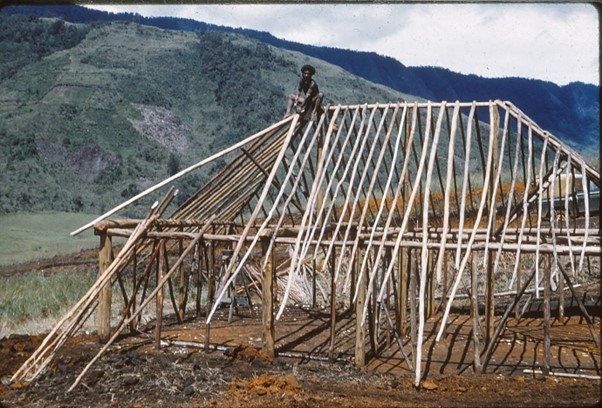


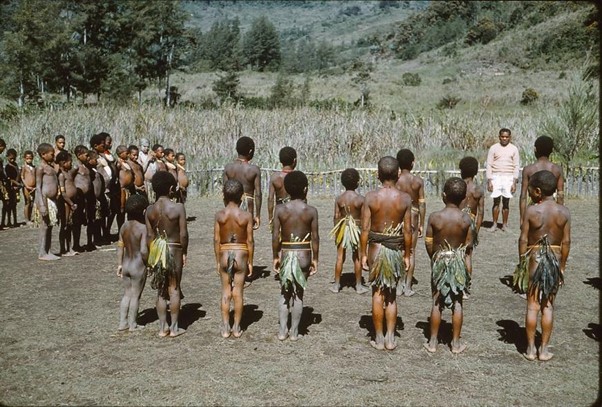


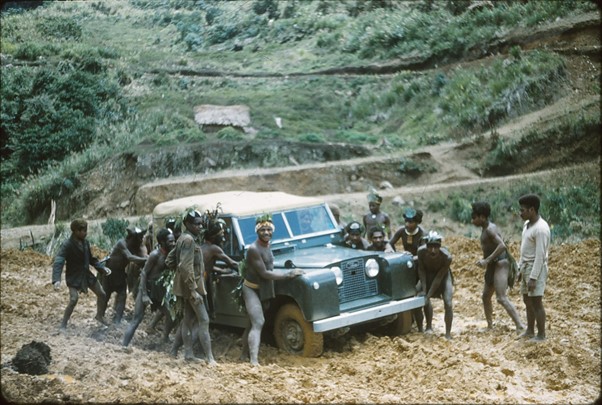


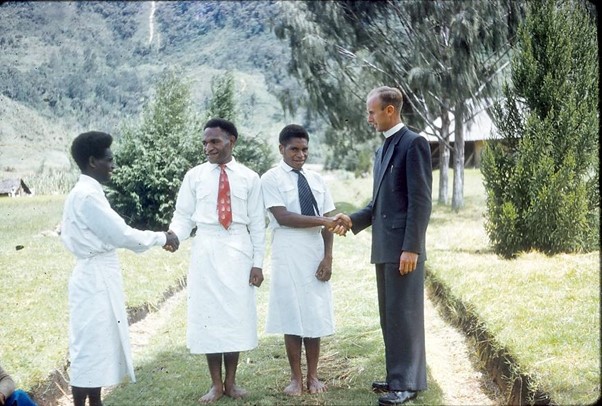


 Margaret Reeson