The people of Mendi were busy with their own lives, their own ideas, traditions and beliefs. They saw that the foreign Methodist mission people, and the Government patrol officers, were living in their valley and making some changes, but most of the Mendi people were more interested in their own activities. The mission staff at Unjamap were happy to see that they were making friends with some of the Mendi people and tried to learn more about them.
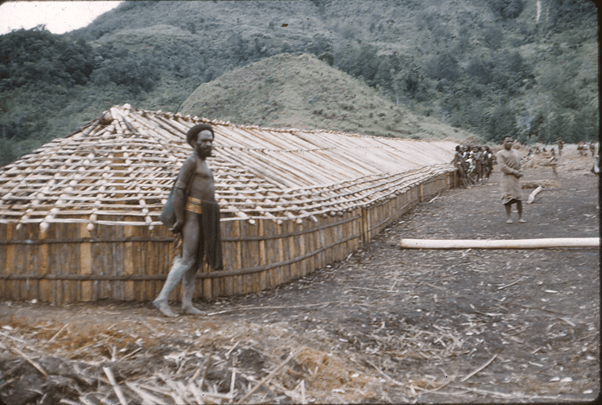
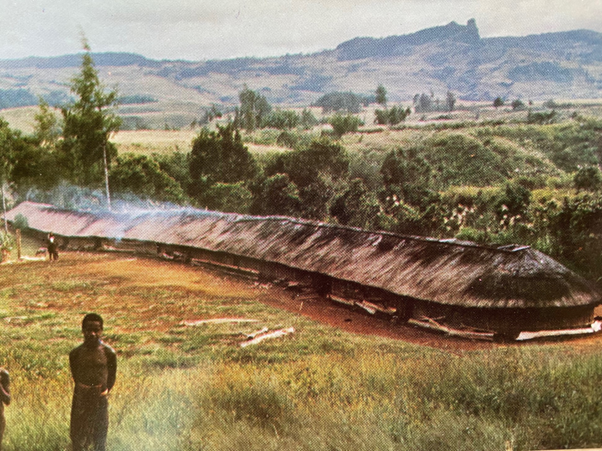
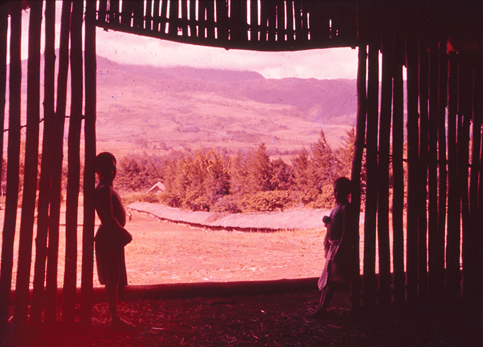
The local men of Mendi were preparing for very important ceremonies to do with the Timb cult early in 1955. For many months they worked to build very long, low houses at their ceremonial ground where many visitors would come to stay. They built an important large spirit house with very big timbers, much bigger than other houses, big enough to show their neighbours how strong and wealthy they were. This was a time for the powerful secrets and ceremonies of the Timb cult. Some men knew the secrets, and these ceremonies and sacrifices were intended to bring prosperity and power to the clans who took part in them. Women and children were not allowed to see or know the secrets but could watch the dances and share in the pig-kill feasts.
When the Methodist group heard that there would be a great gathering of clans at Elemanda, a place high up on the mountain ridge about 4500 metres above Unjamap, some of them decided to climb up to watch the dancing. Grace Young, teacher Elsie Wilson, nurse Elizabeth Priest and builder Gordon Dey set off on that Saturday. Grace Young wrote about what they saw that day. The main pig-kill was on the next day but, on the Saturday, they watched the dancing and as the people ‘feasted on possums and bananas’.
Grace Young wrote:
“After one and a half hours’ climbing, we arrived at our destination just at the right moment. Some of the dancers were already dancing, but others were still being “dressed”. We stood and watched while one was being decorated, and the first item was the pouring of oil all over the body from a gourd (it is a tree oil which they buy from their neighbours). He wore his best “string apron” (onab), and over the top a grass skirt like the women, only each piece of grass about 3 in. apart; brightly coloured leaves as tail feathers; a pearl shell on the back of his neck and one in front (some of them had beads as well as other shells); his best armlets and leg bands; his face was painted with various colours of paint (most of which they get for payment of vegetables, etc., at the Government Station or here—they still use some of their home-made paints); on his head was a flat top wig. and in the centre an ornament made from birds’ feathers, mostly blue and red, also some long bird of paradise feathers at the top; between the ornament and the wig was a paper bark frill and around his ears below the wig was a band of possum fur; on his forehead a “coronet” of tiny shells; in his hands he held his bow and arrows and a long cone-shaped basket arrangement with “rattles” inside (the rattles on inspection proved to be small pieces of tin and stones); these were shaken vigorously during the dancing. (I am not sure of the meaning of all this, but know on other occasions these rattles have been used to send the evil spirits away from the area where the celebrations are taking place).”

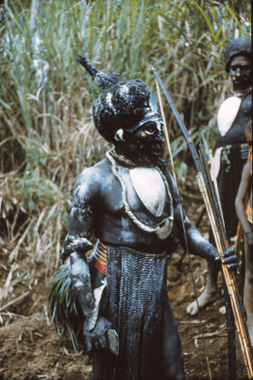
Preparations for sing-sing with charcoal and tree oil, Mendi (Reeson 1962) Symbolic decoration (Reeson 1962)
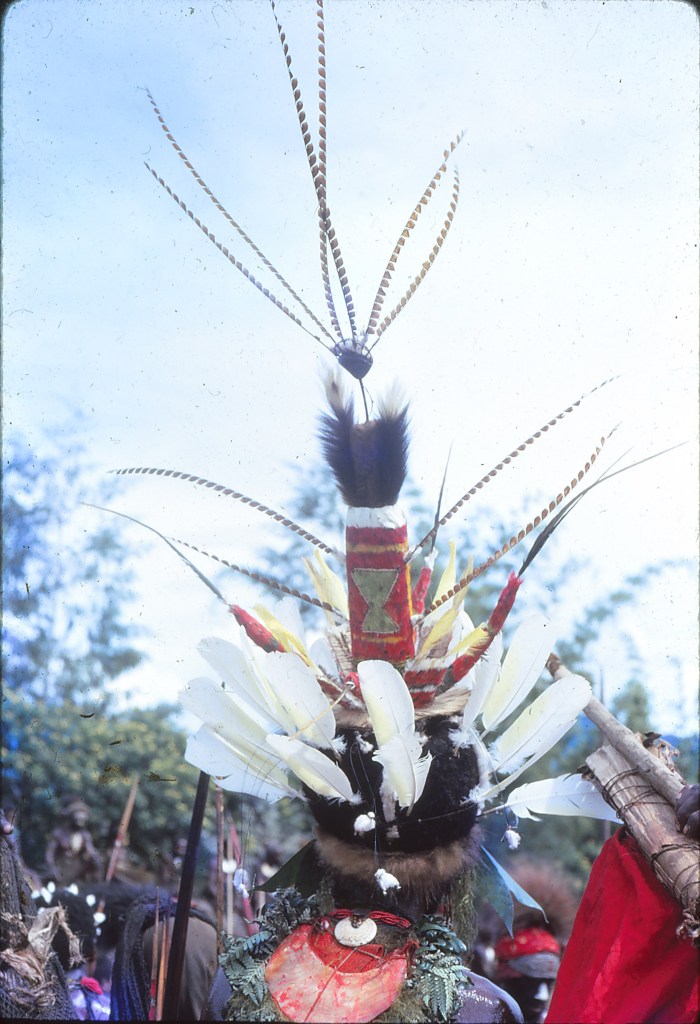
“The dancers were all men and boys, some of the others had put charcoal on top of the tree oil and made themselves black, but the majority showed their gleaming brown skins; some carried their stone axes or had a weapon stuck in their wide bark belts. The dancing is a very serious business, and it seems it is almost a crime to laugh or smile. All the time they were chanting (call it singing). The main ceremonial ground had long houses (guest houses) along each side and in front of these were long rows of stones for heating on Sunday to cook their pigs. At the top end was the Spirit House which was well guarded; no women are allowed into this house, but after the men finished dancing, they took the top knots off their wigs and each one went into the house. By the entrance was a special decorative fan-shaped stand over which the pigs were killed on Sunday (this also has something to do with spirits). All this will show you how much time and thought is put into their ceremonial affairs.“
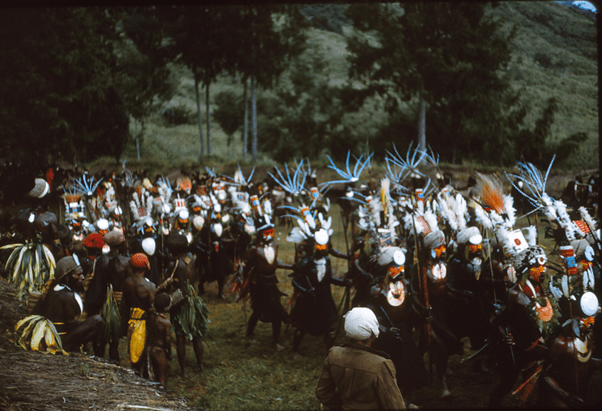
The four from the mission who visited the singsing at Elemanda on the Saturday were shocked to hear that a Mendi leader known to them had been attacked and shot that night.
Sister Elizabeth Priest wrote the story.
“Four and a half years ago when Rev. G. H. Young, the first missionary to the Mendi people, lived and worked alone amongst these scantily-clad, unwashed, primitive highlanders, several of the influential men, leaders of nearby clan groups, showed themselves friendly. Tugurup Mbali was one of these, an intelligent, powerfully-built man with light-brown skin (Mbali means pale-skinned) and twinkling hazel eyes. Fighting, even on the mission site, was a common occurrence in those early days; every man had enemies; and Mbali’s cunning with bow and arrow had earned him perhaps more foes than most. It was genuine fear and distrust of the people across the river that made him adamant in his refusal to accompany Mr. Young to the Government station, a mere mile away.
But four years have wrought a remarkable change in the Mendi people — an external change, that is, not regeneration of heart — we continue to work and pray hard to that end. These days traditional enemies sit side by side in our school and church; they walk unmolested along Government roads where once they would have carried strung bows and cast furtive glances around them as they journeyed; and men, once sworn enemies, now join together on special social and ceremonial occasions.
However, although the Government officers have had fair success in suppressing outbreaks of fighting, something more than “Thou shalt not . . .” is needed to bring the light and dispel the cruel spirit of revenge, of unforgiveness, of hate, that lies beneath the surface in the hearts of many of those who now outwardly comply with Government law.
Tugurup Mbali arrived at the ceremonial ground to join the dance, resplendent in his special “dress”, his light-coloured body completely covered with tree-oil and charcoal. Except that his broad, receding, wrinkled forehead was unblackened, it would have been difficult to recognise him. Four of us had hiked up the 1700 ft. hill behind the mission to the top of the ridge where the sing-sing was in progress and, mingling with the crowds, we talked with many “old friends”. When Mbali learned that no one had offered to give us a piece of pork after the big pig-kill the next morning, he assured us that the pleasure would be his.
It was a very different Mbali we saw only 30 hours later. That night, with the much stimulated crowds asleep in improvised booths, by the light of a pale moon an old enemy of Mbali’s who had waited long for such a golden opportunity, with murder in his heart and a deadly arrow in his bow, crept to the house where Mbali slept and with cool deliberation buried the arrow deep in his chest.
In spite of Mbali’s position in the community, the pig-kill and accompaniments proceeded notwithstanding, and it was not until the next evening, after his friends had cut and gouged in a futile attempt to retrieve the arrowhead, that he was carried in to the mission. He survived the night and it was arranged that a plane come and take him to Madang for operation. It was a pathetic scene in the hospital when, with a great effort, Mbali heaved himself up on one elbow and handed over the promised piece of pork. How many of us would remember such a trifling matter with an arrowhead somewhere in our pleural cavity!
The ward was full of crying relatives who begged us not to send him out as they were sure he would die. It was because we believed he had a fighting chance that we insisted he go, and it was a bitter blow to learn two days later that he was dead. A six-inch sharp-pointed spear head of human bone had been successfully removed from his heart but he had not regained consciousness.
The morning after his transfer to Madang, there was a buzz of excitement through the mission station as word was relayed down to us that a council of war had met up on the ridge. In pre-European days there would have been only one counter for such a cowardly attack — war! But now the Mendis knew their hands to be tied and after a Patrol Officer and 12 native police had visited the assembly, exhorting and warning them, they reluctantly returned home to sit and smoke and discuss the “headlines”.
The tense atmosphere that had held everyone in its grip for days reached a climax when, after many deputations waiting on Administration officers and missionaries, pleading for the return of Mbali’s body, the unprecedented happened and, 48 hours after his death, Mbali’s poor old body was brought back by plane for “proper burial”. For three days, without let-up except after darkness fell, they mourned for their fallen comrade and leader, wailing in strident dirges that carried for miles; they stroked and caressed him; they tore out chunks of their hair; they gashed their ears till the blood flowed; chief mourners amputated a finger joint on their own hands.
“Where has Tugurup Mbali’s spirit gone to?” we questioned a group of elderly men as they sat outside the mission house on their way home from the “funeral”.
Vaguely they waved their arms about, “Here, there and everywhere” was the gist of their reply, “We don’t know.” How intently they listened to the simple truths we told them about God’s good place and eternal life. These men had lost the carefreeness of youth; they had just come face to face again with that grim mystery “Death”.
When Gordon Young wrote his report for 1955, he was able to write about progress in a number of ways. They were not so restricted in travel and now were able to go to many new places every Sunday to preach in hamlets and at ceremonial grounds. They were starting to learn the Mendi language and were able to communicate better than before. He wrote, “There is an ever-growing understanding and friendship with the Mendi people and their children. It is true that attendance is still spasmodic, especially in the Junior School, but one must expect that when living among a primitive people who had never seen schools, nor known reading and writing, until three or four years ago.’ Sister Beth Priest was giving lessons in health and hygiene, and explaining about the human body and simple medicine and they hoped that the children would be able ‘to see the ways whereby they may serve their own people as nurses and medical orderlies in years to come.’
As well as bush-materials houses for staff, a church, a school and a hospital, there were new houses for school boys and school girls, a machine shop and timber shed. The young builder from New Zealand, Gordon Dey, was working on the first permanent building, a fine new office and storeroom with the wonders of an iron roof, weatherboard timber walls and set on concrete stumps. The line of young casuarina trees that Tomas had planted were growing. The vegetable gardens were doing well and David Johnston’s animals were thriving.
But, although all these things were good and encouraging, it was true that the local people were not interested in the message about God and Jesus. They had their own beliefs and customs and these were very strong.
Grace Young wrote:
“I expect you wish to know: has any progress being made in changing the lives of the people? We can truthfully answer ‘yes’. Oh, you say how wonderful. Have some accepted Christ? The answer is no, not yet. By your prayers, you can help this dream come true.“
Margaret Reeson, 2023
Sources:
Grace Young, The Missionary Review—July, 1955—Page 9
Beth Priest, The Missionary Review—October, 1955—Page 4-5
Gordon Young, The Missionary Review—September, 1955—Page 5
Timb cult; women; pig-kill; ceremonies; dancing; sing-sing; decoration; Grace Young; Gordon Young; Elsie Wilson; Elizabeth Priest; Gordon Dey; David Johnston; Tugurup Mbali; Mendi; Elemanda; tribal fighting; attack; revenge; traditional enemies; longhouses; funeral practices; patrol officers; government; language; preaching; school; medical work

