Workers from New Zealand, Germany and Tonga join the mission team
In 1955, the mission team spoke at least six different languages in their homes and tried to learn the languages of the local people as well. They were all a very long way from their homes.
For many centuries, perhaps for thousands of years, the people of the Southern Highlands lived their lives in the mountains. They traded tree oil, salt and shell with near neighbours on local trade routes but knew nothing about people from other parts of the world. People from other parts of the world knew nothing about the people who lived in those high mountains.
Suddenly, this all changed. The first Australian patrol officers walked through the Mendi Valley in 1950. The Methodist missionary Gordon Young went with them. Five years later, many visitors were starting to come. Some came to see a new, beautiful, interesting place. Some came to work, or to take photographs, or to study the culture. These visitors were excited to see a whole colourful world, culture and languages that they had never seen before. They came from many countries, not only from Australia.
At first the Methodist Mission teams at Mendi and Tari were people from Australia, New Guinea Islands and Papuan Islands. By 1954, they were joined by people from the Solomon Islands and New Zealand. A year later in 1955, the team grew even more, with staff from Tonga and Germany. This was the beginning of a beautiful pattern. Christians from very different backgrounds, languages and nationalities would come to serve together in the Highlands of PNG and would discover how much they could learn from each other.
New Zealand friends
Rev C.J. (Cliff) Keightley with his wife Noreen was the first of the Methodist ministers from New Zealand to come to the Highlands. They were appointed to Tari. Late in 1955 they were joined in Tari by experienced New Zealand nurse Sister Edith James. Over the years, many New Zealand Methodists came to the Highlands and they built a strong team with the others. As a sign of this new partnership, the General Secretary of the Foreign Mission Board of the Methodist church in New Zealand, Rev. S.G. Andrews, visited the Highlands for the first time in 1955.
Insert: Reeson 1964 Ministers Rev Cliff and Noreen Keightley (NZ)
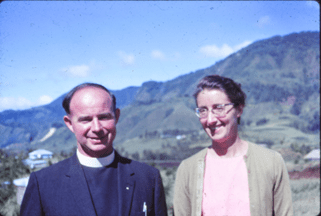
Cliff Keightley had not been in Tari long before he discovered the presence of other newcomers, the Catholic priests from the United States of America. In those years, Catholics and Methodists did not have many things in common and often acted if the other group was a competitor, not a fellow-believer in Jesus.
Keightley wrote:
“Of late we have been feeling very much the effects of the Roman Catholic Mission in the area — they arrived a little before Easter. The Father is a missionary with a wide experience. We give credit where credit is due — he seems to have made remarkable progress in the very short time. However, it has been to some extent at our expense, especially in regard to our school. Almost over-night we lost all but about seven of our 30 boys, due to the fact that the Father commenced to hand out pieces of cloth and other sought-after articles to his school boys. What hurts most was that some of our best boys were among those who went over to him. Up till then we had been building up our school on the basis of the boys living in and not drawing pay. The little work they did on the station we felt was their contribution towards their schooling, and apart from a few issues such as blanket, mug, plate and spoon (theirs to use while they remained with us) they were given nothing except a few rations. But, and in this respect, they are no different from many of us, they prefer to go where they will be given more of this world’s goods.
The incident has caused us not only disappointment, but a great deal of hard thinking. It has driven us to pray more earnestly about our school, and all our work for that matter. It has presented a challenge to us to work harder and make our school even better. Fortunately, our school has grown again, but not on the old basis of school boys unpaid. The boys in the school are now employed on the station on the understanding that they go to school for the mornings”.
It was very difficult for the local Highlanders to understand any difference between the government officers, missions from other countries and other denominations of Christian faith. They were all white-skinned foreigners who had arrived uninvited in their place. Many decades later, Andrew Menger Murubu, a Mendi man who had become a university graduate and political advisor, wrote about the experience of his parents. His parents were among the earliest people to adopt the Catholic Church. He wrote:
“The later arrival of missionaries caused some confusion. My father thought that the Government was the Catholic Church and the Methodist Church were the Missionaries. My father in his arguments emphasised that he was the Government because he attended the Catholic Church. Those who attended the Methodist Church were Missionaries and they were inferior. The Methodist and the Catholic two Christian denominations settled into Mendi almost straight after the first Patrol Officer started establishing the Murumb Station. Missionaries and Patrol Officers were white people and their main focus of their speeches made to the people were concerning restoration of peace and harmony, no fighting and killing each other and no stealing. These were the very strong messages passed on to the people. The local people could not distinguish between the roles of the missionaries and the Government until some years later. The presentation and reading of the bible verses and explaining to the people made my parents and others realise that the work of the Government was different from the work of the missionaries.“
Deaconesses from Germany
Two young women arrived in the Highlands late in 1955 to serve as nurses with the Methodist Mission, one in Mendi and the other in Tari. Cliff Keightley wrote: ‘They are the gift of the German Methodist Church to our work, and it is a real joy to have them working with us.’
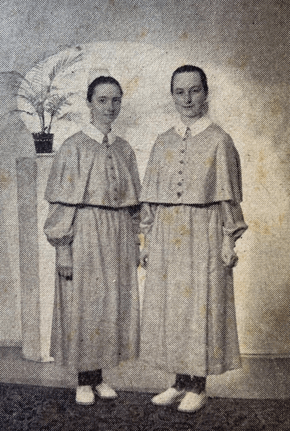
The story of the coming of Sister Lydia Mohring and Sister Elizabeth Kessler was a sign of healing and peace. In the years before the Great War 1914-18, Australian and German missionaries worked well together in the islands of New Guinea when it was a German colony. Sadly, during two terrible world wars, the nations of Australia and Germany were enemies, at war with each other. The German missionaries had to leave New Guinea. At last, when the wars were over, the Methodists in Germany wanted to show a sign of real peace. They contacted the Methodist Overseas Missions Board in Sydney and offered to send two nurses. The two young women were deaconesses who had trained with the Martha Maria Verein Institute at Nuremburg.
Photo: German nurses Lydia Mohring and Elizabeth Kessler (Missionary Review 1955)
‘They are the gift of the German Methodist Church to our work, and it is a real joy to have them working with us.’
Australian General Secretary Cecil Gribble wrote: ‘The German Church has never forgotten the need of the people in New Guinea and through the years the missionaries, now grown old, have kept in touch with us and have continually assured us of their remembrance and prayer… When the threads of fellowship began to be gathered up again and the wounds in the body of the Church began to close and heal, the leaders of the Deaconess Order wrote suggesting that the missionary ties be re-established.’
It was a long, complex process to prepare for these women. Their training was very thorough. As well as Biblical studies, the women were trained in nursing, midwifery, and psychology and other practical skills at the Mother House of the Order, the Martha Maria Institute. This was one of three centres which trained 450 deaconesses in Germany. They also studied tropical medicine in Hamburg and improved their English language in England. When they were ready at last, they were commissioned for their new work at a great service of farewell in their Mother House in Nuremberg.
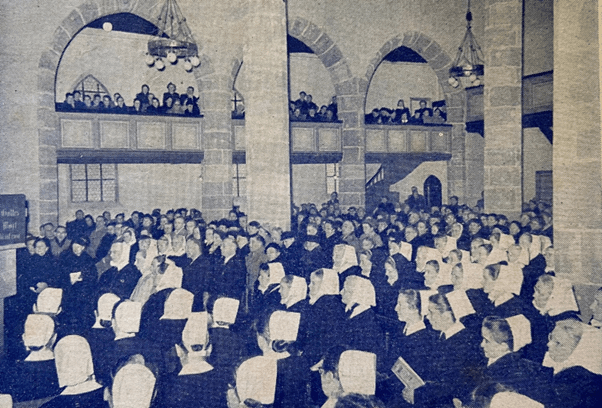
Elizabeth and Lydia, from their community of women and wearing their distinctive uniform, were travelling a very long way from everything that was familiar. They sailed for Australia on the ship Oronsay, and, after visiting some Australian cities, arrived at last in the Highlands. Cecil Gribble wrote of them: ‘In Australia we will surround them with our prayers and friendship and one and all thank God for this further proof of the supra-national qualities of the Gospel and its power for the healing of the nations.’
Cliff Keightley reported the arrival of the German nurses. He wrote:
“Just over a month ago we were pleased to welcome Sister Elisabeth Kessler, one of the two German Deaconesses who have come to the Highlands (Sister Lydia Mohring went to Mendi). They are the gift of the German Methodist Church to our work, and it is a real joy to have them working with us. Sister has already found her niche, and is busying herself in setting up the Hansenide work. Already she has six lepers (all in the advanced stages) to attend to daily, but so far, no building to work in. That is one of our building priorities and we must get on to it as soon as we have completed the new sister’s house and the infant and maternal welfare block. There is estimated to be a fairly large number of lepers in the area and they certainly need our help and prayers.”
(The disease of leprosy was quite common in the Highlands at that time. People used to speak of people with leprosy as ‘lepers’ but changed the language to call it ‘Hansen’s Disease’ and the special hospital ‘The Hansenide Centre’. Later, the language changed again to the ‘Leprosy Hospital’ as people began to understand more about the disease and that people with the disease could be treated and healed.)
A New Friend from Tonga
Christian Methodists from Tonga understood what it was like to be a missionary people. Their own people had heard the Christian gospel from missionaries from 1822 and Tongan missionaries carried the good news of Jesus on to other lands over many years, including to Samoa and Fiji. One of these was a missionary called Rev David Mone. His first mission appointment was to Salamo in the Papuan Islands. When war came to his district, the Australian mission staff left the region. David Mone stayed on in the islands during the years of war and became widely known to men of the Allied Forces in Milne Bay, where he was able to give help and hospitality at his station at Salamo.
After the war, Mone spent a year of study at Kings College, Brisbane and then was appointed as a Tutor at the Theological College in Tonga. He offered to serve in the new Mission in the Highlands and was appointed first to Tari and later to a new area in the Lai Valley.
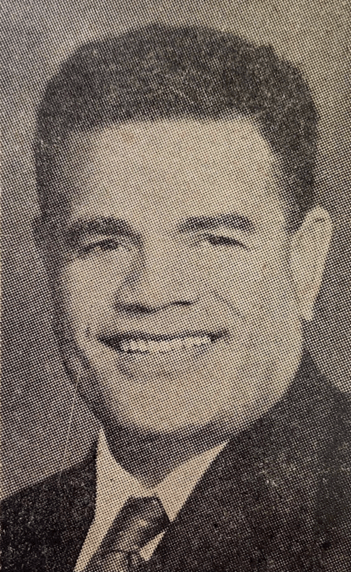
In 1955, the mission team spoke at least six different languages in their homes and tried to learn the languages of the local people as well.
So now the picture of the staff team for work in the Highlands was becoming clear. It was a team of men and women from very different places in the world. In 1955, the mission team spoke at least six different languages in their homes and tried to learn the languages of the local people as well. They were all a very long way from their homes. They had felt God’s call and offered to serve in this new Mission and so they learned to work together and to trust each other.
Margaret Reeson, 2023
Sources:
The Missionary Review—October, 1 9 5 5 — P a g e 1 5
Andrew Menger Murubu, ‘Stone Age to Corruption‘ (c.2020)
The Missionary Review—October, 1955—Page 14
The Missionary Review—January, 1955—Page 15
The Missionary Review—April 1955—Page 4
Cliff Keightley; Noreen Keightley; Edith James; Lydia Mohring; Elizabeth Kessler; Cecil Gribble; David Mone; Rev C.J Andrews; Andrew Menger Murubu; Mendi; Tari; Lai Valley; Nipa; Murumbu; New Guinea Islands; Papuan Islands; Solomon Islands; Tonga; Germany; Methodist Overseas Missions Board; Foreign Mission Board of Methodist Church of New Zealand; Deaconess Order; Martha Maria Institute Nuremburg; leprosy; Hansenide clinic; trade; patrol officers; government; language; Catholic Church; priests; Salamo; Kings College Brisbane

