23 Hope, disappointment and new hope, 1960

Our missionaries are doing a great job but, if their numbers were doubled, they would only be touching the fringe of this field.  Rev Harry Bartlett, visitor to Highlands on behalf of MOM 1960

The cutting edge of the church’s advance is the witness and work of the island missionaries. Missionary Review March 1958

The rain was pouring down that night. It had been raining for days and now water was leaking through the thatched roof. The people in that room were very tired. They had been meeting all day. It was late at night now but they were still not finished. The Methodist Quarterly Meeting in Mendi was at work in September 1960.

Some things were going well but they also had some big problems. They were feeling happy about some things. In the annual report from the Highlands for 1960 they were able to report on the beginning of the new Methodist mission in the Nembi Valley at Nipa to the west of the Lai Valley. At last, the government officers said that it was safe enough for them to start a new mission in that place. That was good.

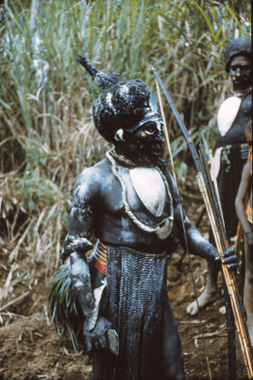
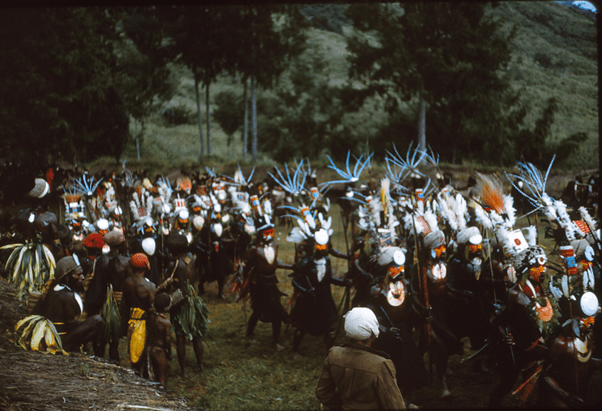
It was not so good that there was very little progress in their main work. They had come to introduce the good news of Jesus to the people, but not many people were interested. In Mendi, many of the men were very busy with everything to do with the cycle of Timb cult activities, with planning for big exchanges of wealth and the secret spirit business. In Tari, at the time when the mission was preparing for their annual Thanksgiving Day, many of the local people were more excited about the traditional mali sing-sing as they prepared for the initiation of young men. The new minister John Rees described the crowds of thousands of excited people with beautifully decorated dance groups. He wrote:

At 2.30 am the next morning we went to the Tege house, specially constructed for the initiation where we watched part of the initiation. A platform ran down each side and a long fire was lit along the centre. Men stood on the platform with bundles of switches and, as at regular intervals, a boy ran down the centre over the fire, the men chanted and struck him with switches.

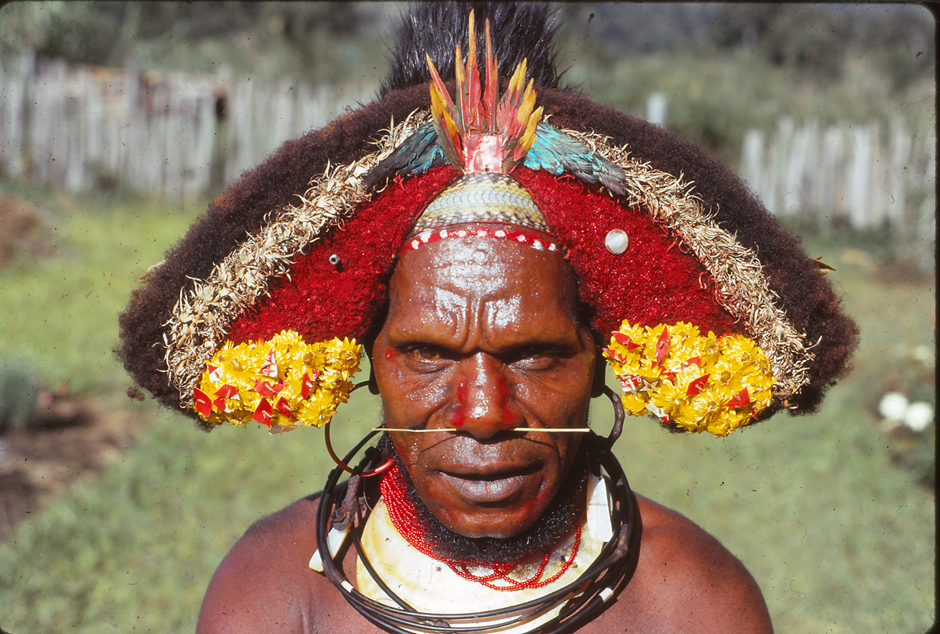
1960 Sing-sing at Hoiebia, Tari (J.Rees 1960)

The mission staff in Tari were working hard on language learning and had translated Bible lessons in Huli language for use in the Sunday Schools and day schools, as well as stories from both the Old Testament and New Testament into simple English. The teacher in Tari, John Hutton, wrote that a few of the school students were ‘thinking seriously about the claims of Christ.’ In Mendi, a few people attended literacy classes there but not many were very successful. David Johnston was doing his best to translate the Gospel of Mark, and David Mone was also doing some translation, but both of them were having problems with finding the best way to spell the words.

Now, on that wet night in September 1960 in Mendi, they were happy that, at last, a few people were starting to ask questions about following Jesus Christ. The first people to become Christians in Mendi were a medical orderly, Wasun Koka, an older school boy, Sondowe, a school girl Wesi, and Tundupi, a senior man from Kamberep. The members of that church meeting were very happy to agree that these people could start preparation for baptism. David Johnston was really happy about all of them. He knew Wasun well and also knew Tundupi from Kamberep. When a pastor was first stationed at Kamberep the local people did not want to welcome him because they had bad experiences with other outsiders. Johnston remembered sleeping there ‘in a camp full of fleas, flies and dust and being surrounded day and night by Mendi people of all shapes and sizes. They insisted on poking inquisitive faces into the camp no matter what I was doing. It was a pleasure to compare those days of unfriendliness with the present friendliness and honest openhearted welcome’.

The mission staff were happy about the new Christians, but they had a problem. Who was going to help these new Christians? Just when they were needed most, a number of experienced staff were leaving the Highlands at the end of their time of service. 

At the beginning of 1960 there were five overseas ministers working in the Highlands; Young in Mendi, Barnes in Tari, Keightley in Nipa, Mone in Lai Valley and newcomer John Rees who planned to go to a new station out of Tari. There were also mission teachers, nurses, builders, an office secretary and an agriculturalist from Australia and New Zealand. They all knew that the mission families who had come to the Highlands from the coastal regions to work as pastors were very important to the work. When a visitor from Australia, Rev Harry Bartlett, was in the Highlands that year, he reported that ‘Our missionaries are doing a great job but, if their numbers were doubled, they would only be touching the fringe of this field.’  

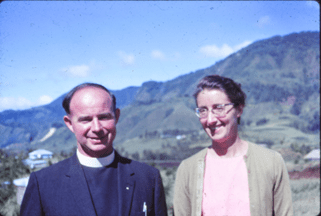
David Johnston, Roland Barnes with visitor Rev Harry Bartlett 1960 (J.Rees 1960)

The visitor Harry Bartlett was correct to say that they needed more staff. The annual report for 1960 masked the real situation. When it stated that ‘thirty-five missionaries serve in the Highlands’, only eight of those came from Australia and four from New Zealand. Twenty-one of the mission staff were the excellent men from the islands of New Guinea, Papua and the Solomons.  These men and their families were faithful, courageous, hardworking people who had chosen to live sacrificially in isolated and demanding places. But their education was very limited and none of them had been given key leadership roles at that time. It was very different in other mission districts under the leadership of Methodist Overseas Missions in Australia. In 1959, for example, there were 34 Australian members of staff working in Aboriginal communities in North Australia compared to seven in the Highlands. In other Pacific Districts there were far more Australian clergy than in the Highlands and they shared the work with large numbers of trained local staff. That same year, MOM invested just under £200,00 (like $7 million Australian dollars in 2024) in North Australia and just over £14,000 (like $493,000 Australian dollars in 2024) in the Highlands District. For a new mission trying to establish its work, perhaps it seemed that they were not being taken seriously by their sponsors.

In 1959, they had a small staff team. By the end of 1960, the team was even smaller. There were only two ministers left and other pioneer workers who had learned the language and had experience had also gone back to their homes. Gordon Young in Mendi went on leave in February 1960 but retired in October and did not return to the Highlands. Roland Barnes in Tari became very ill and was evacuated to Port Moresby and then to Queensland during 1960; he was not able to return to Tari. David Mone, after many years of missionary service, returned to his home of Tonga at the end of 1960. Cliff Keightley was the only minister left with any experience in the Highlands and he was very busy as pioneer of a new mission at Nipa and now as Acting-Chairman. The new man, John Rees, had only arrived in the middle of 1960. Now, instead of going to a new place in the Tari area, he was sent to Mendi to fill the unexpected vacancy left by Gordon Young. 

As well as the loss of ministers, some of the pioneer group to Mendi, who had been learning the language and getting to know the people, were also going back to Australia. Teacher Elsie Wilson left in 1957 and nurse Elizabeth Priest left to be married the same year. The latest one to leave was David Johnston, who was leaving the day after that September Quarterly Meeting in 1960. It was very sad but true; the team at Mendi had not been happy together for some time. It was hard to work and live together when they did not agree with each other and often upset each other. 

Agriculturalist David and Beryl Johnston and teacher Rosalie Sharpe ready to leave Mendi 1960. (J.Rees 1960)

There were so many changes in a short time. The biggest change was that both Gordon Young and Roland Barnes left the Highlands in the same year, 1960. Nobody was expecting that. For nine years, Gordon Young was their leader and reports said that he had ‘carried the main burden and given outstanding leadership’. When Gordon and Grace left Mendi in January 1960, they looked forward to attending a big church conference in Melbourne and then going on a long trip overseas. Rev Roland Barnes was going to be Acting-Chairman while they were away. They did not know that Roland Barnes would be sick and have to leave the Highlands, too. They did not know that they would not return to the Highlands for ten years.

Something seems to have changed. Perhaps Gordon Young was beginning to feel tired and discouraged. He had been working hard ever since his first long walk into Mendi with the patrol officers in 1950. The local people were not interested in his message about Jesus Christ. The language was complex and he was still not fluent in speaking it. He had walked so many miles over mountains and through rivers and mud, trying to make contact with people, but they seemed to him to be stubborn and only interested in material wealth not in the wealth of the spirit. There were times when it was much easier and more rewarding to put his energy into working with the Australians who were working in the region as patrol officers, medical officers, agriculturalists, engineers and the rest. He joined the committee of the local Mendi Valley Club in the small township and was welcomed and popular there. These men appreciated his background as a Rat of Tobruk and soldier, and his work as chaplain to captured Japanese soldiers in Rabaul in the immediate post-war period. Gordon and Grace had always offered hospitality to the patrol officers in their home, from the first pioneering days. 

He became more and more discouraged and despondent about his mission work. Even though a new secretary, Joyce Rosser, came from New Zealand to help him with the correspondence and other secretarial work, and he had a new office building, he seemed to lose interest in the daily work. Even when the latest new mission was opened in Nipa, he walked across the mountains from Mendi to Nipa with the minister who was to pioneer this new work, Rev Cliff Keightley, but left again after two days instead of staying for a few weeks as he had done with earlier new mission stations. Young decided that he would take responsibility for the mission finances, but found this job quite difficult and the financial records were sometimes in a muddle. A member of staff recalled finding him in the mission office with other work incomplete, tidying his paper clips and rubber bands.

In a staff meeting after the Youngs had gone on leave, his colleagues made a decision. They sent a recommendation to the Mission Board. When Gordon Young returned to Australia after his overseas trip, they suggested that it would be better for him, and for the work in the Highlands, if he moved to an Australian ministry as a fresh start.

In October 1960 the MOM Board announced that Rev Gordon Young had retired from mission work. Perhaps, looking back, Gordon Young was the right person for the tough, physically and mentally demanding work of the pioneer. A man of great physical strength and courage, he was able to achieve heroic feats of long mountain patrols on foot, travelling to places and facing dangers that would have defeated many others. Perhaps the time was right for change as the work moved into the next stage.

Ten years later, in 1970, he and Grace Young were welcomed back to Mendi with honour for the twentieth anniversary of the Church, as the pioneer minister. During that visit, he was invited to baptize a group of new Christians, a privilege he had not experienced in his long years of service. Gordon and Grace returned for other anniversaries, including the great event in 1990 to celebrate forty years. Still strong and erect at 78 years of age, Gordon re-enacted the legend of the time when he walked back over the repaired vine bridge to Unja in 1950.

Rev Gordon Young baptising new Christians in Nipa in 1970 (Reeson 1970)

One of the special ceremonies at the 20th anniversary was the unveiling of a memorial plaque at Unjamap. A big crowd of people walked together up the hill to Unjamap to watch. Gordon Young, with the help of his first partners in the mission in the Highlands, Pastor Kaminiel Ladi and Pastor Tomas Tomar, unveiled the memorial stone together. The two pastors from New Ireland served the church in the Highlands for more than twenty years. Gordon Young said, ‘Put their names first on the memorial plaque.’

Unveiling memorial plaque on 20th anniversary of mission, 1970. From left: Sister Joyce Walker, Kaminiel Ladi, John Angello, Gordon Young, Tomas Tomar, Fred Baker.
Gordon and Grace Young visiting Mendi for 30th anniversary in 1980  (Mahy 1980)

Rev Gordon and Grace Young never forgot the people of Mendi. Back in Australia, he made a further contribution as chaplain of Prince Alfred College, Adelaide, held senior positions with Better Hearing Australia and was awarded RSL ANZAC of the Year Award in 1990. Both Gordon and Grace Young gave extended interviews to people who were writing the stories of Mendi in ‘Torn Between Two Worlds’ (Reeson 1972) and ‘A Bridge is Built: a Story of the United Church in the Highlands of Papua New Guinea’ (Wood and Reeson 1987).

After their deaths, the ashes of Gordon and Grace Young were returned to Mendi, where they are remembered with great honour and respect. Their memorial stones are at Unjamap, near where they lived when they were pioneers from 1950. 

Memorial for Gordon and Grace Young at Unjamap, Mendi (Reeson 2001)

Rev Harry Bartlett, Missionary Review January 1961
Margaret Reeson, Torn Between Two Worlds, Kristen Pres, Madang 1972 p.61
Missionary Review July 1957 p.11
Missionary Review July 1957 pp2-4
Missionary Review March 1958
The Open Door Vol.50 No.2 September 1970 pp.9-10
Joyce Rosser, Missionary Review January 1960
Missionary Review February 1959
Missionary Review March 1961
22. Slow progress, 1957-1959

1957-1959

District Report 1957.

Seven years of work among one of the most isolated and primitive peoples in the world has not yet reached the stage when converts can be listed.

In the persons of the missionaries, European and Pacific Island, the church is there. But it is there in order that an indigenous church may be born. So, the missionaries preach and teach and serve in the faithful anticipation that conversions will come, and the church will emerge.

District Report 1958

The mission still awaits its first converts.

District Report 1959

There is a greater willingness to hear the preaching, to ask searching questions about the faith and to join in public prayer. Missionaries believe that God’s Spirit is at work among the people, although definite decisions have yet to come. 

When the MOM General Secretary Rev Cecil Gribble visited the Highlands again in 1958, he reported ‘It was an incredible experience to visit the area recently and to see the change that has taken place in seven years.’  Gribble first visited Mendi in 1951, when Gordon Young was just beginning the work. Now he was impressed to see the medical work, the schools and the agricultural work. Of all the mission activities, the thing that most interested him was the way in which the men and their families from Tonga, New Guinea Islands, Papuan Islands and the Solomon Islands had moved out from the centre to establish new stations. Gribble wrote:

These men, with their wives and children, have gone over mountain ranges into distant valleys, accepting hardship and difficulty with courage and faith. They have built churches, schools, and homes for themselves, and live near to the people—serving, helping and loving them.

This great new work of our Church could not have been done without them.

One example of these men was the Solomon Islander Burley Mesepitu who was the first pastor to live at Kamberep. Another visitor, Mabel Wyllie, who saw his work wrote: 

‘As well as training his children to be literate in his own language, he is attempting to keep abreast of the Government syllabus, which is in English. On Sunday he has several preaching places in his care, and at the present time he is supervising the erection of a church which is being built beside the teacher’s house. And in his spare time, there is his garden to cultivate.’

Why did the Highland people not want to listen and respond to the message of the missionaries’ teaching about God and Jesus Christ? 

The mission staff were not lazy. There were a number of reasons why the Mendi and Huli people did not take the missionaries’ message seriously. Here are some of the reasons.

First, this teaching was foreign. It was something that belonged to the white people, and to the pastors who came from other places with other languages and other cultures. It did not belong to the people of the mountains, or so they thought. They were interested and curious about it but it was strange and different from what they knew about the world.

Another reason was language. In 1957, the missionaries reported that every week ‘in the churches at the central stations and in scores of gathering places in the bush several thousand are hearing the wonderful words of life’. But what were they really hearing? Not many of the preachers could speak the local languages of Mendi and Tari. The ones who could speak some local language often made mistakes and so their message was very confusing. In Mendi, for example, the two best linguists and speakers of Mendi Angal were agriculturalist David Johnston and teacher Elsie Wilson. David Johnston often went out preaching and Elsie Wilson worked with the congregation at the head station at Unjamap. But not many of the others who went out preaching every week could speak clear messages in Angal Eneng. In Tari, Roland Barnes spoke Huli language well and John and Barbara Hutton were learning quickly. But both languages were difficult and complex and so it was easy to make mistakes. The Christian message was very confusing for the people to understand.

A white missionary and a local man trying to communicate 1960 (Reeson 1960)

It was not only language. The Highland people had their own way of understanding the world, and it was not the same as the outsiders from Australia or the Solomon Islands or Germany, for example. There were many misunderstandings. Visitor Cecil Gribble wrote in 1958, ‘Today these strange, strong, primitive people know why the Church is here. In a simple way they are asking to know more of God.’ But it was not clear to most of the Highland people why the church had come to their land. They were interested in the practical skills and useful things that the newcomers brought. Some people wanted to learn to read. Metal spades and axes were sharper than digging sticks and stone tools. But they were puzzled, and not very interested, in the message that the missionaries were trying to tell them.

Dabuma, a man who was a young boy in Tari when the missionaries arrived there, remembered those early days. He told his story in 1970. He remembered the coming of the first missionaries to Hoiebia.

On their arrival we were a bit frightened to go near them because we thought they were the same as the government.  The thing that was different was that these men had no guns. At that time, I was about 12, so I was there too. These missionaries were kind to us and tried to make friends with us. When we saw this, we started to come to them, and they began to learn a few words of our language.  … We started to help them to build their houses, and after the houses were finished, they looked for some boys to work in their kitchens, so they found me and two others…

On Sundays, they preached the gospel to us, usually about 30 people coming. When the missionaries prayed to God, we covered our faces with our hands and kept watching them. 

[Roland Barnes and two pastors] continued their work, preaching the gospel and building the houses for those who came later to do the work of God there. These men tried their best to be one with the people there. When the people saw this, they were very happy to join them and do the work that needed to be done.  Every afternoon they learned some of the Huli language and taught us about the Lord Jesus. … Later, two missionaries came from the Solomon Islands. Alpheus Alekera and John Pirah. We were afraid to talk with them because of the colour of their black skins, but Alpheus Alekera started the school, and I attended with some others. …

I was with the mission for quite a long time, but I didn’t have any idea about Christianity. I only tried to do good work to please the missionaries, and I tried to get good things from them such as axes, knives and sing-sing paint. I went to school with the other boys and girls, but the school was meaningless to me, so often I asked my teacher to let me go home.

Solomon Island Teacher Alpheus Alekera with youth in Tari. (Missionary Review 1954)

It was true that preachers went out every Sunday to tell the gospel story. By 1958 and 1959, they counted about 65 preaching places across the whole region of Mendi and Lai Valley, with more in Tari. These preaching places were scattered and often difficult to reach by the small teams of preachers. A ‘preaching place’ was often a clan ceremonial ground where local people gathered outdoors. When the preacher arrived, a man would send out a loud call or yodel, calling the people to come. When some people came to listen, the preacher would tell a Bible story, pray and perhaps sing a hymn and would then hurry on to another place. Strong men like Gordon Young walked for many miles on a Sunday to preach in distant places. There were only a few of them who were able to do this. This was very hard work, but it meant that they only stayed in each place for a short time. There was no time for the people to ask questions or try to understand the message.

Methodist preacher preaching at a ceremonial ground, Mendi. (Reeson 1965)

Another reason why people were slow to take the Christian message seriously was because they were often busy with tribal fighting. Although the coming of the patrol officers had slowed down fighting in some places, the clans were still eager to fight. When one clan offended another clan in any way, the men would go to fight, to burn houses and wreck gardens. There was always ‘payback’. 

Armed men ready for tribal fight. (Reeson 1990)
Armed men on rooftop watching for enemies. (Reeson 1990)
Property destroyed as result of tribal fighting. (Reeson 1990)

In 1959, teacher John Hutton wrote about tribal fighting; ‘The gardens are frequently deserted and we are told “They’ve gone fighting.”’ Dabuma remembered, ‘I went and joined my people to fight with other groups.’

The Highland people were busy with many other things related to their own customs. They continued to trade in tree oil, salt and shell with trading partners in distant tribal groups. They were very interested in listening to traditional stories told by skilful orators. There were ceremonies of initiation for youths. They worked in clan groups to build houses, or start new gardens. When anyone was sick, the first step was always to decide who had caused the sickness. Was it sorcery by an enemy or an attack from the spirit of a dead family member? When it was clear who had caused the illness, they needed to make suitable sacrifices of pigs. The people were also busy with traditional marriage ceremonies, funerals, festivals of pig kills, displays of wealth such as cassowaries and preparations for sing-sings. 

Most importantly, they had their own traditional beliefs and rituals.

Dabuma remembered

  Sometimes I went and learned more about culture from our leaders and I had to conduct spirit worship. Most of my time I was busy studying these things. Sometimes I didn’t come to school for two weeks. When I came to school again, my teachers used to ask me, “Where have you been, my boy?” I usually told them that I got very big sick when I got home.  Other times I told them my parents stopped me from coming back quickly. My teachers knew what I had been doing, but they never sent me out from school. 

In the 1950s, anthropologists from Australia and other places were very interested to learn about the customs and culture of the people of the Southern Highlands. One Australian anthropologist, D’Arcy Ryan, went to live and study the people in Mendi from about 1955-1958. Ryan spent some time visiting with the staff at the Methodist Mission, although he was not a Christian himself. He didn’t understand why they were trying to bring Christianity to Mendi and questioned their motives. He was more interested in the beliefs of the Mendi people and asked many questions about the important Timb cult.

According to Ryan, rituals and beliefs about sacred stones were common across the Highlands region. In the past, perhaps forty years earlier, the people of Mendi had followed another cult about sacred stones, but had given that up. Now the rituals of the Timb cult had become important in the Mendi Valley. Ryan wrote:

 Timb is best described as a secret men’s ritual centred around the sacred stones and is devoted to the propitiatory sacrifice of pigs to the ancestral ghosts. …

Mendi religion consists almost entirely in propitiation of family ghosts by sacrifice of pigs. Sacrifice for a sick person is seen as an offer of alternative food which it is hoped the ghost will find more attractive than the patient. When a person is sick enough to warrant sacrifice, a divination service is held to determine first which ghost is biting him, and second, where and how the pig will be sacrificed… 

There are other stone cults throughout the highlands and so, although the Timb cult itself is new, the idea of stone cults in general is old and widespread. Thus, when Timb finally came to Mendi, the ground was already prepared for its acceptance. Timb entered the Mendi valley from the south and by 1950 had moved up as far as the present government station [Murumbu]. By August 1954 it moved a further 5 miles north and by 1958 another 3 miles. 

When a clan decides to introduce Timb, it must buy the ritual from a group which already has the cult. This first part is paid for in a number of installments over a number of years, and the donor clan will teach the ritual and spells and also assist in the building of the Timb house. Timb comes in several stages, each taking several years to complete. First of all, the Timb heads are selected by the donors; these men must be strong and in the prime of life and rich enough to afford the necessary payment. Each Timb head has his own special portion of ritual which will not necessarily be known to his fellow heads.

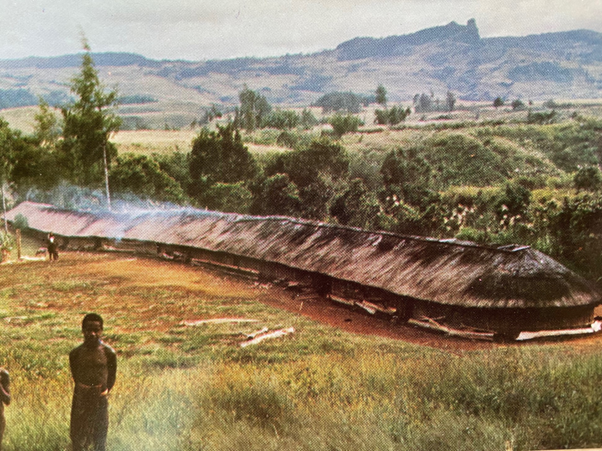
The people at the Methodist Mission knew that the Mendi people were very busy with everything related to the Timb cult. When there was illness or accident in their families, they always wanted to make the correct sacrifices to the family spirits instead of asking for help at the mission hospital. They were interested and busy with the building of large Timb houses, that were much bigger and higher than their own houses, as well as the longhouses prepared for guests at important parts of the ritual. It was always exciting when the people of many clans met to prepare for sing-sings, and big ceremonial pig kills. There were festivals when they displayed their wealth of pigs, cassowaries and pearl shell. There was always drama and colour and display. When many clans met together for these festivals, there was economic exchange, reminders of unpaid debts, symbolic dress to send messages to allies and enemies. There was also the excitement of secrecy, with some important men holding the secrets. Women and the uninitiated were always excluded.

Timb house under construction in Mendi Valley  (Smith 1963)

Insert Gepp 1971 custom Timb cycle Mendi. 

A Timb house in Mendi (Gepp 1971)

Insert: Reeson 1964 custom singsing Mendi

Important traditional sing-sing in Mendi 1964 (Reeson 1964)
Exchange of wealth in shell and oil, Mendi (Reeson 1965)

It was not surprising that the people of the Highlands had little interest in the message of the missionaries. Their world was busy, colourful and understood. The anthropologist D’Arcy Ryan wrote that the Timb cult would continue for some years and then be replaced by something else. He wrote:

In succeeding repetitions, the first aura of secrecy wears off and the performance of the ritual becomes more slipshod. The people become bored and the whole thing begins to run down. After five or six years it is decided to wind up the first stage of Timb. In the wind-up ceremony there is no secrecy except for the section in which the seeds of the chief food plants are be-spelled and buried inside the house. It is a big function with many pigs killed accompanied by a full dress dance. 

This ends the first stage of Timb. Next comes Lunk for several years then Timb again, this time it is permanent until a new stone cult comes in to take its place.

For that time, then, in the 1950s, the missionaries kept on working and preaching and teaching but there was no sign that anyone was very interested.

Cecil Gribble ‘Brown Missionaries have the authentic Word of God’ Missionary Review December 1958
Mabel Wyllie Missionary Review October 1957, pp6-7
The Open Door, New Zealand Methodist Church, Vol.50 No.2, September 1970. Pp 9-10. Special edition to mark twentieth anniversary of mission work in PNG Highlands Region
John Hutton, Missionary Review February 1959
D’Arcy Ryan, anthropology thesis, 1959 (?). In 1961, Margaret Reeson saw a copy of this thesis at the then missionary training college, All Saints College in Haberfield, Sydney, and copied passages from this thesis as preparation for working in the Highlands

21. New contacts in the Lai Valley, 1957

1957

Two visitors came to the mission at Unjamap in 1954. They were curious about these strange white people. They saw many signs of change and new things on the mission site. New gardens, large foreign buildings built in ways that were different from the traditional Mendi style.  There were strange animals, voices speaking in other languages, people wearing unfamiliar clothing. The school and the hospital were very surprising to them. These visitors explored the government station, too, and were interested in everything they saw.

Where had they come from? They explained that they had come from their home beyond two mountain ranges to the west of the Mendi Valley. A river ran through their home valley and they called it Ip Lai, the Lai River. They were a long way from home. These men were very brave to come into enemy territory to see these strange things. They had heard rumours but wanted to see for themselves.

‘Come to our valley’, they said, ‘and bring some of these new things to us.’

Gordon Young heard them and wanted to send someone. But at that time the Lai Valley was restricted territory and even the government patrol officers had not gone there yet. They took a photo of the men from the Lai Valley and did not forget them. They had to wait.

Two visitors from Lai Valley in 1954 (Missionary Review, January 1955)

A year or two later, Gordon Young was invited to go with a government patrol, led by District Commissioner Gerry Toogood, to explore some new areas. For the first time, he walked with the patrol to the west, crossing first one range, then a second one and climbing down the steep limestone cliff faces into the Lai Valley. They found a large population of people living along the valley. The patrol kept walking west, crossing another series of mountain ridges into the Nembi Valley to Nipa, then on to the south to Lake Kutubu and Ialibu. At last, they arrived back at Mendi. Young had flown over some of these places by plane on his way to Tari, but now he saw and met many new groups of people on the ground. He began to hope to start new mission work among them.

Gordon Young was a very strong man and went on many long patrols. On Sundays he sometimes walked as far as twenty miles to preach in a number of different preaching places. His physical strength was important as he was able to lead new initiatives in remote places. 

After that first patrol into the Lai Valley, Young returned there in 1956 with David Johnston and Tomas Tomar. This time they went to find a place where they could start a new mission station. The patrol officers had decided to de-restrict the Lai Valley so now it was possible for the mission to enter. The patrol officers negotiated with the local people for a lease of land at Tukup on the eastern side of the swift-flowing Lai River. The valley was long, with the river running between high walls of limestone cliffs. The people living there had been quite isolated because it was not easy to climb beyond those walls.

Lai Valley, view from eastern ridge (Reeson 1962)
Lai Valley Limestone cliffs with pandanus palms (Reeson 1964)
Limestone cliff and Lai River (Smith 1964)

The first pastor-teacher to be appointed early in 1957 to the Lai Valley, at Tukup, was Tomas Tomar from New Ireland. Tomas was a simple man, strong and faithful, willing to take the risks of being a pioneer in new places. He was not well-educated and struggled to speak the Mendi language but he earned the respect and love of both missionaries and the local people over many years of service in the Highlands. As a single man, he was prepared to go to difficult places and to open the way for others to follow.

Pastors Tomas Tomar from New Ireland, Sekri To Vodo from New Britain in Lai Valley (J Rees 1962)
Pastor Sekri To Vodo and family ready to walk to Homep in Lai Valley (J. Rees 1962)

It was clear that there was a big population of people in the Lai Valley. The Methodist mission decided that it was important to open other pastor stations as soon as possible. A new place was opened by pastor Sekri To Vodo, from New Guinea Islands, at Homep in the north of the valley, and then another was opened at Kip, on the western side of the river, by pioneer Kaminel Ladi from New Ireland.

The first Pacific Island minister to Highlands Region, Rev David Mone

Rev David Mone 1956 (Missionary Review 1956)

Rev David Mone from Tonga was the first minister to be appointed to the Lai Valley. He was already well known in Australia and New Zealand. During the years of war, Australian troops appreciated his help and hospitality at his mission station at Salamo in the Papuan Islands. He and his family stayed in Papuan Islands for a number of years before spending a year at King’s College, Brisbane. In Tonga he was appointed by the Church as Tutor at the Theological Institution where he completed the L. Th. diploma of the Melbourne College of Divinity. In 1955, he and his wife Latu offered to serve in the Highlands. Before the family left for New Guinea, Mone spent some months visiting churches in Australia and New Zealand. After some time in Tari and Mendi, he was appointed to be the pioneer minister in the Lai Valley, arriving in August 1957.

David and Latu Mone knew that this new appointment would be a challenge. They needed to learn another new language. They would be isolated from other colleagues and out of reach of medical help. If they were sick, they had to help themselves so it was good that Latu had medical skills. There was no airstrip and no road into the Lai Valley, except for steep walking tracks over the mountains.

With his wife Latu Mone and three of their children, David Mone set off to walk and climb, slip and slide, for eight long hard hours, starting from Wombip in the north of the Mendi Valley, through mud and rock faces, high misty rainforest and creeks, tall canes of pit-pit and rough textured kunai grass. They walked past orchids, ferns, flowering impatiens and rhododendron, until they reached Tukup at last in the Lai Valley. Latu Mone, who was used to the flat lands of Tonga or Papuan Islands, found it very hard and exhausting. ‘I’m staying here in the Valley until we leave at the end of our term’, she said. ‘I will not climb that mountain again!’ And she did stay there for the next four years.

Rev David Mone with Mrs Latu Mone and family at Tukup, Lai Valley (Joyce Dey 1960)

An observer wrote in the missionary magazine:

Mone of Mendi follows in a great succession of Pacific Island missionaries… This is the life of his choice; for beyond the ranges there are many who have not heard the Gospel. David Mone and his wife, Latu, have heard the Call and have gone beyond those ranges. 

Latu Mone may have refused to climb the mountains back to Mendi but she was a very active partner and co-worker with her husband David. She had medical skills and considerable wisdom. A report on their work in the missionary magazine told the story:

Every day is busy for these Tongan missionaries, for both teach in school from Monday to Friday, and sometimes on Saturday. Sick and injured are brought in daily for treatment. On Monday Latu Mone conducts a baby clinic and spends time advising mothers in the care of their children. Recently a small boy was brought in with a deep head wound inflicted when his father struck him with a bush knife. Latu Mone says she could see the brain, but she cleansed the wound and bound it together with plaster. Treatment was given daily and the child’s head is now healing and he is running about the station.

 Another mother, in deep distress, claimed that “devils” were haunting her house, and she begged the missionary to write a letter for her to fix outside her house so the devils would see it and be put to flight. Latu Mone explained that devils could not read, and therefore suggested medicine and prayer. Then and there they knelt and prayed, and an injection of penicillin was also administered with beneficial results.

A few weeks ago, David Mone visited hamlets in the Lai Valley and came upon two hundred warriors engaged in hot battle with bows and arrows. The missionary made his way carefully through their gardens until he stood between the fighting men and called on them to give up their quarrel. Many came around him, and he prayed with them and told them to go home. 

It is estimated that there are ten thousand people in this Lai Valley. David Mone and his wife are happy in their work. They see changes taking place in those who have received the gospel. On Sundays the Mones visit from hamlet to hamlet; Latu Mone also preaches and plans to visit distant hamlets. They see an understanding of Christ particularly in the children, and every Sunday they come with their parents and wait for the Church service. This Church in the Lai Valley is built from local materials to Tongan design, and measures fifty feet by twenty; the school is about forty feet by twenty.

“There is much to be done,” says David Mone. “More workers are needed. Up north there are many people, and no missionary”.

Pastor Tomas Tomar stayed at Tukup until the first church building was finished and then returned to Mendi.

The Missionary Review—January, 1955—Page 15
The Missionary Review—January, 1956—Page 15
The Missionary Review—October, 1956—Page 16
The Missionary Review—December, 1958 Page 11
A.Harold Wood and Margaret Reeson, A Bridge is Built: a story of the United Church in the Highlands of Papua New Guinea Commission for Mission, 1987 p 34-35 

Gordon Young, David Mone, Latu Mone, Lai Valley, Kip, Tukup, Homep, Tomas Tomar, Sekri To Vodo, Kaminiel Ladi, David Johnston, Gerry Toogood, District Commissioner, patrol officers, tribal fighting, ‘devils’, medical, baby clinic, Lai Valley, Nipa, Nembi, Lake Kutubu, Ialibu, New Zealand, Tonga, Papuan Islands, Kings College, Brisbane, Melbourne College of Divinity

20.  New Beginnings in Mendi 1956

It is peaceful around the Mission area now. In the remote areas the way of these people is to settle all disputes by fighting. When the Government steps in, it helps with problems and gradually these are solved without bloodshed.  Gordon Young 1956

“This work of true consolidation in the area has been a hard one and has meant that I have spent a lot of time away from home, but it has been an excellent means of getting to know the people, their language and customs, and I feel will prove of lasting benefit in reaching them for the Lord. Apart from fleas, flies and a few other discomforts, I have thoroughly enjoyed it. David Johnston 1956

We do not claim any definite converts yet; but we do know the Hand of God is at work and His Spirit is moving. Gordon Young 1956

Because of the work of the Australian patrol officers, there was not so much tribal fighting in Mendi by 1956. Now that the Mendi Valley was more peaceful, the patrol officers told the missionaries that they were free to go further away from Unjamap and Tende. For the first years they had been forbidden to go more than a couple of kilometres from their station. They had to wait for people to come to visit them. Now it was possible to start new pastor stations.

In 1956, the Methodists decided to apply for leases for three new pastor stations in the parts of Mendi that were now de-restricted. It was the job of the Australian government patrol officers to negotiate with the local people for leases of some of their land for the use of missions. David Johnston was working hard with his agricultural work but early in the year he spent several months helping to establish new mission places at Wombip, Kamberep and Yaken. 

David Johnston, agriculturalist (Reeson Mendi 1958)

David Johnston told this story:

We have now completed houses and necessary out-houses for native teachers at two localities to the north of the main station. These are approximately two and a half to three hours’ walk from here and about one and a half hours apart. We have stationed Setepano at Wombib and Burley Mesepitu at Was. Due to these areas being very heavily populated, it was rather difficult getting enough area to build a small station. However, this has now been done and we thank the Lord for His giving strength to us all to carry out this strenuous work. 

At the moment Daniel Amen is at Yaken, which is to the south of the Government Station, and the house there is nearing completion. The people in this area have been slow to cooperate with the building, mainly because they are keenly interested in the oil and shell trade and spend a lot of their time collecting these items of wealth. They have been most friendly and I feel that this site is an excellent one for us to move further afield from, at a later date.

This work of true consolidation in the area has been a hard one and has meant that I have spent a lot of time away from home, but it has been an excellent means of getting to know the people, their language and customs, and I feel will prove of lasting benefit in reaching them for the Lord. Apart from fleas, flies and a few other discomforts, I have thoroughly enjoyed it.

There was another change for the Methodist Mission in the Southern Highlands. By 1956 they were not the only Church in the region. In Mendi, the Catholic missionaries first arrived in 1954 and by 1956 five American priests from the Capuchin Order were setting up their own mission at Kumin just on the south of the town centre. In Tari, by 1956 the Methodists shared the work of mission with the Catholic Mission, the Seventh Day Adventists and the Unevangelised Fields Mission. As the pioneer in this area, Gordon Young found this very challenging. Across the whole of Papua and New Guinea many new missions were arriving. The Catholics, the Anglicans, the Lutherans and the Methodists had been in the country for many years and had often tried to make agreements about the areas where they would work. Now, new missions were coming to places where other missions were already working. Government officers were becoming concerned about this new  competition between the mission groups. They decided to hold a big meeting of church leaders to try to work things out between the groups.

Gordon Young wrote:

We believe our Church was commissioned to go into the Highlands. We commenced in this area because there was no other Church there, first to go to both Mendi and Tari. Now in the Mendi

area is the Roman Catholic Church which came in 1954. They have five priests moving amongst the people at all times. We have a staff of three [ministers] and have been trying to lay firm foundations, and have established three teacher stations in the past few months within a radius of seven miles in three different directions. There are now over 50 preaching places and Mendi is developing into an extensive circuit. Tari is fifty-five air miles away. There we have a church and several preaching places. … It is all part of our way of life and freedom of speech and worship. We must face the situation and need the best possible staff. 

Some Missions are not co-operative, but we have very happy fellowship with others.

View from Unjamap to Tende 1956. Agriculturalist’s house in distance at Tende. (Missionary Review 1958)

Some things were not new, but changing and growing. The Methodist missionary team in Mendi and Tari by 1956 was of twenty-eight staff members and their wives and children. They were a very multinational community. Six Australians were from Queensland, New South Wales and South Australia. There were three from New Zealand, two from Germany and one family from Tonga.

Five pastor-teachers came from Solomon Islands, five from Papuan Islands and six from New Guinea District.

Gordon Young was very impressed with the faithful men and their families from the coastal regions of New Guinea, Papua and the Solomon Islands. That year, he and Grace Young were on leave in Australia and on one occasion he spoke to a meeting of Methodist women in Melbourne. The women had many questions about the work in the Highlands because they were supporting it financially. They asked about the language – ‘very difficult, with 38 phonetic sounds but only 26 letters in our alphabet’ – about agriculture – ‘starting coffee plantations, distributing passionfruit plants, introducing new vegetables’ – about availability of food – ‘mostly tinned meat or fish with home grown vegetables’ – and other practical questions. Young told them:

When people ask you ‘Are missions worthwhile?’, tell them this. Fifty-four years ago, Rev. Goldie went to the Solomon Islands. Because he and others faithfully preached the gospel message, five pastor-teachers were sent to the Highlands as missionaries. Not only have these been sent, but the Solomon Islands District fully supports them there… The New Guinea District do the same — paying all expenses for their representatives. Papua have a special offering which almost covers all expenses of their men, too. So, to a very large extent these men are supported by their own Churches.

The most challenging question from the women in Melbourne was, ‘Is there a definite response yet from the people?’ Perhaps they thought that after six years of work there should be signs of people hearing the message of Christ and changing from their traditional beliefs to Christian faith.

Gordon Young told them:

 We do not claim any definite converts yet; but we do know the Hand of God is at work and His Spirit is moving. The men come to adult Sunday School, the married women, too. Some men lead in prayer and we lay a strong foundation amongst these people. These people are shrewd, independent and almost the hardest in New Guinea.

We do need your prayers. We need you to pray intelligently. We need you to pray all the time. Then only can this work be carried on to the glory of God.

The Missionary Review—May, 1956—Page 9
The Missionary Review June 1956
The Missionary Review—October, 1956—Page 16
The Missionary Review—August, 1956—Page 8
The Missionary Review—August. 1956—Page 7

19. Progress in Tari, 1956

1956

  • new interest in church activities
  • language learning
  • traditional beliefs
  • medical work
  • relationship with Unevangelised Fields Mission and Missionary Aviation Fellowship
  • a new minister from Tonga

New interest in church activities

By 1956, the work of the Methodist Mission in Tari was becoming well established. The staff team was a strong international group with pastors from New Guinea, Papuan Islands and the Solomon Islands and ministers, teachers and medical workers from Australia, New Zealand, Tonga and Germany.  The ministers were Roland Barnes from Australia, Cliff Keightley from New Zealand and, later in the year, David Mone from Tonga. Because of illness, Sister Joyce Walker returned to Australia in May and her place was taken by Sister Edith James from New Zealand. Sister Elizabeth Kessler from Germany was working with leprosy patients. Later in the year, John and Barbara Hutton would arrive from Australia to take charge of the school.

Roland and Miriam Barnes and family, Tari 1957 (Missionary Review 1957)
Sister Edith James, from New Zealand 1955 (Missionary Review 1955)

The annual report from Tari in 1956 said:

“Church services have been well attended during the year with congregations of three to four hundred being the general rule. These numbers have been a challenge to us but have constituted a problem while we are still in the process of learning the language. 

“There is more than just a formal acceptance of our message by quite a lot of the thoughtful and there is a real desire to learn and experience the Christian way. We press on in all the ways we can to show them Christ and tell them of Him. 

“Our Missionary Meeting was a memorable occasion. A congregation of 800 to 1,000 crowded the church for the service. Many responded to the invitation for them to contribute to the work of God as they were able and a small mountain of sweet potato, sugar-cane and other foods expressed their desire to help.”

Teacher Alpheus Alekera from Solomon Islands with students in Tari (Missionary Review 1954)

‘Contact is being made with the people through education and medical work. A large number of Hansenides [people with leprosy] have been found in the Tari area and a special centre for their care and treatment will be opened shortly.’

Language learning

A report about language from Cliff and Noreen Keightley:

Early in March 1956, Roland Barnes and Noreen Keightley, and later Edith James, joined Bob Glasse to produce a revised Huli-English dictionary. We are putting it into a card filing system for easy reference and alteration. So far, we have completed about 1000 words, but have much more to do yet. Bob Glasse will have finished his work here very soon, but we should be able to carry on the dictionary. His contribution has been mainly in the field of social structure, ritual and religion. In the last month, Cliff Keightley has been able to take a part in the school and is coaching the top boys in Huli reading. He has three of them through two primers, and these we can say are now able to read. So we must produce more reading matter for them. We are planning to put a monthly paper in Huli to contain devotional matter, Catechism, Bible stories, and general information and stories. As soon as Roland returns from Mendi (he went to Madang with Joyce and has returned as far as Mendi) we hope to publish our first Number. It is to be called BI HENENEDAGO (True Talk). 

A few months later, Cliff Keightley wrote:

We have published our first two numbers of our Huli paper, “Bi Henenedago”. Both of us believe that the time and trouble we spent on their publication are proving their worth. The boys whom Cliff is coaching for Huli reading seem to be making good use of them. Already we have ten boys reading them, and in a short while, we hope to have another to that stage.

Traditional beliefs

Although there was interest in the Christian message, and large numbers of people came to church services, the Huli people understood the spirit world in their traditional way. When someone was sick, they believed that it was the work of evil spirits, or sorcery. An example of this belief was described in a letter from Rev Cliff Keightley. 

He wrote:

A fortnight before Christmas we were saddened by the sudden death of Gorama‘s husband. Gorama, until then assisted with our washing, and her influence among women folk had been very helpful to the mission, particularly in Hospital work. It was a sad scene that we saw that Sunday morning when we visited Gorama. The body on a low platform with crowds of women, standing around, wailing and Gorama in the midst of them frenzied with grief. Her sorrow was also displayed by the destroying of her gardens.  On the Monday morning, the body was taken to our mission cemetery, followed by a trail of wailing women for a burial, according to Huli custom. Gorama did not attend, being confined to her house for seven days. Before the burial, an autopsy was performed by a specialist to determine the cause of death.  His verdict was that four Dama (spirits) were responsible. These were later propitiated by the killing of pigs, to avoid any further vengeance upon Gorama or her three children. Gorama now has to wear a long, dilapidated skirt, old drapes over her head and a heavy string bag, for six months.

In another letter from the missionaries, they wrote:

There have been a number of “Tege Pulu” on all sides of us in the last few months. There are three-to- five day celebrations which include initiation of boys, fertility rites, dancing, and pig-killing (to propitiate spirits). The result is a general upheaval all round. The initiates live in a special house in the bush during the three to five days. There they are kept in continual suspense and not allowed to sleep. They wear a wig made of grass, and their bodies are painted black all over. The house, in which they are initiated by hitting with switches, is a long structure with a sloping roof and an alley-way of burning coals through which the boys must run. Inside this enclosure the Huli women are not allowed. The main spirit in the “Tege Pulu” is “Ni”, also the name of the sun. He is a very ancient spirit, in contrast to some which are quite recent in origin. It seems that “Ni” is a beneficent spirit when placated, but we see great need to point to a better way—to a loving God.

Medical work

Cliff Keightley reported on the advances in the medical program.

Our Hansenide land has been bought and we now have permission to use it. So clearing is going on each day down by the river. Sister Elizabeth [Kessler] is pleased to see her hospital in sight.

We have again been very busy with building, road making, and coffee planting. Already we have the shell of the maternity hospital and the shell of the Hansenide (Leprosarium) Centre completed, and also a trade store about three-parts finished. The Barnes family will be leaving us next week to take their overdue furlough, and Roland wants to get the buildings as far on as possible before he leaves. Also, since returning from Mendi we have extended our coffee plantation by about another 500 trees. The earlier section was planted out about ten months ago and has made very good progress — we have every reason to be confident that the experiment here will be successful.

Last week we held our Annual Meetings which were preceded the week before by a very profitable Retreat, the subject of which was “The Nature of the Church”. This year the meetings were held here at Tari, and we were pleased to have the fellowship of the Mendi representatives in our homes and at our services.”

The annual report on the medical work in Tari:

We have reason to be thankful for the slowly but steadily increasing confidence of the surrounding Huli people in our medical work. However, we have had a few rather disheartening experiences when relatives took obviously very sick patients away to sacrifice pigs to the spirits. Then in two cases the patients shortly afterwards died.

In the last year we were able to treat 372 hospital in-patients and have had an average of 300 to 400 out-patients monthly. Four deaths were recorded: two adults and two babies.

… There are 130 babies on clinic roll, with an average weekly attendance of 60-65 at the Government hospital and our own hospital. There were 15 confinements recorded, although of these only four were Tari women. However, it is hoped that when the separate block for maternity work farther from the general hospital is completed the women will see that the demands of their culture have been observed, and they will be more ready to come.

Housing for leprosy patients at Hoibiea, Tari 1960 (J.Rees 1960)

The maternity building, which will provide more adequate facilities for staff and patients, was started in May. After negotiations, the land for the Hansenide Centre was purchased by the Administration in February. Permission to occupy the land was not granted until May. The clearing of the land for the building site is nearly completed. It is planned to erect one building of native materials for medical and administrative purposes and several small ones for the housing of in-patients. A house for a married medical orderly is being built. Sister E. Kessler arrived in Tari on the 7th July. The object was to begin work among the many men and women who suffer from Hansen’s Disease. Apart from treating a number as out-patients little could be done, as there were no facilities for in-patients (only two at present). The work is not yet satisfactory as the patients do not understand that they are still sick, after their worst sores are healed, and they cease coming for regular treatments.

Marion Ote Alekera, a daughter of the Solomon Islands Missionary, Alpheus Alekera, with her insight and knowledge of the Tari language is a very good help. There are also four medical orderlies in training. Two of them come from Wabag, and two are Tari men. They attend the afternoon boys’ school regularly, and in hospital work have shown themselves willing to learn. One of them takes part in the daily devotions in the hospital. One will be transferred to the Hansenide Centre as soon as it is established.

Many thanks are due to the Department of Public Health for providing the essential drugs and equipment, and to each member of the mission staff for helpful co-operation. 

But above all we thank God who has given us the strength and wisdom to carry out this work, and is giving to our Huli people the willingness to come and seek our help. Without Him and His guidance we could do nothing, and with Him we are prepared to go into a new year of service.

Relationships with Unevangelised Fields Mission

In Tari, the missionaries of the Methodist Mission became good friends with the missionaries of the Unevangelised Fields Mission. The two groups had many things in common. Their good relationship meant that they wanted to cooperate with each other. One important question for them all was: ‘Where are the boundaries of the work of each mission?’ They wanted to be clear with each other and not interfere with the work of the other mission, but they also wanted to be able to expand their work into new areas. The leaders of the two groups, Roland Barnes and Len Twyman, decided to work together to make a clear plan of the areas where each group would work. At first, they thought that they would go on a long patrol together, on foot through the mountains, to see and meet the people of the many communities who lived in the region. Then they had a better idea. They chartered a plane with Missionary Aviation Fellowship and flew over the land, looking carefully at the landscape with its rivers and mountain ridges and seeing where there were signs of houses and gardens of local people. Instead of a tough patrol taking at least three weeks, they ‘established in 2 ½ hours the borders of each district’.

Missionary Aviation Fellowship plane with local people (Missionary Review 1956)

Missionary Aviation Fellowship plane at Nipa 1960 (Reeson 1960)

A new minister from Tonga

Rev David Mone was already an experienced minister. During the years of war in the Pacific, he was stationed at Salamo in the Papuan Islands Region, and stayed at his post during the war. Many Australian troops appreciated his care at the mission station at Salamo. Later, he had a year of study in Brisbane and then served for another year in the Theological College in Tonga. His heart was still for missionary service and he offered to serve in the PNG Highlands.

Rev David Mone of Tonga, during period at Kings College Brisbane (MIssionary Review 1954)

When David Mone and his family arrived in Tari, this was the report:

The Reverend David Mone, his wife and family arrived recently at Tari in the Papua New Guinea Highlands, and the acting superintendent Reverend RL Barnes, in writing of the welcome tendered to Mr Mone says, “Mr Mone passed onto those present the greetings to those working in the Papua New Guinea Highlands, which were personally given by Queen Salote before he left Tonga. He went on to indicate the great interest of the Tongan church in the Highlands venture. Mr Mone’s size greatly impressed the people and a couple of Tari boys said “Oh, he is big. We are frightened. Will he eat us?”

Mr Mone in the letter says ‘I am now teaching in the school and we have school from 8 to 11 in the morning for over 50 boys and from 4 to 5.30 in the afternoon for another 20 other boys. In school we teach the boys cricket, football (Australian Rules) and soccer”. 

Unfortunately, not long after the Mone family arrived, their house made of bush materials caught fire and burned. The family escaped with their belongings. It was not long before a new decision was made. Instead of working in Tari, David Mone was appointed to pioneer a new work in the Lai Valley.

The Missionary Review—September, 1955—Page 5
Rev D. McCraw ‘With wings as eagles’ Missionary Review April 1956 pp 10-11
Missionary Review, April 1956, page 12
Missionary Review—November, 1956—Page 14
Missionary Review—December, 1956—Page 7

18. Learning to speak the language, 1955

1955, Mendi

‘Beyond linguistics, beyond personality, we are sure that the Holy Spirit shares this task of language analysis, and teaches us. We acknowledge that it is by prayer and faith, our own and that of friends who uphold us, that we shall comprehend the things we seek to know. How else, than by His enabling, shall we reveal to these people the spiritual truths we have come to teach them?’

Elsie Wilson 1955

One very important challenge for all the work of the Methodist mission in Mendi was the language. The Mendi people and the missionaries did not understand each other. At that time, very few people in Mendi spoke Tok Pisin. People who came from the New Guinea Islands area did speak Tok Pisin and people from the Papua side used Police Motu as a trade language. Some people did not want to learn or use Tok Pisin because they thought that it was not a real language, but in 1955 some scholars said that Tok Pisin ‘has become a real and living spoken language with spelling, grammar and vocabulary of its own … it is known and used by the majority of native people across New Guinea.’ The Australian staff in Mendi struggled to learn the local language, Angal Eneng, but it was very difficult and they often made mistakes.

It was a problem for the medical work when people could not explain what was wrong, or understand the advice of the nurse. It was a problem for the teachers and the agriculturalist. It was a serious problem for the pastors and missionaries who tried to preach about the gospel of Jesus Christ. People would come and listen to a preacher but often they had no idea what he was saying.

Miss Elsie Wilson, the teacher in Mendi, was the one who did a lot of the work in trying to understand the Mendi language. She listened to the people carefully and asked many questions. She was the first one to make a list of Mendi Angal words. 

Elsie Wilson wrote to an Australian audience:

Would you be a Christian if the Gospel had been preached to you in Spanish? To be effective missionaries, we must speak their languages. Until we have won their confidence by our grasp and fluent use of their vernaculars, we cannot make the best use of modern educational devices, we cannot convince them of the efficacy of medicine in Christian hospitals as opposed to their sacrifices, we cannot translate the Word of God for them. … How shall we obtain [ grammatical concepts] if the languages to which we come have never been written? We must analyse the languages, and write our own grammars.

Elsie Wilson was a fine teacher. She was also a good linguist and studied the science of linguistics with the Summer Institute of Linguistics (SIL) in Melbourne. She understood that every language had a special structure and shape and followed clear rules. As she listened carefully to Mendi speakers, she began to understand that the verbs in Angal Eneng were very rich and complex, carrying a lot of information. She wrote ‘In Highland languages, prefixes and suffixes are very significant. Verbs have more than 60 suffixes, for tense, person and number, as well as some prefixes. All are meaningful.’ Elsie also found out that there were many sounds in the language and she wanted to work out how to spell them, so that people could read; this was a problem that was very difficult and was still a problem many years later. She was very thankful when good linguists from Unevangelized Fields Mission (UFM), Murray and Joan Rule, came to work with her and the other mission staff for some weeks to help them with their language work. David Johnston and Elizabeth Priest also did their best to study and learn the local language.

Elsie Wilson wrote:

The personality of the language learner is a vital factor. An eloquent speaker, or one who can be hail-fellow-well-met in his own language is likely to be so in another. But there must be patience as well as natural facility. Sometimes the patient plodder gets there first. One needs a sense of humour. In the approach to a new language, we sometimes have an intermediate language or lingua franca.

In some parts of New Guinea, Pidgin English is used in this way. But here we had to use the direct or monolingual approach, because Pidgin was not known to the Highlands people. Mistakes are inevitable in such a difficult situation. There is a word which means “you (or he) did not give me any’. We took it to mean “No’, and used it in every instance when we wanted to say, “No*. The people ridiculed us, and “talked down’ to us. We thought we should never learn to speak correctly, but because we could laugh with them about our mistakes, they have become more patient and helpful.

The problem of having no common language. Gwenda Rees with Mendi women (J Rees 1961)

Because of her good work with education and with language, Elsie Wilson was appointed by the Administrator as a member of a Committee on Languages for the Territory of Papua and New Guinea. In 1955.  Their work was to advise on the language of instruction for schools, the formation of a basic orthography for PNG languages as well as language issues related to education.

Sources:

Elsie Wilson, The Missionary Review—August, 1955—Page 2-3

The Missionary Review, May 1955

The Missionary Review, April 1955

17. Drama and death among the people of Mendi, 1955

The people of Mendi were busy with their own lives, their own ideas, traditions and beliefs. They saw that the foreign Methodist mission people, and the Government patrol officers, were living in their valley and making some changes, but most of the Mendi people were more interested in their own activities. The mission staff at Unjamap were happy to see that they were making friends with some of the Mendi people and tried to learn more about them.

The local men of Mendi were preparing for very important ceremonies to do with the Timb cult early in 1955. For many months they worked to build very long, low houses at their ceremonial ground where many visitors would come to stay. They built an important large spirit house with very big timbers, much bigger than other houses, big enough to show their neighbours how strong and wealthy they were. This was a time for the powerful secrets and ceremonies of the Timb cult. Some men knew the secrets, and these ceremonies and sacrifices were intended to bring prosperity and power to the clans who took part in them. Women and children were not allowed to see or know the secrets but could watch the dances and share in the pig-kill feasts.

When the Methodist group heard that there would be a great gathering of clans at Elemanda, a place high up on the mountain ridge about 4500 metres above Unjamap, some of them decided to climb up to watch the dancing. Grace Young, teacher Elsie Wilson, nurse Elizabeth Priest and builder Gordon Dey set off on that Saturday. Grace Young wrote about what they saw that day. The main pig-kill was on the next day but, on the Saturday, they watched the dancing and as the people ‘feasted on possums and bananas’.

Long House under construction at Unjamap, Mendi (Reeson 1962)
Long House with visitors in Mendi (Reeson 1962)
Long house viewed from inside large Timb house, Unjamap, Mendi (Reeson, 1962)

Grace Young wrote:

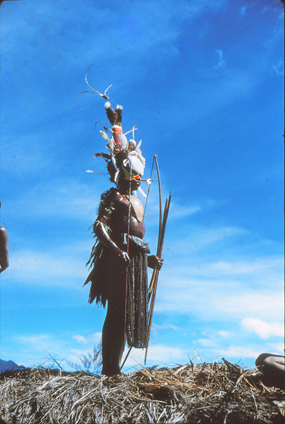
“After one and a half hours’ climbing, we arrived at our destination just at the right moment. Some of the dancers were already dancing, but others were still being “dressed”. We stood and watched while one was being decorated, and the first item was the pouring of oil all over the body from a gourd (it is a tree oil which they buy from their neighbours). He wore his best “string apron” (onab), and over the top a grass skirt like the women, only each piece of grass about 3 in. apart; brightly coloured leaves as tail feathers; a pearl shell on the back of his neck and one in front (some of them had beads as well as other shells); his best armlets and leg bands; his face was painted with various colours of paint (most of which they get for payment of vegetables, etc., at the Government Station or here—they still use some of their home-made paints); on his head was a flat top wig. and in the centre an ornament made from birds’ feathers, mostly blue and red, also some long bird of paradise feathers at the top; between the ornament and the wig was a paper bark frill and around his ears below the wig was a band of possum fur; on his forehead a “coronet” of tiny shells; in his hands he held his bow and arrows and a long cone-shaped basket arrangement with “rattles” inside (the rattles on inspection proved to be small pieces of tin and stones); these were shaken vigorously during the dancing. (I am not sure of the meaning of all this, but know on other occasions these rattles have been used to send the evil spirits away from the area where the celebrations are taking place).”

Preparations for sing-sing with charcoal and tree oil, Mendi (Reeson 1962) Symbolic decoration (Reeson 1962)

Feathered headdress typical of Mendi (Reeson 1962)

“The dancers were all men and boys, some of the others had put charcoal on top of the tree oil and made themselves black, but the majority showed their gleaming brown skins; some carried their stone axes or had a weapon stuck in their wide bark belts. The dancing is a very serious business, and it seems it is almost a crime to laugh or smile. All the time they were chanting (call it singing). The main ceremonial ground had long houses (guest houses) along each side and in front of these were long rows of stones for heating on Sunday to cook their pigs. At the top end was the Spirit House which was well guarded; no women are allowed into this house, but after the men finished dancing, they took the top knots off their wigs and each one went into the house. By the entrance was a special decorative fan-shaped stand over which the pigs were killed on Sunday (this also has something to do with spirits). All this will show you how much time and thought is put into their ceremonial affairs.

Dancers at sing-sing, Mendi 1962 (Reeson 1962

The four from the mission who visited the singsing at Elemanda on the Saturday were shocked to hear that a Mendi leader known to them had been attacked and shot that night.

Sister Elizabeth Priest wrote the story.

“Four and a half years ago when Rev. G. H. Young, the first missionary to the Mendi people, lived and worked alone amongst these scantily-clad, unwashed, primitive highlanders, several of the influential men, leaders of nearby clan groups, showed themselves friendly. Tugurup Mbali was one of these, an intelligent, powerfully-built man with light-brown skin (Mbali means pale-skinned) and twinkling hazel eyes. Fighting, even on the mission site, was a common occurrence in those early days; every man had enemies; and Mbali’s cunning with bow and arrow had earned him perhaps more foes than most. It was genuine fear and distrust of the people across the river that made him adamant in his refusal to accompany Mr. Young to the Government station, a mere mile away.

But four years have wrought a remarkable change in the Mendi people — an external change, that is, not regeneration of heart — we continue to work and pray hard to that end. These days traditional enemies sit side by side in our school and church; they walk unmolested along Government roads where once they would have carried strung bows and cast furtive glances around them as they journeyed; and men, once sworn enemies, now join together on special social and ceremonial occasions.

However, although the Government officers have had fair success in suppressing outbreaks of fighting, something more than “Thou shalt not . . .” is needed to bring the light and dispel the cruel spirit of revenge, of unforgiveness, of hate, that lies beneath the surface in the hearts of many of those who now outwardly comply with Government law.

Tugurup Mbali arrived at the ceremonial ground to join the dance, resplendent in his special “dress”, his light-coloured body completely covered with tree-oil and charcoal. Except that his broad, receding, wrinkled forehead was unblackened, it would have been difficult to recognise him. Four of us had hiked up the 1700 ft. hill behind the mission to the top of the ridge where the sing-sing was in progress and, mingling with the crowds, we talked with many “old friends”. When Mbali learned that no one had offered to give us a piece of pork after the big pig-kill the next morning, he assured us that the pleasure would be his.

It was a very different Mbali we saw only 30 hours later. That night, with the much stimulated crowds asleep in improvised booths, by the light of a pale moon an old enemy of Mbali’s who had waited long for such a golden opportunity, with murder in his heart and a deadly arrow in his bow, crept to the house where Mbali slept and with cool deliberation buried the arrow deep in his chest.

In spite of Mbali’s position in the community, the pig-kill and accompaniments proceeded notwithstanding, and it was not until the next evening, after his friends had cut and gouged in a futile attempt to retrieve the arrowhead, that he was carried in to the mission. He survived the night and it was arranged that a plane come and take him to Madang for operation. It was a pathetic scene in the hospital when, with a great effort, Mbali heaved himself up on one elbow and handed over the promised piece of pork. How many of us would remember such a trifling matter with an arrowhead somewhere in our pleural cavity!

The ward was full of crying relatives who begged us not to send him out as they were sure he would die. It was because we believed he had a fighting chance that we insisted he go, and it was a bitter blow to learn two days later that he was dead. A six-inch sharp-pointed spear head of human bone had been successfully removed from his heart but he had not regained consciousness.

The morning after his transfer to Madang, there was a buzz of excitement through the mission station as word was relayed down to us that a council of war had met up on the ridge. In pre-European days there would have been only one counter for such a cowardly attack — war! But now the Mendis knew their hands to be tied and after a Patrol Officer and 12 native police had visited the assembly, exhorting and warning them, they reluctantly returned home to sit and smoke and discuss the “headlines”.

The tense atmosphere that had held everyone in its grip for days reached a climax when, after many deputations waiting on Administration officers and missionaries, pleading for the return of Mbali’s body, the unprecedented happened and, 48 hours after his death, Mbali’s poor old body was brought back by plane for “proper burial”. For three days, without let-up except after darkness fell, they mourned for their fallen comrade and leader, wailing in strident dirges that carried for miles; they stroked and caressed him; they tore out chunks of their hair; they gashed their ears till the blood flowed; chief mourners amputated a finger joint on their own hands.

“Where has Tugurup Mbali’s spirit gone to?” we questioned a group of elderly men as they sat outside the mission house on their way home from the “funeral”.

Vaguely they waved their arms about, “Here, there and everywhere” was the gist of their reply, “We don’t know.” How intently they listened to the simple truths we told them about God’s good place and eternal life. These men had lost the carefreeness of youth; they had just come face to face again with that grim mystery “Death”.


When Gordon Young wrote his report for 1955, he was able to write about progress in a number of ways. They were not so restricted in travel and now were able to go to many new places every Sunday to preach in hamlets and at ceremonial grounds. They were starting to learn the Mendi language and were able to communicate better than before. He wrote, “There is an ever-growing understanding and friendship with the Mendi people and their children. It is true that attendance is still spasmodic, especially in the Junior School, but one must expect that when living among a primitive people who had never seen schools, nor known reading and writing, until three or four years ago.’  Sister Beth Priest was giving lessons in health and hygiene, and explaining about the human body and simple medicine and they hoped that the children would be able ‘to see the ways whereby they may serve their own people as nurses and medical orderlies in years to come.’

As well as bush-materials houses for staff, a church, a school and a hospital, there were new houses for school boys and school girls, a machine shop and timber shed. The young builder from New Zealand, Gordon Dey, was working on the first permanent building, a fine new office and storeroom with the wonders of an iron roof, weatherboard timber walls and set on concrete stumps. The line of young casuarina trees that Tomas had planted were growing. The vegetable gardens were doing well and David Johnston’s animals were thriving.

But, although all these things were good and encouraging, it was true that the local people were not interested in the message about God and Jesus. They had their own beliefs and customs and these were very strong.

Grace Young wrote:

“I expect you wish to know: has any progress being made in changing the lives of the people? We can truthfully answer ‘yes’. Oh, you say how wonderful. Have some accepted Christ? The answer is no, not yet. By your prayers, you can help this dream come true.

Margaret Reeson, 2023

Sources:
Grace Young, The Missionary Review—July, 1955—Page 9
Beth Priest, The Missionary Review—October, 1955—Page 4-5
Gordon Young, The Missionary Review—September, 1955—Page 5

Timb cult; women; pig-kill; ceremonies; dancing; sing-sing; decoration; Grace Young; Gordon Young; Elsie Wilson; Elizabeth Priest; Gordon Dey; David Johnston; Tugurup Mbali; Mendi; Elemanda; tribal fighting; attack; revenge; traditional enemies; longhouses; funeral practices; patrol officers; government; language; preaching; school; medical work

16. Visitors from a wider world, 1955

Workers from New Zealand, Germany and Tonga join the mission team

In 1955, the mission team spoke at least six different languages in their homes and tried to learn the languages of the local people as well. They were all a very long way from their homes.

For many centuries, perhaps for thousands of years, the people of the Southern Highlands lived their lives in the mountains. They traded tree oil, salt and shell with near neighbours on local trade routes but knew nothing about people from other parts of the world. People from other parts of the world knew nothing about the people who lived in those high mountains.

Suddenly, this all changed. The first Australian patrol officers walked through the Mendi Valley in 1950. The Methodist missionary Gordon Young went with them. Five years later, many visitors were starting to come. Some came to see a new, beautiful, interesting place. Some came to work, or to take photographs, or to study the culture. These visitors were excited to see a whole colourful world, culture and languages that they had never seen before. They came from many countries, not only from Australia.

At first the Methodist Mission teams at Mendi and Tari were people from Australia, New Guinea Islands and Papuan Islands. By 1954, they were joined by people from the Solomon Islands and New Zealand. A year later in 1955, the team grew even more, with staff from Tonga and Germany. This was the beginning of a beautiful pattern. Christians from very different backgrounds, languages and nationalities would come to serve together in the Highlands of PNG and would discover how much they could learn from each other.

New Zealand friends

Rev C.J. (Cliff) Keightley with his wife Noreen was the first of the Methodist ministers from New Zealand to come to the Highlands. They were appointed to Tari. Late in 1955 they were joined in Tari by experienced New Zealand nurse Sister Edith James. Over the years, many New Zealand Methodists came to the Highlands and they built a strong team with the others. As a sign of this new partnership, the General Secretary of the Foreign Mission Board of the Methodist church in New Zealand, Rev. S.G. Andrews, visited the Highlands for the first time in 1955.

Insert: Reeson 1964 Ministers Rev Cliff and Noreen Keightley (NZ)

Rev Cliff and Noreen Keightley, from New Zealand. (Reeson 1964)

Cliff Keightley had not been in Tari long before he discovered the presence of other newcomers, the Catholic priests from the United States of America. In those years, Catholics and Methodists did not have many things in common and often acted if the other group was a competitor, not a fellow-believer in Jesus.

Keightley wrote:

“Of late we have been feeling very much the effects of the Roman Catholic Mission in the area — they arrived a little before Easter. The Father is a missionary with a wide experience. We give credit where credit is due — he seems to have made remarkable progress in the very short time. However, it has been to some extent at our expense, especially in regard to our school. Almost over-night we lost all but about seven of our 30 boys, due to the fact that the Father commenced to hand out pieces of cloth and other sought-after articles to his school boys. What hurts most was that some of our best boys were among those who went over to him. Up till then we had been building up our school on the basis of the boys living in and not drawing pay. The little work they did on the station we felt was their contribution towards their schooling, and apart from a few issues such as blanket, mug, plate and spoon (theirs to use while they remained with us) they were given nothing except a few rations. But, and in this respect, they are no different from many of us, they prefer to go where they will be given more of this world’s goods.

The incident has caused us not only disappointment, but a great deal of hard thinking. It has driven us to pray more earnestly about our school, and all our work for that matter. It has presented a challenge to us to work harder and make our school even better. Fortunately, our school has grown again, but not on the old basis of school boys unpaid. The boys in the school are now employed on the station on the understanding that they go to school for the mornings”.

It was very difficult for the local Highlanders to understand any difference between the government officers, missions from other countries and other denominations of Christian faith. They were all white-skinned foreigners who had arrived uninvited in their place. Many decades later, Andrew Menger Murubu, a Mendi man who had become a university graduate and political advisor, wrote about the experience of his parents. His parents were among the earliest people to adopt the Catholic Church. He wrote:

“The later arrival of missionaries caused some confusion. My father thought that the Government was the Catholic Church and the Methodist Church were the Missionaries. My father in his arguments emphasised that he was the Government because he attended the Catholic Church. Those who attended the Methodist Church were Missionaries and they were inferior. The Methodist and the Catholic two Christian denominations settled into Mendi almost straight after the first Patrol Officer started establishing the Murumb Station. Missionaries and Patrol Officers were white people and their main focus of their speeches made to the people were concerning restoration of peace and harmony, no fighting and killing each other and no stealing. These were the very strong messages passed on to the people. The local people could not distinguish between the roles of the missionaries and the Government until some years later. The presentation and reading of the bible verses and explaining to the people made my parents and others realise that the work of the Government was different from the work of the missionaries.

Deaconesses from Germany

Two young women arrived in the Highlands late in 1955 to serve as nurses with the Methodist Mission, one in Mendi and the other in Tari. Cliff Keightley wrote: They are the gift of the German Methodist Church to our work, and it is a real joy to have them working with us.’

The story of the coming of Sister Lydia Mohring and Sister Elizabeth Kessler was a sign of healing and peace. In the years before the Great War 1914-18, Australian and German missionaries worked well together in the islands of New Guinea when it was a German colony. Sadly, during two terrible world wars, the nations of Australia and Germany were enemies, at war with each other. The German missionaries had to leave New Guinea. At last, when the wars were over, the Methodists in Germany wanted to show a sign of real peace. They contacted the Methodist Overseas Missions Board in Sydney and offered to send two nurses. The two young women were deaconesses who had trained with the Martha Maria Verein Institute at Nuremburg.

Photo: German nurses Lydia Mohring and Elizabeth Kessler (Missionary Review 1955)

They are the gift of the German Methodist Church to our work, and it is a real joy to have them working with us.’

Australian General Secretary Cecil Gribble wrote: ‘The German Church has never forgotten the need of the people in New Guinea and through the years the missionaries, now grown old, have kept in touch with us and have continually assured us of their remembrance and prayer… When the threads of fellowship began to be gathered up again and the wounds in the body of the Church began to close and heal, the leaders of the Deaconess Order wrote suggesting that the missionary ties be re-established.’

It was a long, complex process to prepare for these women. Their training was very thorough. As well as Biblical studies, the women were trained in nursing, midwifery, and psychology and other practical skills at the Mother House of the Order, the Martha Maria Institute. This was one of three centres which trained 450 deaconesses in Germany. They also studied tropical medicine in Hamburg and improved their English language in England. When they were ready at last, they were commissioned for their new work at a great service of farewell in their Mother House in Nuremberg.

Commissioning service in Mother House of Martha Maria Verein Institute in Nuremburg, Germany. (Missionary Review 1955)

Elizabeth and Lydia, from their community of women and wearing their distinctive uniform, were travelling a very long way from everything that was familiar. They sailed for Australia on the ship Oronsay, and, after visiting some Australian cities, arrived at last in the Highlands. Cecil Gribble wrote of them: ‘In Australia we will surround them with our prayers and friendship and one and all thank God for this further proof of the supra-national qualities of the Gospel and its power for the healing of the nations.’

Cliff Keightley reported the arrival of the German nurses. He wrote:

“Just over a month ago we were pleased to welcome Sister Elisabeth Kessler, one of the two German Deaconesses who have come to the Highlands (Sister Lydia Mohring went to Mendi). They are the gift of the German Methodist Church to our work, and it is a real joy to have them working with us. Sister has already found her niche, and is busying herself in setting up the Hansenide work. Already she has six lepers (all in the advanced stages) to attend to daily, but so far, no building to work in. That is one of our building priorities and we must get on to it as soon as we have completed the new sister’s house and the infant and maternal welfare block. There is estimated to be a fairly large number of lepers in the area and they certainly need our help and prayers.”

(The disease of leprosy was quite common in the Highlands at that time. People used to speak of people with leprosy as ‘lepers’ but changed the language to call it ‘Hansen’s Disease’ and the special hospital ‘The Hansenide Centre’. Later, the language changed again to the ‘Leprosy Hospital’ as people began to understand more about the disease and that people with the disease could be treated and healed.)

A New Friend from Tonga

Christian Methodists from Tonga understood what it was like to be a missionary people. Their own people had heard the Christian gospel from missionaries from 1822 and Tongan missionaries carried the good news of Jesus on to other lands over many years, including to Samoa and Fiji. One of these was a missionary called Rev David Mone. His first mission appointment was to Salamo in the Papuan Islands. When war came to his district, the Australian mission staff left the region. David Mone stayed on in the islands during the years of war and became widely known to men of the Allied Forces in Milne Bay, where he was able to give help and hospitality at his station at Salamo.

After the war, Mone spent a year of study at Kings College, Brisbane and then was appointed as a Tutor at the Theological College in Tonga. He offered to serve in the new Mission in the Highlands and was appointed first to Tari and later to a new area in the Lai Valley.

Rev David Mone from Tonga (Missionary Review 1956)

In 1955, the mission team spoke at least six different languages in their homes and tried to learn the languages of the local people as well.

So now the picture of the staff team for work in the Highlands was becoming clear. It was a team of men and women from very different places in the world. In 1955, the mission team spoke at least six different languages in their homes and tried to learn the languages of the local people as well. They were all a very long way from their homes. They had felt God’s call and offered to serve in this new Mission and so they learned to work together and to trust each other.

Margaret Reeson, 2023

Sources:
The Missionary Review—October, 1 9 5 5 — P a g e 1 5
Andrew Menger Murubu, ‘Stone Age to Corruption‘ (c.2020)
The Missionary Review—October, 1955—Page 14
The Missionary Review—January, 1955—Page 15
The Missionary Review—April 1955—Page 4

Cliff Keightley; Noreen Keightley; Edith James; Lydia Mohring; Elizabeth Kessler; Cecil Gribble; David Mone; Rev C.J Andrews; Andrew Menger Murubu; Mendi; Tari; Lai Valley; Nipa; Murumbu; New Guinea Islands; Papuan Islands; Solomon Islands; Tonga; Germany; Methodist Overseas Missions Board; Foreign Mission Board of Methodist Church of New Zealand; Deaconess Order; Martha Maria Institute Nuremburg; leprosy; Hansenide clinic; trade; patrol officers; government; language; Catholic Church; priests; Salamo; Kings College Brisbane

15. Life in Mendi, 1954

  • People who liked to fight
  • A prohibited area
  • Early medical work
  • Catholic Mission in Mendi
  • Observations of the Methodist Mission, 1954

People who liked to fight

By 1954, it was clear that there were many challenges for both the Australian government administration and for missions working in the Southern Highlands. Tribal fighting was one of many problems. When some people asked why missions were there at all, the MOM General Secretary Cecil Gribble replied.

But behind all these problems are the more fundamental problems in man himself, and here the Christian Church has a part to play beside the Government. The Christian doctrines of God and man compel us to be there—of God and His all-inclusive interest in, and care for, the whole of His creation as shown once and for all in Jesus Christ and in His universal Word and atoning death; of man, and his power to rise to great heights and sink to low depths and his need of God— the God who was in Christ Jesus reconciling the world unto Himself. This is our Christian justification for being in Central New Guinea.” (Rev Cecil Gribble, MOM General Secretary)

The men of Mendi have always been quick to get into a fight. When they were not fighting each other and fighting enemy clans, in the 1950s they were attacking the Australian patrol officers when they came through their territory. One report said, in 1954:

“We were sorry to read the reports of still another attack on administration officers while on patrol in the Mendi area. This further report brings home to us the difficulty of bringing under control the people of these isolated areas in central New Guinea. Mendi is regarded by the Administration as one of the “trouble spots” of the area. In this recent attack natives ambushed the patrol as it was returning to camp and fired “dozens of arrows” into the ranks of the party. The Patrol Officer, Mr. F.V.G. Esdale, tried to protect the party without having to retaliate but when the attack persisted, he ordered the patrol to fire.”

A few months later, a new patrol officer was with a patrol led by Assistant District Officer Des Clancy. Nearly seventy years later, after the death of Clancy, Jim Sinclair remembered:

“I was posted to the Southern Highlands in November 1954 and for the first time worked under Des Clancy’s direction. We made one particular patrol together that I will never forget – arresting fierce Mendi warriors for tribal fighting. You get to know the worth of a man when arrows are flying.” (Jim Sinclair, patrol officer)

You get to know the worth of a man when arrows are flying. Jim Sinclair, patrol officer

Clockwise from left: Mendi training with bows (Reeson 1962); Mendi man dressed for sing-sing (Reeson 1962); Mendi defensive fence with armed man (Smith 1963)


‘A prohibited area’

It was not surprising that the region was still a ‘prohibited area’ and any outsider who wanted to visit needed to have permission from the government. The Methodist Overseas Missions General Secretary Rev Cecil Gribble visited the Highlands again in 1954. He was very interested and later wrote several long articles for the mission magazine about his visit. In one of these articles, he wrote, ‘There are few more difficult places to administer in the world than the Trust Territory of New Guinea and the mainland and island chains of Papua.’ Climate, diseases, many languages, isolation, difficult mountain country, tribal fighting – all these things were challenging. That year of 1954 a major government patrol discovered a hidden valley in a remote part of the Highlands. The local people of that valley had never before seen people from the outside world. Some people started to say ‘Just leave them alone. Don’t disturb their happy life.’ Gribble admired the Highland people he had met. He wrote:

They are an active, virile, intelligent people.

“In many ways the people of the Highlands impress us with their gifts and aptitudes. In a healthy climate with sunshine, good rainfall and fairly fertile soil they have become amazing agriculturists and with the simple digging-stick and the stone adze they have cultivated their valleys with intelligence and skill, learning for themselves many of the things that we, too, have discovered by the processes of trial and error. 

Their difficult languages they have evolved away from the contacts which have shaped the speech of the Melanesian and the Polynesian. Some of their implements of war, their ceremonial dress and their personal ornaments reveal a marked artistic sense. They are an active, virile, intelligent people.”

Rev Cecil Gribble , Methodist Overseas Missions General Secretary

Photo: Mendi man with bow (Missionary Review 1957)

But Gribble saw the damage of tribal fighting that went on and on, wrecking houses, gardens and lives. He also knew that the people of the Highlands were afraid of sorcery, witchcraft and the power of evil spirits. Life was not calm, peaceful or safe. A visitor told a story about visiting the Methodist Mission at Unjamap in Mendi one day. When he was walking back across the vine bridge on his way back to the government station, he met a crowd of people screaming in shock. A young woman had just thrown herself off the bridge into the churning river far below. The visitor was horrified to see the girl’s husband pull his stone axe from his belt and chop off his own finger joint in grief.

Gribble saw the value of many of the changes that were coming to Highland society. Law and order, health services, education, improved agriculture and a broader economy; all these things would be good. But he was prophetic when he added:

In all this development new problems will emerge. When steel axes replace stone ones, the wounds go deeper. When roads are made, insularity goes but diseases spread. When new and fertile lands are opened up, the European so often puts profit before the people’s welfare.

“In all this development new problems will emerge. When steel axes replace stone ones, the wounds go deeper. When roads are made, insularity goes but diseases spread. When new and fertile lands are opened up, the European so often puts profit before the people’s welfare. In all these things and many more, only a wise administration will show whether or not we are true to our trust in leading these people out into a fuller and better life. … For the Government there will be great and increasing economic, social and political problems which will be solved only with the best and most careful thought and action.

But behind all these problems are the more fundamental problems in man himself, and here the Christian Church has a part to play beside the Government. The Christian doctrines of God and man compel us to be there—of God and His all-inclusive interest in, and care for, the whole of His creation as shown once and for all in Jesus Christ and in His universal Word and atoning death; of man, and his power to rise to great heights and sink to low depths and his need of God— the God who was in Christ Jesus reconciling the world unto Himself. This is our Christian justification for being in Central New Guinea.” (Rev Cecil Gribble , Methodist Overseas Missions General Secretary)

Gribble was pleased to see what he called ‘on the whole a feeling of mutual respect between Government and Christian missions.’  The Minister for Territories, Paul Hasluck, said of the inter-dependence of Administration and Missions, ‘We are, in effect, a working partnership in the special realm of human endeavour and activity.’


Early medical work

At the Methodist Mission in 1954, they were thankful that they were not attacked. Month by month, they were gradually earning the trust of the local people. The new young nurse, Sister Beth Priest, sometimes needed to treat people with arrow wounds, but more of her work was helping women with childbirth, accident victims and children with malnutrition. Beth Priest wrote:

“One night recently, when we were just about to settle to an evening with the language, news came to us that there was a young mother who was dangerously ill, following the birth of her first child. Knowing that it might be too late if we waited until the morning, the Rev. Gordon Young, Dr. Brotchie (who was visiting Mendi) and I, guided by our Mendi informant, set off to find her. For an hour we trekked through muddy tracks, up and over steep slippery hills, skirted on either side by trees and tall pitpit grass, until at last we emerged on to a clearing where the family house was built. A few yards from it, was a little temporary shelter where the husband sat. It was here that he had killed a pig that afternoon and now explained that his wife was better as a result! After a bit of persuasion, he led us to a small house where his wife was alone with the baby, custom preventing him from going to her. Dr. Brotchie and I had to crawl on hands and knees through the low doorway, and, once inside, we found that what the husband had said was true . . . only we did not give the pig the credit for it!

A wasted evening? Maybe! But by our obvious desire to help we had forged one more link in the chain of winning these folk to our Saviour. Some of the members of that family were present at Church on the next Sunday.”

Among other work, Beth Priest offered a temporary home to several malnourished infants whose mothers had died.  Sometimes a grandmother or the child’s father brought the child to the mission and were amazed and impressed to see that the nurse was able to feed the baby with a powdered milk mixture. At one point, six infants lived with the nurse and teacher until they were strong enough to go home to their families.

At one point, six infants lived with the nurse and teacher until they were strong enough to go home to their families.

Sister Beth Priest in Mendi (Missionary Review 1956)

At the end of 1954, Beth Priest sent home some excerpts from her diary.

August 22, 1954: David Johnston arrived back at Mission after a day’s preaching, with a “bag of bones” in the haversack on his back — a two-year-old girl, weight. 11 1b. 6oz., to add to our hospital family. (She is now an adorable, chubby lass, tipping the scales at 21 1b.)

September 30 : Elsie Wilson left for a month at Tari to help Rev. Barnes prepare a Primer and charts for the school.

October 16: 8 a.m., hearing wailing, indicating a death or “nigh unto”, David Johnston and I, plus four natives and stretcher, hiked to scene; man with pneumonia being “wailed to death”. Much heated talk; relatives were eventually persuaded to carry man to hospital. Funeral procession—tearful, hysterical wailing all the way! Anangol made amazing recovery; grudging gratitude by close of kin.

November 5 : Very ill five-year-old lad carried to hospital by parents from distance down valley. (Later, colossal amount of pus evacuated from areas around elbow and thigh; child recovered; splendid contact with this group of people.)

November 14: Evening. News of young man, known to us, fallen in river. Four of us followed our Mendi guide, almost at a run, up hill and down dale ( whew ! ! ) for half an hour. Arrived at house where we had previously found Anangol. This man, Tigit, still alive; had NOT fallen in river. Wailing almost deafening; pitch dark but for our lamp. Stretcher hastily improvised—no argument this time. Tigit’s mates shouldered stretcher and the wailing retinue headed for hospital. Decidedly eerie experience. (Tigit well enough to go home next day!) The Govt.-appointed “chief” of this clan, a young man, Benawi, given severe and lengthy instructions to bring sick people to hospital instead of going into mourning.

December 14: Benawi carried in his wife and child on home-made stretcher!! (Wife, too ill to walk, went home under her own steam five days later.) Perhaps this group of Mendis have at last learned their lesson, that we are their friends, here to help them.

January 7: Dr. Brotchie and I removed a two-inch arrow head (relic of fighting days) from man’s back, under local anaesthetic, while an apprehensive, then surprised, then delighted crowd of his friends gathered to watch.

Already, within the small community of outsiders in Mendi, there was change by Christmas 1954. Since the day in 1951 when the Youngs entertained the three patrol officers and the small mission team for Christmas dinner, now there was a growing community. On New Years Day 1955, twenty-three European residents of Mendi plus nine visitors gathered to play tennis on the new tennis courts built by the kiaps. One of the latest arrivals was a young builder from New Zealand, Gordon Dey, the first of the promised New Zealand Methodists to arrive in the Highlands. Dey was to be responsible for the building of many of the well-built permanent buildings of the Methodists in Mendi, Tari, Nipa and Lai Valley for the next sixteen years. Among the visitors was Dr Brotchie who had been in Mendi to open the Methodist church building in 1953; he was so charmed by the Highlands that he brought his wife and three daughters for a three-week holiday there in January 1955. [Sadly, Dr Brotchie was killed in Sydney in August 1956. Someone, perhaps a person with a mental illness, placed a homemade bomb under the doctor’s car which exploded when the ignition was turned on, killing the doctor and his sister who was his secretary. This was a great shock and loss for the Methodist Church and for the support of mission.]


Catholic Mission in Mendi

One entry in Beth Priest’s diary read:

7 September 1954: Two Roman Catholic priests came to commence a Mission at Mendi.

It was not a surprise. Now that the rest of the world had discovered that a great many people lived in the Highlands, other churches wanted to start their own work among those people. In 1954, the leader of the Catholic Church for the very large area that covered the Western Province and much of the south coast of Papua sent two missionaries to visit Mendi and Tari for the first time. Their leader Fr Alexis Michellod MSC, a friendly man of many talents and deep faith, was finding out where the Catholic Church could start a new work. While Fr Alexis was visiting Mendi and Tari, an Archbishop was busy looking for one of the many Catholic Orders around the world who could come to the Highlands. Fr Alexis was getting ready to leave Tari at the end of his first visit when he received a message. It said, ‘Stay. Start foundation of Southern Highlands. Helpers coming soon.’

Fr Alexis found out later that an Order of Capuchin priests in United States of America were going to come to the Highlands. These men from the St Augustine Province of Pennsylvania had received an invitation from the Vatican in Rome. Would they be willing to send a team to the Highlands of Papua and New Guinea? It was a very long way from their home in America.  But these men decided that God was calling them to a new work and very quickly, in two weeks, they agreed to be the pioneer Catholic group in the Southern Highlands. Because they were a long way away, and needed to prepare, the first of the team of Capuchin priests arrived in November 1955, Fr Otmar Gallagher OFM Cap. Soon the new men began missions in Mendi, Tari and Ialibu. In Mendi, they were welcomed to land at Kumin, just to the south of the little township and airstrip at Murumb, and started to build their houses, church and school. For the first year, the more experienced MSC missionaries trained the new Capuchin group, then left them to do their own work. In the same way as the Methodists brought Christian workers from other parts of the country, the Catholics also brought local workers from Western Province and Mekeo to share the new mission in the Southern Highlands. In those years, the Methodists and the Catholics didn’t have much to do with each other. Local Mendi or Tari people made up their own minds about whether they would follow one of the churches, or none of the churches.

In those years, the Methodists and the Catholics didn’t have much to do with each other. Local Mendi or Tari people made up their own minds about whether they would follow one of the churches, or none of the churches.


Observations of the Methodist Mission, 1954

One of the visitors to the Methodist Mission in 1954 was Rev Cecil Gribble. The first time he went to visit Mendi was in 1951, then in 1953 and now he was back again. Gribble wrote a long story about what he saw in Mendi in 1954. This is what he wrote:

“Flying in a D.C. 3 freighter from Port Moresby to Goroka one enters the more settled area of the Central Highlands of New Guinea and reaches country that for scenic grandeur must rank with the world’s finest. It is from Goroka that one goes west to Mendi and flies into what the Government calls a “prohibited area,” influenced by the Administration but not yet fully controlled by it. To enter this region, one must carry a special Government permit.

At 8.30 a.m. the little single-engined CESSNA plane of gleaming silver and red arrived at Goroka to fly me to Mendi. The ‘plane belongs to the Lutheran Mission and we owe much to the co-operation and friendship which this Mission has shown us in the pioneering of the Highlands Mission. The pilot, Bob Hutchins, is a young American of the Missionary Aviation Fellowship, which works with the Lutheran Mission in this country and serves any mission which needs its help. Hutchins gave me confidence in the care he took with every detail before we taxied to the take-off. I sat beside the pilot in this little machine which, as ‘planes go, seemed only a toy, and marvelled at the splendour of the country, the ingenuity of man, and of his faith that is actually removing mountains. We soared up to 10,000 feet over mountains, forests and rivers, grassy highland plateaux, razor-back ridges and down the great Wahgi Valley. Below, from time to time, there were the little hamlets so characteristic of the Highlands, sometimes built precariously, away up on the very knife-edges of escarpments. Range after range passed until we swept down into the Mendi Valley, over the Mission Station and on to the small strip which from the air looked no more than a cricket pitch scraped between the mountains and close beside the Mendi River. Pilots in New Guinea certainly need to know their business.

Government offices at Murumbu, Mendi, in 1961 ( J Rees 1961)
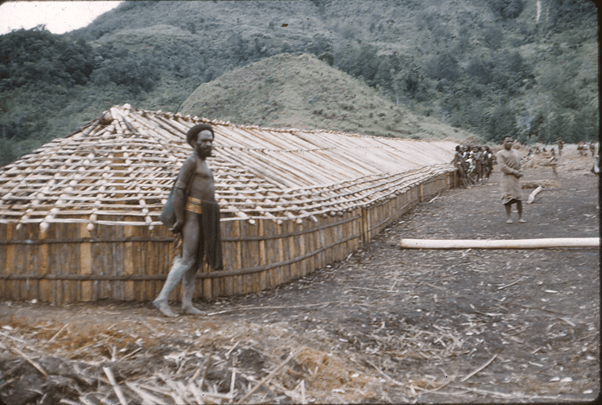
The Government Station at Murumb with the Australian flag flying beside neat native-type administration buildings had the air of officialdom. A mile away up a steep but well-made road the Mission has been established on a plateau with a magnificent view across the valley and then away to the distant north and south. The development within three years is surprising and high credit should be given the Superintendent, the Rev. G. H. Young, who has led this pioneering work.

Here is a striking establishment—church, school, hospital, mission houses. Paths link up the whole, lined with casuarina trees and shrubs. All the buildings are thatched with kunai grass and walled with the attractive plaited pit-pit or wild bamboo. The school is in charge of Miss Elsie Wilson, who is a born teacher with real insight into the educational approach to this primitive people. Inside, the walls are bright with simple but effective teaching aids and charts. They were strange classes, with both adults and children clad only in the string girdle with the leaves flung behind. Some had the coveted pearl-shell around their neck and a feather or two in their hair, old and young together.

But there was interest, the prerequisite of all real education, and one was not surprised that this school has received such commendation from official visitors.

Methodist Mission at Unjamap, Mendi in foreground. (Missionary Review 1954)

The hospital, supplied with drugs and equipment by the Government, was under Sister Beth Priest, and although the people have not been as receptive to the medical work as we had hoped, lives are being saved, confidence is being built up, and in these clean, attractive, kraal-shaped buildings, men, women and children come under the skilful treatment of the Mission Sister.

One hundred acres or more have been brought under cultivation with the trained leadership of Mr. David Johnston. Not only have fine vegetable gardens been established but valuable experimentation in tea, coffee and other crops is taking place. A small herd of cattle is being built up. Impressive development has taken place in agriculture and the people’s interest in the crops introduced is growing.

Rising steeply at the back of the Mission is a range of 1,700 feet and at the top of this is the pit-saw under the Papuan missionary, Timoti, and his team of Mendi men. At 8 a.m. we set out to climb to the pit-saw through scrub and thick mountain forest up a grade so steep in places that we could only plant our feet in the imprints of those who had done it often. Looking back there were magnificent views over the Mendi Valley. We saw the preaching groves, where services are held regularly, and outside in the restricted area we were shown places where dangerous people live and where patrol officers have been surrounded and ambushed, and arrows and spears had come from hidden hands. We reached the pit-saw over the top of the range and were then 8,000 feet above sea-level. It was worth climbing to see Timoti’s pleasure at our visit. We returned home wondering how he faces this climb three times a week in order to come down to the Church meetings on the Station. These pastors from Papua and New Britain are in the true missionary tradition giving themselves without stint and doing a work that is invaluable.

A human sidelight was the waking one morning to find that thieves had broken into the store. They had dug a tunnel under the wall and come up under the pit-pit floor, taking one case thought to be filled with the much-prized pearl-shell. But the box held an electric fence bought for the cattle and as yet unused. The only clue left for the police was a few leaves from the clump that the people wear behind them. Alas, these few “tail feathers” would not tell much to either police or missionaries. The case and the fence were found later, discarded, but whole, in a patch of kunai grass.

While at breakfast, two fearsome-looking men with blackened faces and bows and arrows came to the mission house. Their country was over the ranges in the Lai Valley, where administration officers had not long ago been attacked. They asked that missionaries be sent across to live amongst them. Perhaps it was the pearl-shell and the trading goods that made some appeal, but perhaps, too, there was real desire for something better.

Setepano Nabwakulea preaching at airstrip in Mendi (Missionary Review 1954)

On Sunday, the patrol with the preaching services in the hamlets was for me an unforgettable experience. First down to the air-strip where the Rev. G. H. Young and Setapano, the Papuan pastor, gathered the people from the Administration quarters. As the sun rose over the mountains there was prayer and a simple story from the New Testament, in pidgin English for the police and cargo boys who had come up with the Government from the coast, and in Mendi [language] for the people of the Valley. It was a New Testament situation: mountains on all sides, the blue sky above us, bright morning sunshine and a young Papuan speaking about the things of the spirit which he had found true in his own life. We walked on over the hills to Wagwag and other places, meeting people on the road, men with feathered head-dress, axes over their shoulders, bow and arrows in their hands. Women working in the field joined us and sat with us in the little cleared ceremonial grounds that go with each hamlet and which are surrounded by groves of casuarina trees. Strange congregations! A woman with a pig under her arm, a man with burning charcoal to light his cigarette, an old wrinkled, skinny woman eating a baked sweet-potato, chattering children. But when the preacher told a simple parable there was a real attempt by them to follow and understand. Week by week the missionaries go out two by two into the surrounding countryside, bringing to people this message which they have come to call the “good talk”. To think about it is to know that out of this embryo situation will come the Church victorious.”

Week by week the missionaries go out two by two into the surrounding countryside, bringing to people this message which they have come to call the “good talk”. To think about it is to know that out of this embryo situation will come the Church victorious.

Margaret Reeson 2023

Sources:

The Missionary Review—April 1954—Page 15
Jim Sinclair, Tribute: Recollections of Des Clancy, Admired Kiap, 8 February 2020 Una Voce
Elizabeth Priest, The Missionary Review—April, 1 9 5 5 — P a g e 6
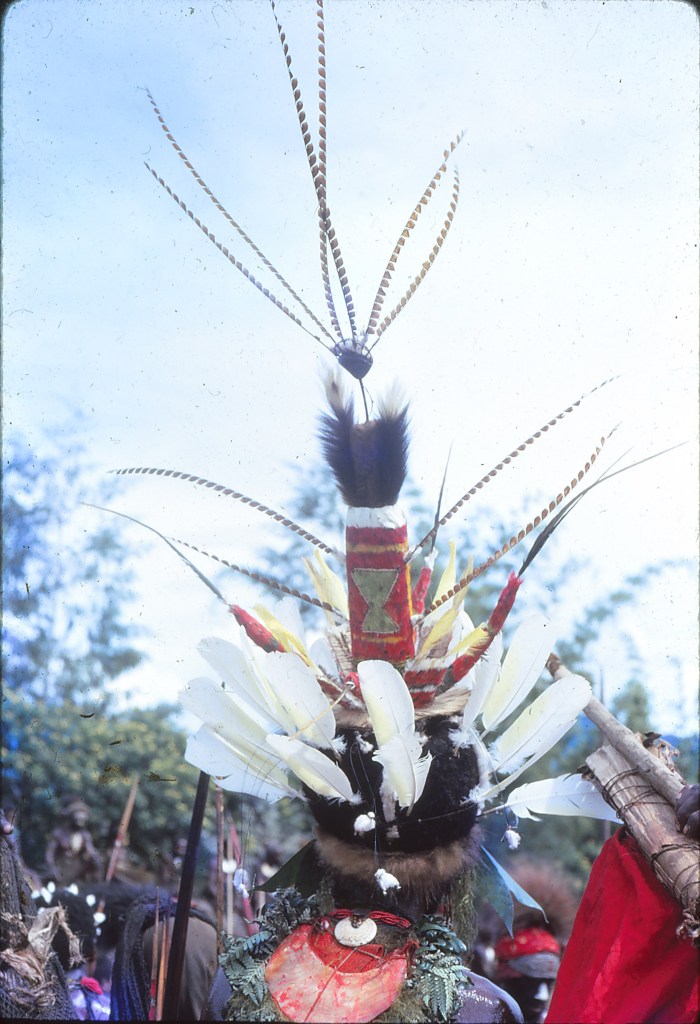
Cecil Gribble, The Missionary Review—May, 1954—Page 13
Cecil Gribble, The Missionary Review—December, 1954—Page 6-7
The Missionary Review— August 1954—Page 2
Central Queensland Herald (Rockhampton, Queensland) 16 August 1956 https://trove.nla.gov.au/newspaper/article/79267391#
Bishop Stephen Reichert OFM Cap. ‘A Short History of the Mendi Mission’. https://en.wikipedia.org/wiki/Roman_Catholic_Diocese_of_Mendi
Cecil Gribble, The Missionary Review October 1954

14. A Visitor to Tari: 1954

November 1954

The General Secretary of Methodist Overseas Missions (MOM) in the 1950s was Rev Cecil Gribble. He was very interested and encouraging of the new mission work in the Southern Highlands and began to visit Mendi regularly from 1951. In 1954 he came from Sydney to visit the new work in Tari for the first time.

This is his report.


“The great Tari Basin, 5,500 feet above sea level, lying near the centre of New Guinea, 130 miles from the Dutch border, is a vast valley girdled with mountains and populated with strong, cheerful, typical highland people. Tari is separated from Mendi by 60 miles of rugged mountainous country rising to land altitudes of eight thousand feet, often too cold for human habitation. Flying over these mountains and then through a gap in the rim of the basin we came into the expansive Tari area and down on to the 4,000-foot air-strip. This must be as fine a strip as there is in Western New Guinea and it will soon take D.C. 3s.

Around us as we stepped from the little ‘plane swarmed a happy crowd of these fearsome-looking Tari people; the women clad only in a bunch of leaves and a string girdle, the men with their great wigs of hair decorated, sometimes artistically, with everlasting flowers or bird of paradise feathers. Sometimes, too, the decorations have a ludicrous modern touch — a Craven A packet or a Sunshine Milk label being used. The walk from the air-strip to the Mission Station is a good mile along an undulating clay road, across two rivers and precarious bridges held up by forest vines and some faith.

It was early in 1953 that the Rev. G. H. Young and two native teachers flew into Tari in the first ‘plane to land passengers in the area. The site was chosen, Hoyebia, where the only Europeans to touch the area previously had camped while on patrol — Taylor and Black in 1938 and Smith, Clancy and Neville in 1951. On January 26th, 1953, the Rev. R.L. Barnes flew in to be the first Superintendent.

Huli man in Tari (Reeson 1961)
Huli man with typical decorated wig, Tari (Reeson 1970)

It is not easy to convey the picture of achievement in eighteen months. Houses, hospital, church, gardens and a broad sweep of green grassy lawn some three hundred by one hundred yards was the view we met at the end of that clay road from the air-strip at Ramu Ramu. Rugged mountains and massive banks of clouds were in every distant view. But the first impressions of beauty and achievement deepened as one felt the close and friendly contacts which the missionaries had made in so short a time with these primitive and violent people. The planning and building of the fine station site, the struggle with the difficult language, the planting of gardens, the enquiries into native customs and usages in the area, the securing of land, the simple beginning of gospel teaching — these and much more have been the pioneering task of our missionaries, white and brown, who have lived and worked cheerfully in this untamed area under rough and demanding conditions.

At the hospital. Sister Joyce Walker has become the trusted friend and helper of men, women and children. Women come from afar with their children. There is a card for each child and guidance is given by the Sister and eagerly accepted by the mothers. They come with all the usual troubles of children and many more that are unusual. But for the expert medical treatment many would die. No wonder there is such confidence between mothers, children and the Mission Sister.

Sister Joyce Walker with women at Hoiebia clinic 1954 (Missionary Review 1954)

Stretched out on a bed in Sister Walker’s consulting room in this grass-thatched hospital was a woman — her head covered to hide the blackened eyes, the bruised and beaten face and the scalp cut wide open by a husband, whose right to do this kind of thing has been unquestioned. Sister Walker fills the gaping wounds with penicillin, stitches them up and gives a kindly touch that has never been known before. Then she sends for the Government officer to question the husband and take action.

A young lad was sitting in a chair outside knitting a scarf from scraps of wool that had been sent to Tari. Four months ago he was carried to Miss Walker, a pathetic, emaciated case of skin and bone, unable to move hands, legs or joints. He can sit up now, feed himself and move his fingers. He can smile now and has hope. The father who brings the boy’s food stood by, trying to convey to me excitedly in his own language what the sister had done.

A family brings an unconscious young warrior. The sister suspects an arrow embedded deep in the neck and close to the spine. A general anaesthetic is given. The sister makes the incision deeper and deeper, searching for what she is sure is there but cannot find. She prayed and probed further. Eventually the arrow head was found, two inches long, and in a few weeks life for him was normal again.

There are many lepers at Tari and the Government is anxious that we commence a special work among them. The Mission Board has decided to set a nursing sister aside to do this work and it is hoped that one of the German deaconesses who are arriving early next year will undertake this task.

“And Jesus went forth, and saw a great multitude and was moved with compassion towards them and He healed their sick.” And He still heals, working miracles today through the consecrated hands of those who serve Him with dedicated medical training and knowledge.

On Sunday, several hundred gathered in the large Church in response to the message yodelled through the valleys that this was the day ‘for gathering together’. A more grotesque congregation surely never met for worship — men with flamboyant head-dress, bones through the nose, bodies coloured with dyes and clays, axes and the huge bows and arrows in hand; and the women with webbing bags of babies or vegetables slung on their heads.

Youngsters in front were keen, bright, quiet and interested. How do we use their primitive religious ideas upon which to build Christian truth? Several old men have come to Mr. Barnes and said: “You talk of God. His message is good. We think He is the one we call Ni. Will you call God by our name, too?” They have a supreme creator spirit — Ni, but he has a wife and two daughters! It is not easy to weave the Christian gospel into those ideas. And yet we must have understanding in our handling of their cultural possessions. It was good to see the wisdom and care with which our missionaries were approaching this problem and one was glad that all our workers are trained in the patient approach to the most cherished beliefs of the people, gradually showing by word and deed the better way which is in Christ Jesus our Lord. Thomas, the New Britain pastor, preached in pidgin and then this was translated into Tari. The text was, “Render unto Caesar the things that are Caesar’s and unto God the things that are God’s.” “Something belonga man — something belonga God.” I wish I had a transcript of the whole sermon. But whatever was made of it, there was close interest from the congregation.

It is this interest which, amid much that is slow and discouraging, gives hope in the work. An old, bent and shrivelled woman brings her son and says, “He is yours. Will you teach him?” A group of fourteen young men, after a simple talk by Mr. Barnes on what it means to follow Jesus, came and said, “Teach us how to follow and we will try. Train us and we will serve our people with you.”

And so, in the midst of a social work that is quite spectacular a few perhaps are coming to understand in a simple way the deeper meaning of our presence among them. These will grow in grace and in the knowledge of Christ and live among the people, a saving, cleansing influence until gradually the things that are dark and evil will be overcome by the good.

Patience and long views are needed, but the people of Tari are the children of God and if His Church is faithful, they will know Him and serve Him in the end. For those who are called to live and work among these highland valley people there is “Some handful of His corn to take/ And scatter far afield/Till it in turn shall yield/ Its hundredfold Of grains of gold/To feed the waiting children of our God”

Cecil Gribble, November 1954, Tari

Source: The Missionary Review—November, 1954—Page 12